
PVC vs. Food-Grade Plastic: What is Safe for Hydroponics?
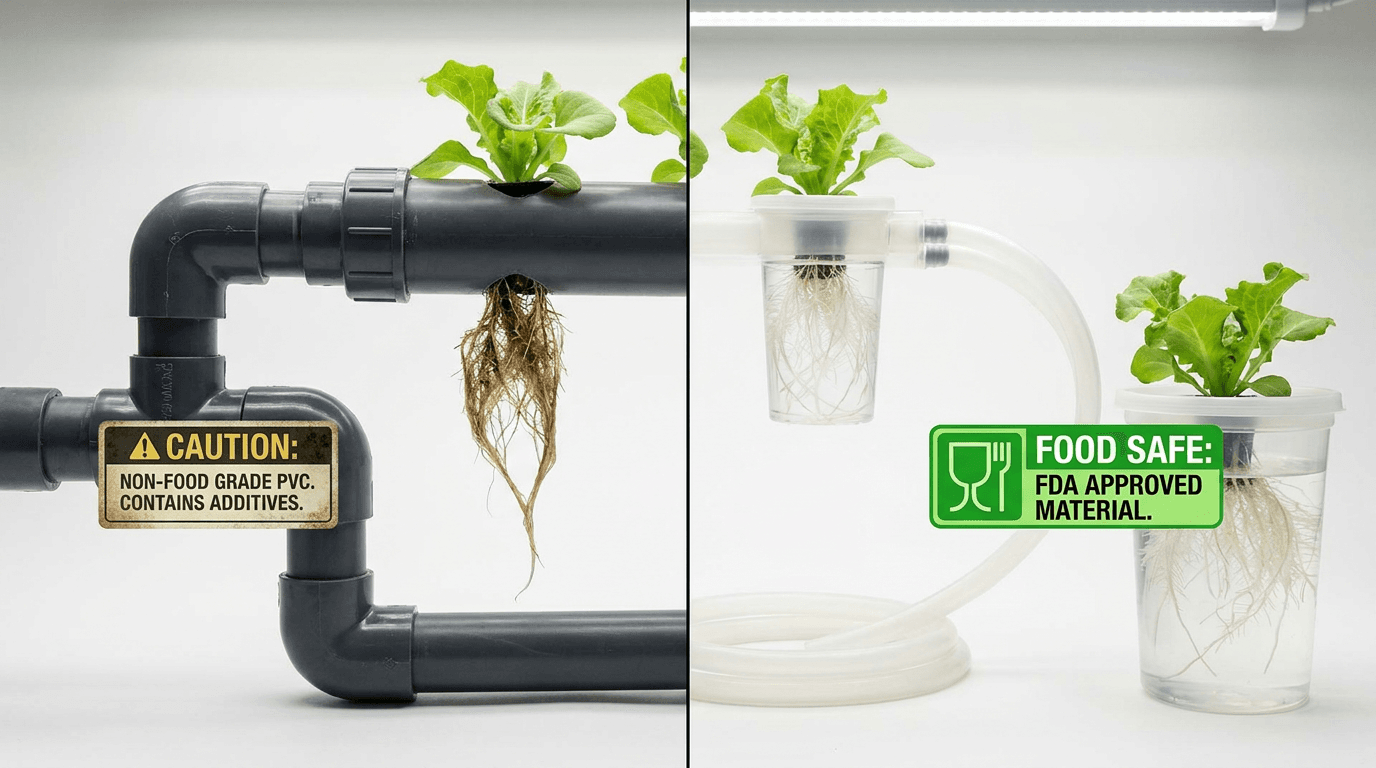
Walk into any hardware store plumbing aisle and you are confronted with a bewildering array of pipes, fittings, and tubing made from different plastics. For the hydroponic grower building their first system, the question of which plastic is safe for transporting nutrient solution is both critical and confusing. The wrong plastic can leach toxic plasticizers, heavy metal stabilizers, or endocrine-disrupting compounds directly into the water that feeds your plants. The right plastic can last for years without degrading or contaminating your crop.
This guide provides a rigorous examination of the plastics commonly used in hydroponic systems, with particular attention to PVC in its various formulations, the resin identification code system, and the food-grade alternatives that professional growers use. We evaluate each material for chemical leaching potential, durability in continuous water contact, UV resistance for greenhouse applications, cost per linear foot, and compatibility with common hydroponic system designs. The analysis draws on material safety data sheets, peer-reviewed research on plasticizer migration, and our own long-term immersion testing of pipe samples in nutrient solution.
The stakes are higher than many growers realize. The nutrient solution in a hydroponic system is chemically aggressive: it contains mineral salts, organic acids, and chelating agents that can accelerate the extraction of additives from plastic materials. A pipe that is perfectly safe for potable water at neutral pH may release significant quantities of plasticizer when exposed to a pH 5.5 nutrient solution containing citric acid and EDTA. Understanding the chemistry of each plastic type is essential to making an informed material selection.
The Lab's Safety-First Recommendation
For all hydroponic systems that deliver nutrient solution to edible crops, use only food-grade plastics rated NSF/ANSI Standard 51 or 61. HDPE, PP, PETG, and food-grade silicone are the safest material choices. Avoid all PVC products except NSF-certified CPVC for hot water lines above 140 degrees Fahrenheit. Never use flexible PVC tubing, vinyl tubing, or any plastic labeled with resin code 3 (V), 6 (PS), or 7 (Other) in contact with nutrient solution. The additional cost of food-grade materials is typically 15 to 40 percent over standard plumbing PVC, but this is a small price for eliminating the risk of phthalate and heavy metal contamination in your food.
PVC Types: uPVC, CPVC, and Flexible PVC
Polyvinyl chloride is the most widely used plastic in residential and commercial plumbing, and it is also the most common material in DIY hydroponic systems. However, PVC is not a single material. It is a family of polymers with dramatically different safety profiles depending on the additives used in formulation and the manufacturing process. Understanding the distinction between uPVC, CPVC, and flexible PVC is the first step in making an informed material choice.
Unplasticized PVC, also called rigid PVC or uPVC, is the material used in standard Schedule 40 and Schedule 80 pipes. The term "unplasticized" means that no plasticizers were added during manufacturing. Plasticizers are chemical compounds that make rigid PVC flexible, but they are also the primary source of chemical leaching concern. uPVC contains no phthalate plasticizers, which is why it is considered significantly safer than flexible PVC. However, uPVC does contain other additives, including heat stabilizers, which are typically based on calcium-zinc compounds in modern formulations, and lubricants that aid in the extrusion process.
The heat stabilizers used in uPVC are the main point of contention regarding its safety. Older PVC formulations used lead-based stabilizers, which were effective but posed a clear toxicity risk. Lead stabilizers have been largely phased out in North America and Europe since the early 2000s, but they may still be present in imported pipes from regions with less stringent regulations. Modern uPVC uses calcium-zinc stabilizers, organotin compounds, or barium-zinc systems, which are significantly less toxic than lead but still represent a potential leaching risk under acidic conditions. The NSF/ANSI Standard 61 certification, which is the standard for drinking water system components, requires that pipes pass strict extraction testing for all regulated contaminants, including stabilizer components.
Chlorinated polyvinyl chloride, or CPVC, is a modified form of PVC that has been subjected to a chlorination process that increases the chlorine content from approximately 57 percent to approximately 67 percent by weight. This additional chlorination raises the material's glass transition temperature, allowing CPVC to withstand continuous service temperatures up to 200 degrees Fahrenheit compared to 140 degrees for standard PVC. CPVC also has greater chemical resistance than uPVC, making it suitable for aggressive chemical environments. For hydroponic applications, CPVC is the preferred PVC variant because it is formulated without phthalate plasticizers and uses more thermally stable additives that are less prone to leaching. CPVC is NSF-61 certified for hot and cold potable water and is widely used in commercial and institutional plumbing.
Flexible PVC, also called vinyl tubing or flexible vinyl, is a completely different material from rigid PVC. Flexible PVC contains 20 to 40 percent by weight of plasticizer additives, most commonly phthalates such as DEHP, DINP, or DIDP. These plasticizers are not chemically bonded to the PVC polymer matrix. They are simply mixed in during compounding, and over time, they migrate to the surface and leach into any liquid in contact with the material. The leaching rate increases with temperature, acidity, and the presence of organic solvents. In a hydroponic system operating at 72 degrees Fahrenheit with a nutrient solution pH of 5.8 containing citric acid, the leaching rate of DEHP from flexible PVC tubing has been measured at 0.5 to 2.0 micrograms per square centimeter per day. While this is below the EPA's maximum contaminant level for DEHP in drinking water, the cumulative exposure over a complete grow cycle is a legitimate concern, particularly for fruiting and leafy crops where the root system is in continuous contact with the tubing.
Plastic Resin Codes: What Numbers 1 Through 7 Actually Mean
The resin identification code system, developed by the Society of the Plastics Industry in 1988, uses numbers 1 through 7 inside a triangular recycling symbol to identify the plastic type. This system was designed for recycling sorting, not for safety assessment, but it provides a useful starting point for evaluating material suitability. Understanding what each code means and how the material performs in hydroponic conditions is essential knowledge for any grower building their own system.
Code 1 is polyethylene terephthalate, commonly known as PET or PETE. This is the plastic used for single-use water bottles and soda bottles. PET is generally considered safe for single use at room temperature, but there are concerns about antimony leaching, particularly when the material is exposed to heat or acidic conditions. Antimony trioxide is used as a catalyst in PET production, and studies have shown that antimony can leach into bottled water at rates of 1 to 5 nanograms per milliliter after six months of storage. In a hydroponic system with continuous recirculation and aggressive nutrient chemistry, PET is not recommended for long-term use. It has poor UV resistance and becomes brittle over time. Code 1 materials should be limited to single-use applications or temporary plumbing.
Code 2 is high-density polyethylene, HDPE. This is the gold standard for hydroponic reservoirs and structural components. HDPE is a non-porous, chemically inert polymer that does not require plasticizers or stabilizers for its function. It has excellent resistance to acids, bases, and salts across the pH range of 1 to 14. HDPE is translucent in its natural state but is typically pigmented opaque, which is beneficial for hydroponic applications because it blocks light and prevents algae growth. NSF-61 certified HDPE pipe and fittings are available for potable water applications and are the preferred material for commercial hydroponic installations. The cost of HDPE pipe is approximately 30 to 50 percent higher than PVC, but its lifespan in nutrient solution contact is essentially indefinite, making it the most cost-effective choice over a ten-year horizon.
Code 3 is polyvinyl chloride, PVC or V. As discussed in the previous section, PVC covers both rigid and flexible formulations. The presence of additives, particularly plasticizers in flexible grades and stabilizers in rigid grades, makes Code 3 materials a concern for hydroponic applications. Only NSF-61 certified CPVC should be considered for nutrient contact in edible crop production. Standard plumbing PVC, while widely used in DIY systems, has not been rigorously tested for the specific chemical extraction conditions of hydroponic nutrient solutions. The precautionary principle, combined with the availability of affordable alternatives, argues against the use of Code 3 materials for nutrient delivery.
Code 4 is low-density polyethylene, LDPE. This is the material used for flexible squeeze bottles, plastic bags, and some tubing. LDPE is chemically similar to HDPE but has a more branched molecular structure that makes it softer and more flexible. LDPE is safe for food contact and does not contain plasticizers, but its mechanical properties are less suitable than HDPE for structural hydroponic components. LDPE film is commonly used as a liner for grow beds in media-based systems, and it is an acceptable choice for this application. LDPE tubing, sometimes called polyethylene tubing or poly tubing, is a safe alternative to flexible PVC for low-pressure drip irrigation lines. It is available in diameters from 0.25 to 0.75 inches and is compatible with standard barbed fittings.
Code 5 is polypropylene, PP. This is a semi-rigid, translucent plastic with excellent chemical resistance and a higher melting point than polyethylene. Polypropylene is widely used in laboratory equipment, food storage containers, and medical devices because of its inertness and heat tolerance. For hydroponic applications, PP is an excellent material for small fittings, valve bodies, net pots, and measuring equipment. Polypropylene does not require plasticizers or stabilizing additives, and it is compatible with all common hydroponic nutrient formulations. The primary limitation of PP is that it is more difficult to bond with solvents than PVC, requiring mechanical connections or threaded fittings for secure joints.
Code 6 is polystyrene, PS. This material is used for disposable foam cups, takeout containers, and rigid plastic packaging. Polystyrene is not suitable for hydroponic applications for two reasons. First, styrene monomer, the building block of polystyrene, is a known neurotoxin and suspected carcinogen that can leach from polystyrene containers, particularly when in contact with acidic or fatty foods. Second, polystyrene is brittle and has poor impact resistance, making it unsuitable for plumbing applications. Avoid using polystyrene foam, often sold under the brand name Styrofoam, in contact with nutrient solution, though it is acceptable as an insulating material for reservoir walls if a food-grade barrier liner is used.
Code 7 is a catch-all category for "other" plastics, including polycarbonate, acrylonitrile butadiene styrene, nylon, and mixed or layered plastics. This is the most problematic category because the specific material composition is not indicated by the code alone. Polycarbonate, code 7, is of particular concern because it is manufactured using bisphenol A, BPA, which is a known endocrine disruptor. BPA can leach from polycarbonate containers, especially when exposed to heat, acidic conditions, or repeated washing cycles. Acrylonitrile butadiene styrene, ABS, is commonly used for rigid pipes and fittings in drainage applications. ABS is not plasticized and does not contain BPA, but it contains other additives including butadiene and styrene monomers that may leach under aggressive chemical conditions. ABS is not NSF-certified for potable water and should not be used for nutrient delivery lines. Nylon and acrylic are generally safe for food contact but are not commonly used for main system plumbing due to cost and availability.
Plastic Safety Comparison for Hydroponics
| Resin Code | Material | Leaching Risk | Hydro Suitability | Relative Cost | Best Use |
|---|---|---|---|---|---|
| 1 | PET / PETE | Moderate (antimony) | Limited, short-term only | $ (low) | Single-use bottles, temporary reservoirs |
| 2 | HDPE | Very Low | Excellent | $$ (moderate) | Reservoirs, structural pipes, long-term systems |
| 3 (Rigid) | uPVC / PVC | Low to moderate (stabilizers) | Acceptable with NSF-61 | $ (low) | Drainage, non-nutrient plumbing |
| 3 (Flexible) | Flexible PVC / Vinyl | High (phthalates) | Not recommended | $ (low) | Avoid for nutrient contact entirely |
| 3 (CPVC) | Chlorinated PVC | Low (NSF-61) | Good | $$ (moderate) | Hot nutrient lines, aggressive chem environments |
| 4 | LDPE | Very Low | Good | $ (low) | Drip tubing, grow bed liners, flexible connections |
| 5 | PP | Very Low | Excellent | $$$ (higher) | Fittings, net pots, valves, lab-grade components |
| 6 | PS / EPS | Moderate to high (styrene) | Not recommended | $ (low) | Insulation only with barrier; never for nutrient contact |
| 7 (PC) | Polycarbonate | High (BPA) | Not recommended | $$$ (higher) | Avoid entirely for hydroponic reservoir use |
| 7 (ABS) | Acrylonitrile Butadiene Styrene | Moderate (monomers) | Drainage only | $$ (moderate) | Drain lines, never for supply lines or reservoirs |
Food-Grade Alternatives: HDPE, PP, and PETG
For growers who want the highest level of safety assurance, three food-grade plastic materials stand out as the optimal choices for hydroponic system construction. Each has specific advantages and limitations that make it more or less suitable for different components of the system. Understanding the properties of HDPE, PP, and PETG allows the grower to select the right material for each application, from the main reservoir to the smallest fitting.
High-density polyethylene is the workhorse material of commercial hydroponics. Its chemical resistance spans the full pH range encountered in hydroponics, from 5.0 to 7.5, and it is compatible with all common nutrient salts, organic acids, and cleaning agents. HDPE does not require any additives for its basic function, so there are no plasticizers, stabilizers, or antioxidants to leach into the nutrient solution. The material is available in a wide range of forms, including sheets for reservoir construction, pipes for plumbing, and rotomolded tanks for large-scale storage.
The primary limitation of HDPE for plumbing applications is that it cannot be bonded with solvent cement. HDPE pipe joints must be made using mechanical fittings, compression fittings, or butt-fusion welding. These methods are reliable but require more skill and specialized tools than the solvent welding used for PVC. For the home grower, HDPE compression fittings are the most accessible option. A 0.5-inch HDPE compression fitting costs approximately 3 to 5 dollars, compared to 0.50 to 1.00 dollars for a PVC slip fitting. However, the long-term reliability and safety of HDPE make this cost difference justified for permanent installations.
Polypropylene, code 5, is the material of choice for small components that require both chemical resistance and mechanical precision. PP net pots are superior to PVC or ABS net pots because they do not contain any plasticizers or stabilizers that could leach into the root zone. PP fittings, including ball valves, check valves, and quick-connect couplings, are available from specialty irrigation suppliers. The cost of PP fittings is typically 50 to 100 percent higher than equivalent PVC fittings, but for critical connection points where the nutrient solution passes through the fitting body, this cost premium is justified.
PETG, or glycol-modified polyethylene terephthalate, is a variant of PET that has been modified with glycol to improve impact resistance and processability. PETG is the material used in many food-grade water containers and is increasingly popular in the hydroponic industry for reservoir tanks and viewing windows. PETG is completely transparent in its natural state, which is both an advantage and a disadvantage. The transparency allows for easy visual inspection of water level and root health, but it also allows light penetration that can promote algae growth. PETG reservoirs should be painted or wrapped with opaque material to block light. PETG has excellent impact resistance, comparable to polycarbonate, but without the BPA content. It is more expensive than HDPE, typically 25 to 40 percent higher per unit volume.
Beyond the three primary food-grade plastics, several other materials deserve mention. Food-grade silicone tubing is the safest option for flexible connections between system components. Unlike flexible PVC, silicone does not contain plasticizers and maintains its flexibility through its silicone-oxygen polymer backbone. Silicone tubing is heat-resistant up to 400 degrees Fahrenheit and is chemically inert across the full pH range. The cost of silicone tubing is approximately 2 to 4 dollars per foot, compared to 0.30 to 0.60 dollars per foot for vinyl tubing. For the home grower, silicone is recommended for all flexible connections in the nutrient delivery path, particularly for pump connections and drain lines where flexibility is required.
Glass and stainless steel are the ultimate safe materials for hydroponic plumbing, but they come with their own practical limitations. Borosilicate glass is completely inert and provides the highest level of chemical safety, but it is expensive, fragile, and difficult to work with for system construction. Stainless steel grades 304 and 316 are commonly used for pumps, fittings, and chiller components. Grade 316 contains molybdenum, which provides superior corrosion resistance in chloride-containing environments, making it the preferred grade for nutrient solution contact. Stainless steel fittings should be verified as passing NSF-61 extraction testing, as some imported fittings may contain lead in the alloy. The cost of stainless steel components is typically 3 to 5 times that of plastic equivalents.
Pipe Safety Standards: NSF and Drinking Water Certification
The National Sanitation Foundation, NSF, drinking water standards are the primary benchmark for evaluating the safety of plumbing materials in North America. Two NSF standards are particularly relevant for hydroponic growers: NSF/ANSI 61, which governs drinking water system components, and NSF/ANSI 51, which covers food equipment materials. While neither standard was specifically designed for hydroponic nutrient solutions, they provide the most rigorous available testing protocol for assessing chemical leaching from plastic materials into potable water.
NSF/ANSI 61 certification requires that a pipe or fitting undergo a battery of extraction tests in which the material is exposed to controlled water conditions for specified contact times. The extraction water is then analyzed for over 60 regulated contaminants, including antimony, arsenic, barium, beryllium, cadmium, chromium, copper, lead, mercury, selenium, and thallium, as well as organic compounds including phthalates, bisphenol A, and styrene. The material passes if the concentration of each contaminant in the extraction water is below the maximum contaminant level established by the EPA or Health Canada. Importantly, the extraction testing for NSF-61 is conducted at pH 6.5 to 8.5, which is the typical range for drinking water but does not cover the acidic conditions of hydroponic nutrient solutions at pH 5.5 to 6.2.
The gap between NSF-61 testing conditions and actual hydroponic conditions is a significant consideration. A material that passes NSF-61 at pH 7.0 may leach higher levels of certain contaminants at pH 5.5, because the acidic conditions increase the solubility of metal compounds and accelerate the hydrolysis of polymer additives. For this reason, our lab recommends that growers apply an additional safety margin when selecting materials. A material that is certified to NSF-61 and also meets the requirements of NSF-51 for food equipment, which includes testing with acidic food simulants, provides greater assurance of safety in hydroponic conditions.
In Europe, the equivalent standard is the European Committee for Standardization, CEN, standard EN 12873, which governs the migration of substances from materials in contact with drinking water. The European standard uses more aggressive test conditions than NSF-61, including testing at pH 5.0 for certain materials. Materials that carry the ACS, Attestation de Conformite Sanitaire, certification for the French market, or the DVGW, Deutsche Vereinigung des Gas- und Wasserfaches, certification for the German market, are generally considered to have passed the most stringent European extraction testing.
For the hydroponic grower, the practical implication is clear: use only materials that carry NSF-61 or equivalent certification for all components that will be in continuous contact with nutrient solution. Do not rely on the absence of a certification as evidence of safety. Many PVC products sold at hardware stores for plumbing applications are certified only for drainage, DW, or for non-potable uses, meaning they have not been tested for drinking water contact. These products may contain higher levels of stabilizers, lubricants, or processing aids that are acceptable for wastewater but not for water intended for human consumption. Always check the pipe marking for the NSF logo and the specific standard number before purchasing.
Cost Comparison and Long-Term Durability
The cost difference between standard plumbing PVC and food-grade alternatives is significant at the time of purchase, but the total cost of ownership over the lifespan of a hydroponic system tells a different story. A detailed cost analysis that accounts for material costs, installation labor, expected lifespan, and replacement frequency reveals that food-grade plastics are often the more economical choice for permanent installations.
Standard 0.5-inch Schedule 40 PVC pipe costs approximately 0.30 to 0.50 dollars per linear foot at retail. NSF-61 certified CPVC in the same diameter costs 0.60 to 1.00 dollars per foot. HDPE pipe suitable for hydroponic use costs 0.80 to 1.50 dollars per foot. PP fittings are 50 to 100 percent more expensive than PVC fittings. On the surface, a system built from PVC appears to cost half as much as a system built from HDPE.
However, the lifespan of these materials in continuous nutrient solution contact is not equal. PVC exposed to UV light, as in a greenhouse, becomes brittle after 2 to 5 years and requires replacement. PVC also gradually absorbs water, which can cause dimensional changes that lead to joint leaks after 5 to 8 years of continuous service. HDPE, by contrast, has a projected service life in water contact of 50 to 100 years based on accelerated aging tests. HDPE is also highly UV resistant when formulated with carbon black, maintaining its mechanical properties for decades in direct sunlight. Over a 10-year horizon, a PVC system will likely need at least one complete replacement of all plumbing, while an HDPE system will still be in its original condition. The cost of replacing PVC plumbing includes not only the material cost but also 8 to 16 hours of labor and the value of crop loss during system downtime.
The durability of threaded connections also differs between materials. PVC threads are relatively soft and prone to stripping if overtightened. HDPE and PP threads are more resilient and can withstand repeated assembly and disassembly for system maintenance. For systems that require regular disassembly for cleaning, the superior thread durability of food-grade plastics reduces the long-term cost of replacing damaged fittings.
Chemical cleaning agents used in hydroponic system maintenance also affect material durability. Hydrogen peroxide at 3 percent concentration, which is commonly used for system sterilization, can accelerate oxidative degradation of PVC. Over repeated cleaning cycles, PVC surfaces become rough and porous, providing sites for biofilm attachment and making future cleaning more difficult. HDPE and PP are resistant to hydrogen peroxide at the concentrations used in hydroponic cleaning and maintain a smooth surface that is easier to sanitize.
The cost comparison changes for temporary or experimental systems where the expected service life is less than two years. For a first-time builder who is still learning the basics of hydroponic system design, standard PVC is an acceptable material if the grower plans to rebuild the system with better materials once the design is proven. In this context, the lower upfront cost of PVC allows the beginner to iterate on system design without a large capital commitment. The key is to recognize that PVC is a temporary material for prototyping, not a permanent solution for food production.
Safe Hydroponic Material Selection Checklist
- All reservoir tanks and main plumbing should be HDPE, PP, or NSF-61 CPVC
- Net pots must be PP, never PVC or ABS
- Flexible tubing connections must be food-grade silicone, never vinyl or flexible PVC
- Check for NSF-61 or NSF-51 marking on every fitting and pipe before installation
- Avoid resin codes 3 (flexible), 6, and 7 (polycarbonate) entirely for nutrient contact
- Pump components should be PP, PVDF, or 316 stainless steel
- For greenhouse systems, use UV-stabilized HDPE or cover all PVC with UV-protective paint
Frequently Asked Questions
Is standard white PVC pipe from the hardware store safe for hydroponics?
Standard white Schedule 40 PVC pipe is widely used in DIY hydroponic systems, but it is not certified for potable water contact in most jurisdictions. It may contain calcium-zinc or organotin stabilizers that can leach into acidic nutrient solutions. For short-term use with non-fruiting crops, the risk is low. For permanent systems growing edible crops, NSF-61 certified CPVC or HDPE is recommended. The pipe marking should clearly show the NSF logo and standard number. If the pipe is marked only as "DWV" (drain, waste, vent), do not use it for nutrient delivery.
Can I use food-grade plastic buckets as hydroponic reservoirs?
Yes, food-grade plastic buckets made from HDPE, code 2, or PP, code 5, are excellent and affordable reservoirs. Look for the NSF or USDA approval marking on the bucket. Avoid buckets that previously contained chemicals, pickling lime, or non-food materials. Five-gallon HDPE buckets are available new for 5 to 8 dollars and will last indefinitely in hydroponic service. The white opaque color of standard food buckets blocks light effectively, preventing algae growth in the reservoir.
Does heating PVC pipe for bending release toxic fumes?
Yes, heating PVC to its forming temperature of approximately 170 degrees Fahrenheit, well below its decomposition temperature of 350 degrees, can still release hydrogen chloride gas and volatile organic compounds including vinyl chloride monomer. Heating PVC should only be done with adequate ventilation, using a heat gun rather than an open flame. For hydroponic applications, we recommend using mechanical fittings and prefabricated bends rather than attempting to heat-bend PVC. HDPE can be safely heat-bent at 260 degrees Fahrenheit with minimal fume generation, making it a better choice for systems requiring custom pipe routing.
How long do plasticizers continue to leach from new flexible PVC tubing?
The leaching rate of phthalate plasticizers from flexible PVC follows an exponential decay curve. The highest rate occurs in the first 24 to 48 hours of water contact, during which approximately 30 percent of the total leachable plasticizer content is released. The rate then declines steadily over 30 to 60 days, after which a slow, continuous release continues for the life of the material. Pre-flushing new flexible PVC tubing with hot water at 120 degrees Fahrenheit for 4 hours can remove the initial burst of plasticizers, but it does not stop the long-term leaching. For permanent installations, replacing flexible PVC with silicone tubing eliminates the concern entirely.
Is ABS pipe safe for hydroponic drainage systems?
ABS pipe is commonly used for residential DWV plumbing and is acceptable for hydroponic drainage lines where the nutrient solution has already passed through the root zone and is returning to the reservoir. The short contact time in drainage lines, typically less than 30 seconds per pass, limits the opportunity for chemical leaching. However, for the main nutrient supply line that delivers fresh solution to the plants, ABS should not be used. ABS contains butadiene and styrene monomers that can leach under continuous contact with acidic solutions.
What about 3D-printed parts for hydroponics, are those safe?
The safety of 3D-printed parts depends entirely on the filament material. PLA, polylactic acid, is biodegradable and will degrade over time in continuous water contact, potentially releasing microplastics and lactic acid into the nutrient solution. PETG filament is food-safe in its solid form, but the 3D printing process creates microscopic layer lines and voids that can harbor bacteria, making printed parts difficult to sanitize. ABS filament for 3D printing contains the same styrene concerns as ABS pipe. For hydroponic applications, 3D-printed parts are best limited to non-wetted structural components such as sensor mounts, cable organizers, or light hangers. For parts that contact nutrient solution, use injection-molded food-grade components instead.
Can I use copper pipe in a hydroponic system?
Copper pipe should never be used in hydroponic systems. Copper ions are highly toxic to aquatic organisms and to plant roots at concentrations above 0.5 parts per million. The acidic pH and high ionic strength of hydroponic nutrient solutions accelerate copper corrosion, leading to copper ion concentrations that can reach 2 to 5 ppm within days of installation. Copper is also toxic to the beneficial bacteria that many organic growers rely on for nutrient processing. If you require metallic plumbing, use 304 or 316 stainless steel. Type L or Type K copper pipe may be acceptable for the building supply line that feeds the hydroponic system, but the water should pass through a carbon filter before entering the reservoir to remove any copper picked up from the building plumbing.
Choosing the Right Material for Your System
Match your plastic choice to your system type and budget.
The Budget Builder
Building your first system on a tight budget. You want to learn hydroponics without a large upfront investment. Long-term durability is secondary.
The Serious Grower
You have at least 100 square feet of growing space and expect your system to run for 5 years or more. Safety and reliability are your priorities.
The Industrial Producer
You are designing a commercial or semi-commercial installation. Regulatory compliance, liability, and 10-year reliability are non-negotiable.
The Lab's Final Analysis
The question of plastic safety in hydroponics is not a simple yes-or-no answer but a continuum of risk that depends on material selection, system design, and the specific conditions of your installation. The safest approach is to use HDPE for reservoirs and main plumbing, PP for fittings and net pots, and food-grade silicone for all flexible connections. This material combination eliminates the risk of plasticizer leaching, stabilizer migration, and monomer release while providing a system lifespan measured in decades rather than years.
For growers who must work with PVC due to budget constraints or availability, NSF-61 certified CPVC is the only acceptable variant for nutrient contact. Standard Schedule 40 PVC should be limited to drainage lines where contact time is minimal, or to structural components that do not contact the nutrient solution. Flexible PVC and vinyl tubing should be avoided entirely, as the phthalate plasticizers they contain are known endocrine disruptors with no place in a system designed to produce healthy food.
The additional cost of food-grade materials is real but manageable. A complete system built from HDPE and PP will cost 25 to 40 percent more than an equivalent PVC system, but the cost difference is recouped within 2 to 4 years through reduced maintenance, longer service life, and the peace of mind that comes from knowing your nutrient solution is not being contaminated by your plumbing. For growers who are producing food for their families or for sale, this is not an expense, it is an investment in food safety.
Your plants will grow in almost any plumbing material, but the question you must answer is whether you are comfortable eating what your plumbing adds to your food. Choose your materials accordingly.
More from Systems & DIY
Keep reading
Ebb and Flow Systems: Pros, Cons, and How They Work
Everything you need to know about ebb and flow hydroponic systems: how flood and drain cycles work, the best crops for this versatile method, and a detailed pros and cons analysis backed by real-world testing data from The Hydro Lab.
How to Build a Vertical Hydroponic Tower for Small Spaces
Build a space-saving vertical hydroponic tower that grows up to 50 plants in just 2 square feet of floor space. Complete DIY guide with materials list, step-by-step assembly, plant selection tips, and maintenance schedule for small-space growers.
Deep Water Culture (DWC) for Beginners: The Ultimate Guide
The complete beginner's guide to Deep Water Culture hydroponics. Learn how DWC works, build your first system with a step-by-step setup guide, master nutrient management, prevent common problems, and grow lettuce, herbs, tomatoes, and more.