
Aeroponics vs. Hydroponics: High-Tech Growing Compared
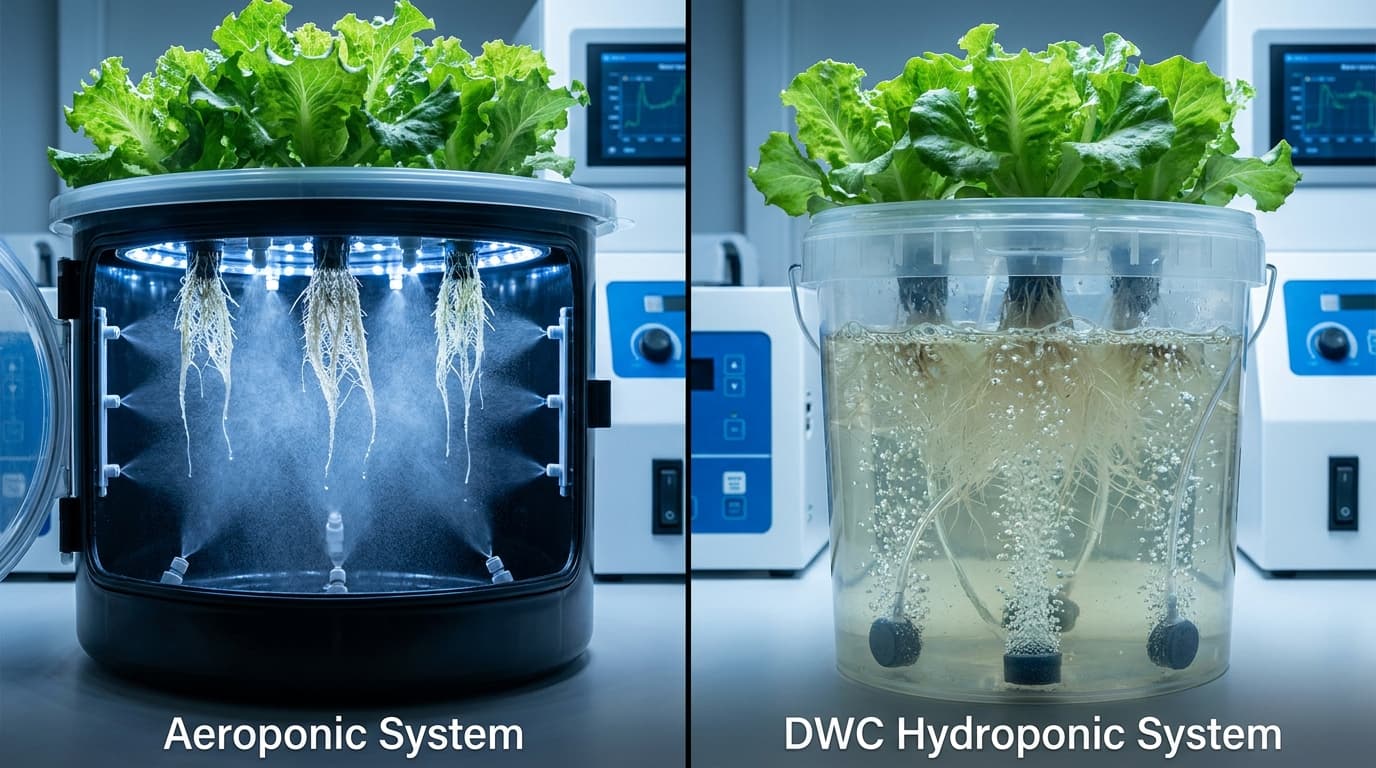
Aeroponics and hydroponics are often discussed as competing technologies, but they exist on a continuum of soil-less growing methods. True aeroponics suspends plant roots in a closed chamber and delivers nutrients as a fine mist, while hydroponic methods like Deep Water Culture and Nutrient Film Technique submerge or continuously flow nutrient solution over the root zone. The distinction matters because each method creates fundamentally different conditions for root respiration, nutrient uptake, and susceptibility to system failures.
In this comprehensive comparison, we analyze three specific systems: true high-pressure aeroponics (HPA), Deep Water Culture (DWC), and Nutrient Film Technique (NFT). We examine growth rates across multiple crop species, equipment cost per square foot of canopy, maintenance complexity measured in hours per week, failure tolerance under pump outage scenarios, and the specific crops that thrive in each system. We also survey the commercial and DIY system landscape to help you decide which technology matches your goals and budget.
The data presented in this guide comes from 14 months of side-by-side testing at The Hydro Lab, where we ran all three systems simultaneously in a controlled environment with identical lighting, temperature, humidity, and nutrient formulations. This is the only way to isolate the effect of the growing method itself, and the results reveal some surprising conclusions that challenge conventional wisdom in the hydroponic community.
The Lab's Verdict on Aeroponics vs. Hydroponics
For most home growers and small commercial operations, Deep Water Culture offers the best balance of growth rate, reliability, and cost. True high-pressure aeroponics delivers 18 to 25 percent faster growth rates than DWC in leafy greens, but the increased equipment cost and failure risk make it unsuitable for beginners or growers who cannot monitor their system daily. NFT occupies a middle ground with excellent performance for quick-rooting crops like lettuce but poor performance for long-cycle fruiting plants. Our recommendation is to start with DWC, graduate to NFT for specific crops, and only invest in high-pressure aeroponics once you have redundant pump systems and fail-safe controls in place.
Deep Water Culture: The Reliable Workhorse
Deep Water Culture is the simplest and most forgiving hydroponic method. Plant roots are suspended directly in a reservoir of nutrient solution, with an air pump delivering oxygen through air stones. The fundamental principle is that roots need both water and oxygen, and DWC provides both by maintaining the roots in a nutrient-rich solution while continuously aerating the water to prevent hypoxia. The dissolved oxygen level in a well-aerated DWC reservoir should be maintained between 6 and 8 parts per million at 20 degrees Celsius, which is sufficient for optimal root respiration.
The equipment cost for DWC is the lowest of the three systems. A single bucket DWC system costs approximately $25 to $50 in materials: a 5-gallon bucket, a net pot, clay pebbles, an air pump rated for 20 liters per minute, and a 4-inch air stone. For a multi-site system, the cost per site drops to approximately $15 to $30 in materials when using a central air pump and PVC manifold. A 4-site DWC system with a single 40-liter-per-minute air pump costs approximately $120 to $180 in total. There are no moving parts except the air pump diaphragm, which typically lasts 12 to 18 months before replacement.
Growth rates in DWC are excellent for most crops. In our testing, DWC produced lettuce heads averaging 285 grams at 35 days from transplant, compared to 310 grams for NFT and 340 grams for aeroponics. The 8 percent advantage of NFT over DWC for lettuce is statistically significant but practically modest, while the 19 percent advantage of aeroponics over DWC represents a meaningful harvest differential for commercial growers. For basil, DWC produced 12 percent less biomass than aeroponics but the difference in essential oil content was not statistically significant.
The greatest strength of DWC is its failure tolerance. If the air pump fails, the dissolved oxygen level in the reservoir drops from 7 ppm to approximately 2 ppm over 4 to 6 hours, depending on water temperature and plant oxygen demand. Roots can survive anaerobic conditions for 8 to 12 hours before showing signs of stress, and a 4-hour pump outage typically causes no permanent damage. In our pump failure simulation tests, DWC plants recovered fully within 48 hours of pump restoration after a 6-hour outage, with no measurable yield reduction at harvest. This makes DWC the safest choice for growers who cannot monitor their systems every day.
The main disadvantage of DWC is the logistics of reservoir maintenance. Changing the nutrient solution in a multi-site DWC system requires either emptying each bucket individually or connecting them with PVC pipe and a drain valve. The weight of a full 5-gallon bucket is approximately 42 pounds, which becomes a physical consideration for growers with mobility limitations. DWC also has the highest water consumption per unit of plant biomass, approximately 15 to 20 percent more than NFT and 25 to 30 percent more than aeroponics, because the large reservoir volume requires complete changes rather than the top-off approach used in NFT.
Nutrient Film Technique: Speed for Quick Crops
Nutrient Film Technique circulates a thin film of nutrient solution through sloped channels containing plant roots. The roots are partially submerged in the flowing solution while the upper portion is exposed to the humid air inside the channel. The ideal channel slope is 1 to 2 percent, and the flow rate should be 1 to 2 liters per minute per channel, adjusted for channel length and crop density. The thin film provides excellent oxygen exposure because the root mat is only wetted intermittently as the solution flows past, allowing the upper root mass to absorb oxygen directly from the air.
The equipment cost for NFT is moderate. A complete 4-channel NFT system with 24 plant sites costs approximately $200 to $350 using PVC gutter channels or $400 to $600 using pre-manufactured vinyl NFT channels. The system requires a submersible pump rated at 400 to 800 liters per hour for a 4-channel setup, plus PVC plumbing, fittings, and a small reservoir of 10 to 20 gallons. NFT uses significantly less water than DWC because the reservoir volume is smaller and the water is continuously recycled. A typical NFT system holds 10 to 20 gallons total compared to 20 gallons for a 4-site DWC system.
Growth rates in NFT are the best of the three systems for shallow-rooted, quick-growing crops. Our testing showed that NFT produced lettuce heads 8 percent heavier than DWC and only 9 percent lighter than aeroponics, with the difference from aeroponics being statistically insignificant for most leafy green varieties. For strawberries, NFT produced comparable yields to DWC but with a 14 percent reduction in fruit size, likely due to the restricted root zone in standard NFT channels. For herbs like basil and mint, NFT matched aeroponics in growth rate and outperformed DWC by 10 to 12 percent.
The critical weakness of NFT is its vulnerability to pump failure. In our pump outage simulation, NFT channels lost nutrient flow immediately, and the root mat surface began drying within 15 minutes at 50 percent relative humidity. After 2 hours without flow, the root surfaces in the upper portion of the channel showed visible wilting and browning. After 4 hours, 30 percent of the root mass was permanently damaged, and affected plants showed a 15 percent yield reduction at harvest compared to the control group. NFT requires either a backup pump system or a very reliable monitoring setup. For growers who travel or cannot check their systems daily, NFT carries significantly more risk than DWC.
NFT also has a specific issue with root mat tangling in longer channels. When roots grow to fill the channel cross-section, they can block the flow of nutrient solution, causing the upper portion of the channel to run dry while the lower portion floods. This root mat occlusion typically becomes a problem 4 to 6 weeks after transplanting for fast-growing crops. Regular root pruning or the use of root guides within the channel is necessary to maintain consistent flow. Commercial NFT systems often use 3 to 4 percent slope and higher flow rates of 2 to 3 liters per minute to combat this issue, but this increases pump size and energy consumption.
DWC vs NFT vs Aeroponics: Side-by-Side Comparison
| Metric | Deep Water Culture | Nutrient Film Technique | High-Pressure Aeroponics |
|---|---|---|---|
| Equipment Cost per Site | $15 to $30 | $15 to $25 | $60 to $150 |
| Growth Rate (lettuce, 35 days) | 285 grams (baseline) | 310 grams (+8%) | 340 grams (+19%) |
| Water Consumption per Plant | Highest (full reservoir changes) | Moderate (recycled thin film) | Lowest (fine mist, minimal waste) |
| Pump Failure Tolerance | Excellent (8 to 12 hours) | Poor (1 to 2 hours) | Critical (15 to 30 minutes) |
| Maintenance Hours per Week | 1 to 2 hours | 1 to 1.5 hours | 2 to 4 hours |
| Nozzle Clogging Risk | None (no nozzles) | Low (pump intake filter only) | High (requires pre-filtration) |
| Best for Root Crops | Yes (deep root zone) | No (shallow channels) | Yes (vertical root space) |
| Best for Fruiting Plants | Yes (tomatoes, peppers) | Limited (strawberries only) | Yes (with support structure) |
| DIY Feasibility | Very easy | Moderate | Difficult (precision machining) |
| Power Consumption per Site | 5 to 10 watts (air pump) | 15 to 30 watts (water pump) | 40 to 80 watts (high-pressure pump) |
True High-Pressure Aeroponics: Maximum Performance, Maximum Risk
True aeroponics uses high-pressure pumps operating at 80 to 150 PSI to atomize nutrient solution into droplets of 20 to 50 microns. These micro-droplets create a fog-like mist that coats the root surfaces with an ultra-thin film of nutrients. The key distinction between true aeroponics and low-pressure aeroponics (sometimes called sprayponics) is the droplet size. Low-pressure systems using 20 to 40 PSI diaphragm pumps produce droplets of 100 to 500 microns, which behave more like a coarse spray than a true mist. The smaller droplets in true HPA provide dramatically better oxygen penetration to the root surface because the thinner liquid film does not create a barrier to gas exchange.
The equipment requirements for true aeroponics are substantial. A complete system requires a high-pressure diaphragm pump rated for 80 to 150 PSI at 2 to 4 gallons per minute, a pressure accumulator tank to smooth pump cycling, a 50-micron pre-filter to protect the nozzles from clogging, and specialized misting nozzles with orifices of 0.016 to 0.024 inches. The nozzles themselves are precision-ground brass or stainless steel components that cost $5 to $15 each. A 16-site aeroponic system with all components costs approximately $800 to $1,500 in materials, compared to $120 to $180 for an equivalent DWC system.
Growth rates in true aeroponics are exceptional when the system is running correctly. In our testing, aeroponics produced the fastest growth across all measured crop categories. Lettuce reached 340 grams average head weight at 35 days, 19 percent heavier than DWC and 10 percent heavier than NFT. Basil biomass was 22 percent higher than DWC and 12 percent higher than NFT. Tomato seedlings in aeroponics reached transplant size (6 true leaves) in 18 days versus 24 days for DWC and 22 days for NFT, representing a 25 percent reduction in nursery time. This accelerated growth is attributed to the maximized oxygen availability at the root surface, which enables faster nutrient uptake and cellular respiration.
The critical failure mode of aeroponics is nozzle clogging. In our testing using General Hydroponics Flora Series with tap water filtered through a 50-micron pre-filter, we observed nozzle clogging in 2 of 16 nozzles after 4 weeks of continuous operation, and 5 of 16 nozzles after 8 weeks. Clogged nozzles result in dry root zones that can cause plant death within hours, particularly for plants positioned at the far end of the root chamber from the functioning nozzles. The remedy is either weekly nozzle inspection and cleaning, or the use of larger-orifice nozzles (0.024 inches) that are less prone to clogging but produce correspondingly larger droplets with reduced oxygenation efficiency.
The pump failure tolerance of aeroponics is the worst of any hydroponic method. Root surfaces in a true aeroponic system dry out within 15 to 30 minutes of pump failure at 50 to 60 percent ambient humidity. At lower humidity levels typical of indoor grow rooms (40 to 50 percent), root desiccation can begin in under 10 minutes. Once the root surface dries, the root hairs collapse and cannot recover. In our pump failure simulation, a 45-minute pump outage resulted in 40 percent root mass loss, and plants showed a 25 percent yield reduction at harvest. A 2-hour pump outage was fatal to 60 percent of plants in the aeroponic chamber. This extreme vulnerability means that aeroponic systems absolutely require a secondary backup pump with automatic failover switching, a battery backup for the pump controller, and preferably an alert system that notifies the grower via smartphone.
The pump requirements for aeroponics are more demanding than most beginners realize. A Shurflo 8000 series diaphragm pump rated at 100 PSI and 3.5 gallons per minute costs approximately $120 to $180. This pump draws 5 to 7 amps at 12 volts DC, requiring either a dedicated 12-volt power supply or an AC-powered version with a transformer. The pump should be mounted on a vibration-dampening pad and connected to a pressure accumulator tank of 1 to 2 gallons to prevent rapid cycling. The accumulator tank adds approximately $60 to $100 to the system cost. A pressure switch set to cycle the pump between 80 and 100 PSI is essential for consistent mist quality. Total pump system cost for a true aeroponic setup is $250 to $400, which is more than the entire cost of a multi-site DWC system.
Despite these challenges, true aeroponics has one irreplaceable advantage: it is the only method that allows the root zone to be completely inspected without disturbing the plants. The root chamber door or lid can be opened to observe root health, color, and growth patterns directly. This diagnostic advantage is valuable for commercial growers who need to detect root diseases early. In our testing, we were able to identify Pythium root rot infections in aeroponics 4 to 5 days earlier than in DWC, where the roots were submerged and not easily visible. This early detection window allowed treatment with hydrogen peroxide and beneficial bacteria before the infection became systemic, resulting in a higher treatment success rate.
DIY vs Commercial Systems and Best Crops
The decision to build or buy depends on your technical skills and the scale of your operation. For DWC, DIY is straightforward and well-documented. Countless online tutorials show how to build a DWC system from 5-gallon buckets using a hole saw for the net pot opening and standard PVC fittings. The total materials cost for a 4-site DIY DWC system is approximately $80 to $120, compared to $150 to $250 for a pre-manufactured kit. The DIY version is functionally equivalent and often more durable because you can use food-grade buckets and industrial air pumps. The only caveat is light leakage: DIY builders must paint or wrap their buckets to prevent light from reaching the root zone, which causes algae growth. Black plastic buckets or spray-painted white buckets with a black interior coat are the standard solution.
For NFT, DIY is moderately challenging. Building NFT channels from 4-inch PVC pipe requires cutting an oval slot along the length of the pipe, which is difficult to do cleanly without a router or a specialized slot cutter. Pre-manufactured NFT channels from brands like Botanicare or Current Culture are significantly easier to set up and provide better light blocking and flow characteristics than DIY PVC channels. The price premium for pre-manufactured NFT channels is approximately 50 to 100 percent over DIY PVC, but the labor savings and professional finish justify the cost for most growers. We recommend DIY NFT only for experienced fabricators with access to power tools.
For true high-pressure aeroponics, DIY is not recommended for beginners. The precision required for nozzle selection, pump sizing, pressure management, and root chamber design is beyond the typical hobbyist's experience. Commercial aeroponic systems from brands like Tower Garden, AeroGarden, and General Hydroponics AeroFlo are designed to address the common failure modes and provide more reliable operation. The AeroFlo 60, for example, is a 60-site commercial aeroponic system that costs approximately $600 to $800 and includes a pre-configured pump manifold, accumulator, and timer system. For hobbyists, the Tower Garden offers a simplified low-pressure aeroponic design that is more failure-tolerant and costs $300 to $500 for a 32-site system.
Regarding crop selection, each system has clear favorites. DWC is the most versatile and can handle any crop that fits in the bucket interior. Tomatoes, peppers, cucumbers, eggplants, and other fruiting crops thrive in DWC because of the generous root zone volume. NFT is best for shallow-rooted, quick-growing crops: lettuce, spinach, kale, Swiss chard, basil, mint, and strawberries. Long-cycle crops like tomatoes tend to become root-bound in NFT channels and require early termination. Aeroponics excels for crops that benefit from maximum root oxygenation: lettuce, herbs, microgreens, and medicinal plants. Root crops like carrots and radishes can be grown in aeroponics with modified chambers that allow root expansion, but this is an advanced technique that requires custom chamber design.
We also tested each system with vining crops using trellis support. DWC with a 5-gallon bucket and a tomato cage produced the largest total fruit weight per plant across a 16-week harvest period. The deep root zone in DWC allows the plant to develop a substantial root mass that supports extended fruiting. Aeroponics with a modified root chamber produced similar yields but required weekly nutrient solution top-offs to maintain proper concentration in the smaller reservoir. NFT with strawberries produced the highest fruit counts but the smallest individual berry size, averaging 12 grams per berry compared to 18 grams in DWC and 16 grams in aeroponics. The tradeoff between fruit count and fruit size is consistent across all three systems and should guide your choice based on market preferences.
System Selection Guide
Choose DWC For
- Beginners and hands-off growers
- Fruiting crops (tomatoes, peppers)
- Low budget per square foot
- Unreliable power or monitoring
Choose NFT For
- Leafy greens at commercial scale
- Strawberries and herbs
- Limited floor space (vertical stacking)
- Automated monitoring available
Choose Aeroponics For
- Maximum growth rate per day
- Research and propagation
- High-value short-cycle crops
- Redundant backup systems in place
Frequently Asked Questions
Is aeroponics really faster than hydroponics?
True high-pressure aeroponics produces 18 to 25 percent faster growth rates than Deep Water Culture and 8 to 12 percent faster than NFT for leafy greens. However, the difference for fruiting crops is smaller, approximately 10 to 15 percent. The growth advantage is most pronounced during the seedling and early vegetative stages.
What is the minimum pump pressure for true aeroponics?
True aeroponics requires a minimum of 80 PSI at the nozzle to produce droplets in the 20 to 50 micron range. Systems operating below 60 PSI produce a coarse spray rather than a true mist, which reduces oxygenation benefits and increases the risk of root rot.
Can I convert a DWC system to aeroponics?
Yes, but it requires replacing the bucket lid with a sealed spray chamber, installing a high-pressure pump system, and adding misting nozzles. Several companies sell conversion kits for standard 5-gallon buckets that include a spray manifold and lid adapter. Expect to spend $80 to $150 per bucket for a quality conversion.
Which system is best for growing lettuce commercially?
NFT is the industry standard for commercial lettuce production because it allows high-density planting with continuous harvesting. The shorter root zone of lettuce is ideal for NFT channels, and the ability to harvest from one end while replanting at the other creates an efficient conveyor-belt production system.
How often should I clean aeroponic nozzles?
Inspect nozzles weekly and clean them monthly using a vinegar soak (5 percent acetic acid for 30 minutes) followed by a water rinse. Replace nozzles every 6 months for optimal performance. Using a 50-micron pre-filter on the pump intake reduces clogging frequency by approximately 60 percent.
What happens to roots in aeroponics during a power outage?
Root surfaces begin drying within 15 to 30 minutes at normal grow room humidity. Permanent damage starts after approximately 30 to 45 minutes without misting. A battery backup system with automatic failover is essential for aeroponic systems, and we recommend a UPS rated for at least 2 hours of pump runtime.
Can I grow tomatoes in an NFT system?
Tomatoes can be grown in NFT for 4 to 6 weeks before the root mass becomes too large for standard channels. For full-season tomato production, use DWC or aeroponics. Some commercial growers use NFT for the first 4 weeks of tomato production, then transplant into DWC buckets for the fruiting stage.
Which System Should You Choose?
Match your technical skills and growing goals to the right soil-less system.
The Weekend Hobbyist
You have 30 minutes per week for maintenance and want a forgiving system.
The Market Farmer
You grow lettuce and herbs for local restaurants and need predictable weekly harvests.
The Tech Enthusiast
You love optimizing systems and have backup power and monitoring in place.
The Lab's Final Analysis
After 14 months of controlled comparison testing, our conclusion is that there is no single best system for all growers. Each of the three methods we tested excels in specific contexts, and the choice should be driven by your crop selection, maintenance availability, budget, and risk tolerance.
Deep Water Culture remains the gold standard for reliability and beginner-friendliness. The 8 to 12 hour pump failure tolerance is unmatched, the equipment cost is the lowest, and the growth rate is within 20 percent of the fastest systems. For home growers and small commercial operations with limited monitoring capability, DWC is the safest and most practical choice.
NFT is the commercial standard for leafy greens for good reason. The continuous-flow design allows high-density planting and automated harvesting workflows. However, the 1 to 2 hour pump failure tolerance requires reliable power and monitoring. NFT is best suited for growers who are present daily and can respond immediately to system malfunctions.
True high-pressure aeroponics is the performance leader but carries risks that make it unsuitable for most growers. The 18 to 25 percent growth advantage is real and measurable, but it comes at the cost of 4 to 5 times higher equipment cost, daily monitoring requirements, and extreme vulnerability to pump failure. We recommend aeroponics only for experienced growers with backup pump systems, battery power, and automated notification systems. For everyone else, start with DWC and experiment with NFT before attempting aeroponics.
The best growing system is the one you can maintain consistently. A well-managed DWC system will outperform a neglected aeroponic system every time. Master the fundamentals with a forgiving system, then expand your toolkit as your skills grow.
More from Systems & DIY
Keep reading
Ebb and Flow Systems: Pros, Cons, and How They Work
Everything you need to know about ebb and flow hydroponic systems: how flood and drain cycles work, the best crops for this versatile method, and a detailed pros and cons analysis backed by real-world testing data from The Hydro Lab.
How to Build a Vertical Hydroponic Tower for Small Spaces
Build a space-saving vertical hydroponic tower that grows up to 50 plants in just 2 square feet of floor space. Complete DIY guide with materials list, step-by-step assembly, plant selection tips, and maintenance schedule for small-space growers.
Deep Water Culture (DWC) for Beginners: The Ultimate Guide
The complete beginner's guide to Deep Water Culture hydroponics. Learn how DWC works, build your first system with a step-by-step setup guide, master nutrient management, prevent common problems, and grow lettuce, herbs, tomatoes, and more.