
The Impact of Water Temperature on Oxygen Levels (DO)
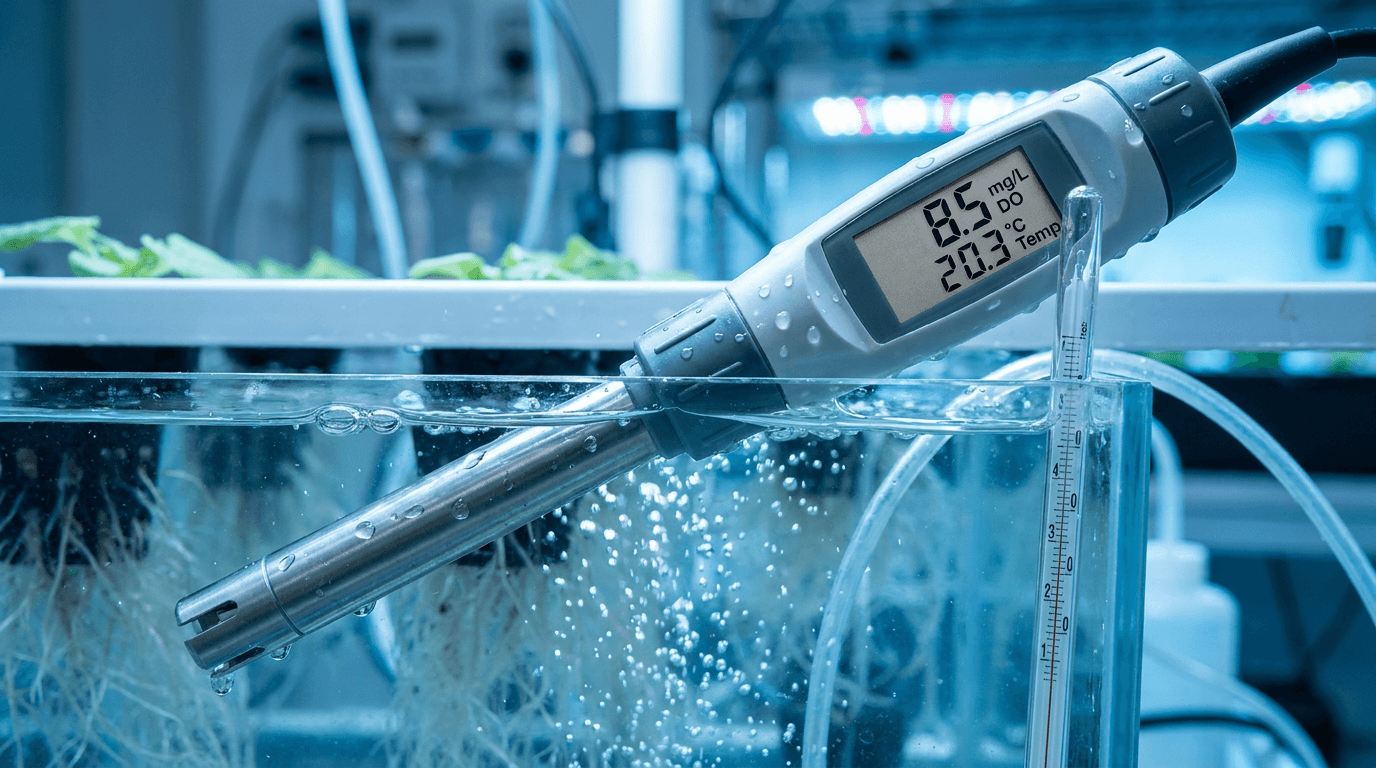
Dissolved oxygen (DO) is the lifeblood of any hydroponic system. Without adequate oxygen at the root zone, even the most precisely formulated nutrient solution becomes biologically unavailable. Roots respire just like human cells, consuming oxygen and producing carbon dioxide. When oxygen levels fall below critical thresholds, root respiration slows, nutrient uptake ceases, and anaerobic pathogens like Pythium and Fusarium seize the opportunity. The most powerful lever a grower has over dissolved oxygen is water temperature.
The relationship between water temperature and dissolved oxygen is governed by Henry's Law: as temperature increases, the solubility of gases in water decreases. This is not a trivial effect. Every one degree Celsius increase in water temperature reduces the maximum possible dissolved oxygen concentration by approximately two to three percent. Over the range of temperatures commonly encountered in hydroponic systems (fifteen to thirty degrees Celsius), the maximum DO concentration nearly halves from about ten parts per million to just over seven parts per million. Once the water exceeds twenty-four degrees Celsius, the combination of reduced oxygen solubility and increased microbial oxygen consumption creates a perfect storm for root zone hypoxia.
At The Hydro Lab, we have measured DO profiles across hundreds of grow cycles. Our data confirms that maintaining water temperature between eighteen and twenty-two degrees Celsius is the single highest-impact intervention a grower can make for root health. This thermal range provides optimal dissolved oxygen while still supporting metabolic activity in warm-season crops like tomatoes and peppers. Understanding the physics, measuring accurately, and controlling proactively are the three pillars of temperature management. This guide covers all three, with specific protocols, equipment recommendations, and troubleshooting guidance.
The Lab's Oxygen Verdict
Water temperature is not a secondary variable in hydroponics. It is a primary environmental control that directly determines the upper limit of your root zone oxygen availability. If your reservoir temperature exceeds twenty-four degrees Celsius for more than forty-eight consecutive hours, you will experience root health degradation regardless of air pump size or stone quality. We recommend all growers, regardless of experience level, install a water temperature controller before investing in any other environmental automation.
The Science of Dissolved Oxygen and Temperature
Henry's Law states that at a constant pressure, the amount of a given gas that dissolves in a given type and volume of liquid is directly proportional to the partial pressure of that gas in equilibrium with the liquid. In plain terms, cold water can hold more oxygen than warm water. At sea level, pure water at zero degrees Celsius can hold approximately 14.6 milligrams per liter of oxygen. At twenty degrees Celsius, that value drops to 9.1 milligrams per liter. At thirty degrees Celsius, it falls to 7.5 milligrams per liter. These are saturation values, meaning the theoretical maximum if the water is perfectly aerated.
In real hydroponic systems, the actual DO concentration depends on three factors: the saturation maximum determined by temperature, the rate of oxygen replenishment from aeration, and the rate of oxygen consumption by plant roots and microorganisms. A mature tomato plant in a DWC bucket can consume between five and ten milligrams of oxygen per liter per day through root respiration alone. The microbial community in the rhizosphere adds another one to three milligrams per liter per day of oxygen demand. If the replenishment rate from aeration does not keep pace with consumption, the DO concentration will drop below the saturation maximum and eventually below the critical threshold for root health.
The critical threshold for most hydroponic crops is approximately four milligrams per liter. Below this level, root respiration slows, nutrient uptake efficiency drops, and the plant begins to display symptoms of oxygen stress: wilting despite adequate water availability, interveinal chlorosis, and stunted root growth. At DO concentrations below two milligrams per liter, anaerobic conditions prevail, and pathogenic bacteria like Pythium proliferate rapidly. This is why temperature management is so critical. A system running at twenty-six degrees Celsius has a saturation maximum of only about 8.0 milligrams per liter. After accounting for plant and microbial oxygen demand, the actual DO may sit at four to five milligrams per liter, dangerously close to the hypoxia threshold.
| Water Temperature | Maximum DO (mg/L) at Sea Level | Typical DO in Well-Aerated System | Risk Level |
|---|---|---|---|
| 15°C (59°F) | 10.1 | 7.5 - 8.5 | Optimal |
| 18°C (64°F) | 9.5 | 7.0 - 8.0 | Optimal |
| 20°C (68°F) | 9.1 | 6.5 - 7.5 | Ideal |
| 22°C (72°F) | 8.7 | 6.0 - 7.0 | Good |
| 24°C (75°F) | 8.3 | 5.0 - 6.0 | Caution |
| 26°C (79°F) | 8.0 | 4.0 - 5.0 | High Risk |
| 28°C (82°F) | 7.7 | 3.0 - 4.0 | Critical |
| 30°C (86°F) | 7.5 | 2.5 - 3.5 | Danger Zone |
Ideal Temperature and DO Ranges Per Crop
Not all crops have the same oxygen requirements or temperature tolerances. Cool-season crops like lettuce and spinach thrive at lower root zone temperatures and have relatively low metabolic oxygen demand. Warm-season crops like tomatoes, peppers, and cucumbers have higher metabolic rates and can tolerate warmer root zones, but they also consume oxygen more rapidly. Understanding the specific requirements of each crop allows you to optimize your reservoir temperature rather than simply targeting a generic value.
At The Hydro Lab, we have compiled data from over two hundred grow cycles across twelve crop types to establish the following recommended temperature and DO ranges. These values represent the sweet spot where oxygen availability and metabolic activity intersect for maximum growth rate and nutrient density.
| Crop Type | Optimal Water Temp | Min DO (mg/L) | Target DO (mg/L) | Notes |
|---|---|---|---|---|
| Lettuce & Leafy Greens | 15 - 18°C (59 - 64°F) | 4.0 | 7.0 - 8.5 | Cool-tolerant; benefit from cold water |
| Basil & Herbs | 18 - 20°C (64 - 68°F) | 4.5 | 6.5 - 8.0 | Moderate warmth; avoid cold shock |
| Tomatoes | 18 - 22°C (64 - 72°F) | 5.0 | 6.0 - 7.5 | High feeders; high O2 demand |
| Peppers (Capsicum) | 20 - 22°C (68 - 72°F) | 5.0 | 6.0 - 7.0 | Warm-loving but O2 sensitive |
| Cucumbers | 20 - 24°C (68 - 75°F) | 5.5 | 5.5 - 7.0 | Tolerate warmth; high water consumption |
| Strawberries | 16 - 18°C (61 - 64°F) | 4.5 | 7.0 - 8.0 | Cool roots = sweeter fruit |
| Microgreens | 18 - 20°C (64 - 68°F) | 4.0 | 6.5 - 8.0 | Short cycle; less O2 critical |
| Kale & Collards | 15 - 20°C (59 - 68°F) | 4.0 | 7.0 - 8.5 | Hardy; wide tolerance range |
Cooling and Heating Strategies for the Reservoir
Once you understand the relationship between temperature and dissolved oxygen, the logical next step is implementing active temperature control. For most growers in most climates, the primary challenge is keeping the reservoir cool enough during summer months. Indoor grow lights, air pumps, and water pumps all generate waste heat that transfers into the nutrient solution. A typical grow room with one thousand watts of HID or LED lighting can raise ambient temperature by five to ten degrees Celsius above the outside air temperature, and the reservoir will follow.
The simplest and most reliable solution for temperature control is a dedicated water chiller. Hydroponic chillers use a refrigeration cycle to extract heat from the nutrient solution and reject it to the ambient air. They are available in sizes ranging from one-tenth horsepower for small home systems to one horsepower or larger for commercial installations. A properly sized chiller can maintain any target temperature within plus or minus one degree Celsius regardless of ambient conditions. The capital cost is significant, typically two hundred to eight hundred dollars for a home-scale unit, but the reliability and precision are unmatched.
For growers on a tighter budget, the frozen water bottle method is a proven alternative. Freeze two-liter bottles of water and rotate them into the reservoir, replacing them as they thaw. This approach requires multiple sets of frozen bottles and regular attention but can effectively reduce reservoir temperature by two to five degrees Celsius in small systems. The key is to freeze bottles with a wide mouth so they thaw more slowly and to use multiple smaller bottles rather than one large one for more consistent temperature control.
Cooling Method Comparison
In colder climates or during winter growing, heating the reservoir can be equally important. Water temperatures below fifteen degrees Celsius slow root metabolism and reduce nutrient uptake even though dissolved oxygen levels are high. The solution is a submersible aquarium heater with a thermostatic controller. Choose a titanium or stainless steel heater for hydroponic use, as glass heaters can shatter and contaminate the nutrient solution. A rule of thumb is five watts of heating power per gallon of reservoir volume. For a twenty-gallon system, a one-hundred-watt heater provides adequate heating capacity.
Insulation is a critical but often overlooked element of temperature management. A reservoir sitting directly on a concrete floor in a basement may be two to three degrees Celsius cooler than one on a wooden floor, but in summer, the same concrete floor may radiate heat into the reservoir. Reflective foam insulation wrapped around the exterior of the reservoir reduces heat exchange with the environment and improves the efficiency of both heating and cooling systems. A two-inch layer of closed-cell foam insulation around the reservoir and covering the water surface with a floating insulating disk can reduce temperature fluctuation by fifty percent or more.
Temperature Management Checklist
- Install a continuous temperature monitor with alarm
- Insulate reservoir with 2-inch closed-cell foam
- Keep air pump and water pump outside the reservoir
- Locate reservoir in coolest part of grow area
- Use reflective bubble wrap under reservoir
- Pre-chill nutrient top-up water before adding
Water Chillers vs. Frozen Bottles: A Practical Comparison
The debate between investing in a dedicated water chiller and using frozen water bottles as a cooling method is one of the most common discussions in the hydroponic community. Both approaches work, but they serve fundamentally different grower profiles. The right choice depends on system size, budget, time availability, and tolerance for temperature fluctuation.
Dedicated Water Chiller
ADVANTAGES
- + Set-and-forget precision within 0.5°C
- + Works 24/7 without human intervention
- + Handles any ambient temperature
- + Scalable to large systems
- + No daily labor required
DISADVANTAGES
- - High upfront cost ($200 - $800)
- - Adds heat to grow room
- - Consumes electricity continuously
- - Requires plumbing integration
Frozen Bottle Method
ADVANTAGES
- + Zero equipment cost
- + No installation required
- + Portable and flexible
- + No electricity consumption
DISADVANTAGES
- - Requires 3-5 bottle rotations daily
- - Temperature swings of 2-4°C per cycle
- - Ineffective above 28°C ambient
- - Freezer space required
- - Does not scale beyond 20 gallons
- - Can crash temperature if overused
Frequently Asked Questions About Water Temperature and Dissolved Oxygen
What is the ideal water temperature for hydroponics?
The universally recommended range is eighteen to twenty-two degrees Celsius (sixty-four to seventy-two degrees Fahrenheit). This range provides adequate dissolved oxygen while maintaining metabolic activity for most warm-season and cool-season crops. Cool-season crops like lettuce can tolerate down to fifteen degrees Celsius, while warm-season crops can tolerate up to twenty-four degrees Celsius with careful aeration.
How much does dissolved oxygen drop with each degree of temperature increase?
For every one degree Celsius increase in water temperature, the maximum possible dissolved oxygen concentration decreases by approximately two to three percent. Over a ten-degree Celsius range from eighteen to twenty-eight degrees Celsius, the saturation maximum drops from 9.5 to 7.7 milligrams per liter, a reduction of nearly twenty percent.
Can I compensate for high temperature with more aeration?
Partially, but not completely. Increasing aeration can help bring the actual DO concentration closer to the saturation maximum, but it cannot exceed that maximum. Once the water temperature pushes the saturation maximum below six milligrams per liter, no amount of aeration will save your root zone. Active cooling is the only solution when temperatures exceed twenty-four degrees Celsius.
Should I use a water chiller or an aquarium heater?
The vast majority of hydroponic growers need a chiller, not a heater. Indoor grow lights, pumps, and ambient heat drive reservoir temperatures up, not down. Only growers in unheated basements or winter grow rooms with ambient temperatures below fifteen degrees Celsius need a heater. In most climates, budget goes to a chiller first.
How do I measure dissolved oxygen accurately?
Use a calibrated optical DO meter or a Clark-type polarographic sensor. Optical meters use luminescent dyes and are more stable and maintenance-free than polarographic sensors. Calibrate weekly using water-saturated air or a zero-oxygen solution. Avoid colorimetric test kits for precision work as they are accurate to only plus or minus one milligram per liter.
Can I use hydrogen peroxide to boost dissolved oxygen?
Hydrogen peroxide does temporarily increase DO but at the cost of damaging beneficial microorganisms and potentially harming root tissues at high concentrations. It should be used only as a short-term emergency intervention, not as a substitute for proper temperature management. Three percent food-grade hydrogen peroxide at one milliliter per liter can raise DO by two to three milligrams per liter for twelve to twenty-four hours.
What happens if my water gets too cold, below fifteen degrees Celsius?
Cold water below fifteen degrees Celsius dramatically slows root metabolism and nutrient uptake, even though DO is abundant. Phosphorus uptake is particularly affected, causing purple stem coloration and stunted growth. Plants may appear to be suffering from nutrient deficiency when the real problem is temperature-induced metabolic slowdown. Raise temperature gradually with a submersible heater.
Take Control of Your Root Zone Temperature
Whether you are building your first DWC system or optimizing a commercial grow, water temperature management is the highest-ROI intervention you can make.
The Hobbyist
Growing a few plants in your basement. Start with frozen bottles and a good thermometer. Upgrade to a chiller when you outgrow the manual approach.
The Serious Grower
Investing time and money into a dedicated grow room. A water chiller is a non-negotiable capital expense. Set it, forget it, and let the plants thrive.
The Commercial Operator
Running a production facility where every gram of yield matters. Invest in a multi-stage chiller system with remote monitoring and alarms.
The Lab's Final Analysis
Water temperature management is the most overlooked fundamental variable in home hydroponics. New growers obsess over nutrients, pH meters, and light spectra while ignoring the single factor that determines whether those inputs are accessible to the plant. At The Hydro Lab, we have seen countless cases of mysterious root rot, persistent nutrient deficiencies, and stalled growth that resolved within days of lowering the reservoir temperature from twenty-five to twenty degrees Celsius.
The science is unambiguous: dissolved oxygen availability is inversely proportional to water temperature, and root zone hypoxia cascades into every aspect of plant health. A plant that cannot respire cannot uptake nutrients, cannot transpire, cannot photosynthesize efficiently. The visible symptoms of temperature stress are almost always misdiagnosed as nutrient deficiency or pathogen infection, leading growers to add more nutrients or apply fungicides when the real solution is simpler and cheaper.
Our recommendation is to invest in measurement first. Buy a reliable digital thermometer with a continuous logging capability and an optical dissolved oxygen meter. Run your system for one week at ambient temperature and record the data. Then implement your chosen cooling strategy and compare the results. The data will speak for itself. The difference between a twenty-two degree and a twenty-eight degree reservoir is the difference between a thriving root system and one that is barely surviving.
Measure your water temperature today. If it is above twenty-four degrees Celsius, your plants are already struggling. The fix is straightforward: insulate, cool, and monitor. Your roots will thank you with explosive growth, and your yield will reflect the investment.
More from Nutrition & pH
Keep reading
pH and EC for Beginners: The Two Meters You Cannot Skip
What pH and electroconductivity actually measure, the targets per crop, and how to calibrate the cheap meters that everyone owns.
How to Flush Your Hydroponic System Before Harvest
Explore our comprehensive guide on How to Flush Your Hydroponic System Before Harvest. Part of our technical series on nutrient science and water chemistry, this report covers everything you need to optimize your yield and maintain a healthy grow environment.
Reading a Nutrient Deficiency Chart Like a Plant Doctor
Yellow leaves, purple stems, twisted tips — a structured way to diagnose the 12 most common deficiencies.