
Reverse Osmosis (RO) vs. Tap Water for Hydroponics
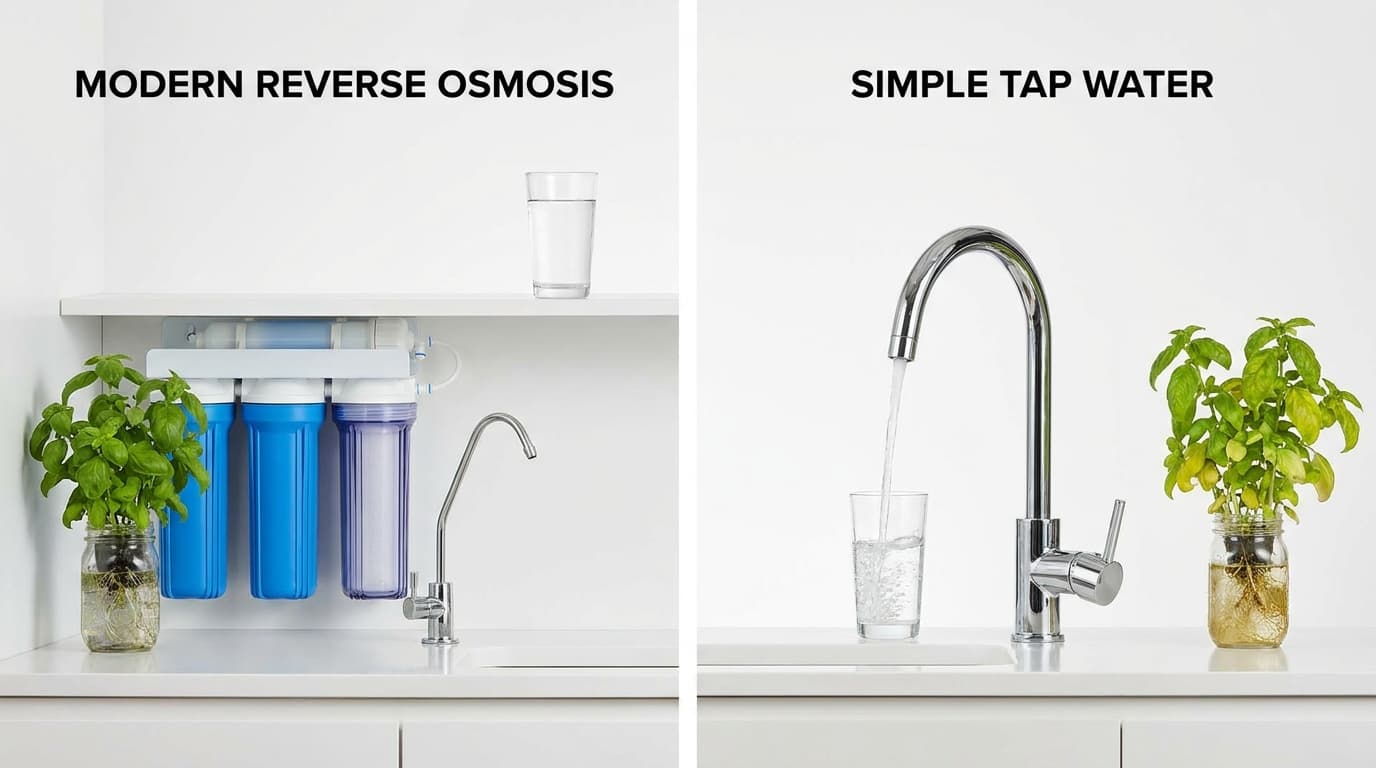
Water is the single most underappreciated variable in hydroponic growing. Most growers obsess over nutrients, lighting, and pH while taking their water source entirely for granted, assuming that if it is safe to drink, it is good enough for their plants. The reality is far more complex. The difference between municipal tap water and purified reverse osmosis water can mean the difference between lush, rapid growth and a constant struggle with deficiencies, toxicities, and mysterious leaf symptoms that defy diagnosis.
Tap water is a complex chemical cocktail that varies dramatically depending on your geographic location, your local water treatment plant, and even the season. Some tap water is so pure it rivals RO water, while other sources contain dissolved solids levels exceeding five hundred parts per million, loaded with calcium, magnesium, sodium, chlorides, sulfates, and trace heavy metals that can wreak havoc on a carefully balanced nutrient formula. The pH buffering capacity of hard tap water alone can make nutrient management a nightmare, requiring excessive amounts of pH adjuster every single day.
In this comprehensive guide, The Hydro Lab breaks down everything you need to know about RO versus tap water for hydroponics. We cover the chemistry of municipal water treatment, the contaminants you should worry about and those you should not, the true cost of owning an RO system, and the specific scenarios where RO water is essential versus situations where it is an unnecessary expense. By the end, you will know exactly which water source is right for your grow operation and how to optimize either choice for maximum plant health and yield.
The Lab's Verdict
RO water is the gold standard for hydroponic nutrient management, but it is not always necessary. If your tap water is below 150 parts per million total dissolved solids and you are not growing sensitive crops like strawberries, blueberries, or certain herbs, you can achieve excellent results with properly treated tap water. However, if your water source exceeds 200 parts per million, contains chloramines, or you are growing high-value or pH-sensitive crops, an RO system is one of the best investments you can make. At The Hydro Lab, we use RO water exclusively in all our research trials because it eliminates an entire variable from the equation, allowing for precise, repeatable nutrient formulations.
What Is Actually in Your Tap Water?
Understanding what comes out of your garden hose is the first step toward making an informed decision about water treatment. Municipal water suppliers are required to publish annual water quality reports, but these documents are written for human health compliance, not for hydroponic growers. The contaminants and compounds that matter most to your plants are often different from those regulated for drinking water safety.
Chlorine and Chloramines
Chlorine and chloramines are disinfectants added to municipal water supplies to kill bacteria and pathogens. Chlorine is relatively harmless to hydroponic systems because it dissipates naturally within twenty-four hours when water is aerated or exposed to sunlight. Simply filling your reservoir and letting it sit overnight with an air stone running is usually sufficient to eliminate chlorine. Chloramines, however, are a different story. Chloramines are chlorine combined with ammonia, creating a much more stable compound that can persist in water for weeks. Chloramines do not off-gas readily and can accumulate in your reservoir, killing beneficial microbes and stressing plant roots. If your water utility uses chloramines, which an increasing number do, you absolutely need RO filtration or a specialized dechlorinator like vitamin C (ascorbic acid) to neutralize them. Many growers discover chloramines only after experiencing persistent root health problems that resist all other treatments.
Dissolved Minerals and Hardness
Total dissolved solids is the measurement of all inorganic and organic substances dissolved in your water. In most municipal supplies, the primary contributors are calcium, magnesium, sodium, potassium, bicarbonates, sulfates, and chlorides. Water hardness is specifically the concentration of calcium and magnesium ions. Hard water, defined as water exceeding 120 parts per million of calcium carbonate equivalent, creates several problems in hydroponics. First, it adds a high and unpredictable baseline of nutrients that interferes with your carefully formulated nutrient solution. Second, the bicarbonates in hard water act as a powerful pH buffer, constantly driving pH upward and requiring excessive amounts of pH down solution. Third, the ratio of calcium to magnesium in tap water is almost never ideal for plant growth, leading to imbalances that manifest as deficiency symptoms even when you are adding complete nutrients. Some tap water sources in the western United States and parts of the United Kingdom exceed 400 parts per million total dissolved solids, making them completely unsuitable for hydroponics without treatment.
Heavy Metals and Contaminants
While municipal water is tested for heavy metals, trace amounts of copper, zinc, lead, and iron can still be present, especially in older plumbing systems. Copper is particularly problematic for hydroponics because it is toxic to plant roots at very low concentrations, causing root tip dieback and stunted growth. Lead pipes, while increasingly rare, still exist in older urban infrastructure. Even at levels considered safe for human consumption, heavy metals can accumulate in plant tissue over time, potentially affecting the quality and safety of your harvest. RO systems remove over ninety-nine percent of these heavy metals, providing a clean slate for your nutrient solution. For growers producing leafy greens and herbs for sale, the assurance of contaminant-free produce is a significant value proposition that can justify the investment in RO filtration.
How RO Systems Work and What They Cost
Reverse osmosis systems use a semi-permeable membrane to remove dissolved solids, contaminants, and pathogens from water by applying pressure to force water molecules through microscopic pores while rejecting larger molecules and ions. The membrane typically removes ninety to ninety-nine percent of total dissolved solids, depending on the membrane quality, water pressure, and temperature. The result is water with a purity approaching distilled quality, typically measuring between zero and ten parts per million total dissolved solids.
System Components and Configuration
A typical RO system consists of several stages. The first stage is a sediment pre-filter that removes sand, rust, and large particles that would clog the membrane. The second stage is a carbon pre-filter that removes chlorine, chloramines, and organic compounds that can damage the membrane. The third stage is the RO membrane itself, which is the heart of the system. Some systems include a fourth stage, a post-carbon filter or deionization resin, for final polishing. For hydroponic applications, a basic three-stage system is usually adequate, though adding a deionization stage can be beneficial for research-grade applications where absolute purity is required. The system also requires a flow restrictor to maintain proper pressure across the membrane, a check valve to prevent backflow, and an automatic shutoff valve that stops production when the storage tank is full.
Upfront and Ongoing Costs
The cost of RO systems varies widely based on capacity and quality. A basic under-sink household RO system with a fifty-gallon-per-day membrane can be purchased for under one hundred and fifty dollars, but these units are generally too slow for hydroponic applications where you may need twenty to fifty gallons per water change. A purpose-built hydroponic RO system with a one hundred to two hundred gallon-per-day membrane typically costs between three hundred and eight hundred dollars, including the necessary fittings, storage tank, and auto-shutoff valve. Commercial-grade systems capable of producing five hundred to two thousand gallons per day can cost several thousand dollars but are only necessary for large-scale operations. Ongoing costs include replacement pre-filters every six to twelve months at twenty to forty dollars each, carbon filters annually at thirty to sixty dollars, and the RO membrane itself every two to five years at fifty to one hundred and fifty dollars. The waste water ratio must also be considered: traditional RO systems reject two to four gallons of water for every gallon of purified water produced. This waste water, called brine or concentrate, goes down the drain and represents both a water cost and an environmental consideration. High-efficiency systems with permeate pumps can reduce this ratio to one-to-one, but they cost more upfront.
Maintenance Requirements
RO systems require regular maintenance to perform properly. The most common issue is membrane fouling caused by mineral scaling, bacterial growth, or sediment accumulation. Pre-filters should be changed on a schedule based on your water quality and usage volume, not by the calendar. If your system uses a storage tank, the tank bladder should be checked annually and the air pressure adjusted to the manufacturer's specification. The membrane should be sanitized periodically with a hydrogen peroxide solution if you notice a gradual decline in water quality. A simple total dissolved solids meter, costing less than twenty dollars, is essential for monitoring system performance. When the rejection rate, the percentage of dissolved solids removed, drops below ninety percent, it is time to replace the membrane. Many growers neglect this monitoring and continue using water they assume is pure, only to discover their membrane has been failing for months.
When RO Is Necessary vs. Overkill
One of the most common debates in the hydroponic community revolves around whether RO water is worth the investment. The answer depends on several factors including your source water quality, the crops you grow, your system type, and your tolerance for variability. Let us break down the scenarios where RO is essential, where it is beneficial but optional, and where it is probably overkill.
RO Is Essential When
If your tap water exceeds 300 parts per million total dissolved solids, you are fighting an uphill battle trying to manage nutrients without RO water. The buffering from bicarbonates alone will consume excessive pH adjuster and make stable pH nearly impossible. Similarly, if your water utility uses chloramines, you must either install an RO system or use chemical dechlorination for every reservoir fill. Chloramines will destroy beneficial microbes and hydroton bacterial colonies, and they can cause root tip burn in sensitive plants. If you are growing strawberries, blueberries, or other highly pH-sensitive fruiting crops, RO water provides the consistent baseline these plants demand. For research or breeding work where results must be reproducible, RO water is non-negotiable because it eliminates water chemistry as an uncontrolled variable. Finally, if you are running a commercial operation where crop uniformity and predictable harvest timing are essential for business planning, the consistency of RO water is a business necessity rather than a luxury.
RO Is Beneficial When
If your tap water is between 150 and 300 parts per million, RO water will improve your results but may not be strictly necessary. Many successful hobbyists grow excellent crops in this range by adjusting their nutrient formulas to account for the baseline mineral content. For example, if your tap water already contains sixty parts per million calcium, you can reduce the calcium nitrate in your nutrient mix accordingly. The benefit of RO in this range is convenience: starting from zero allows you to use standard nutrient formulas without modification and eliminates pH buffering unpredictability. If you are growing leafy greens and herbs, which are less sensitive to mineral variability than fruiting plants, RO is a nice-to-have rather than a must-have in this range.
RO Is Overkill When
If your tap water is below 100 parts per million total dissolved solids, you are probably wasting money on RO filtration. Water at this purity level, commonly found in regions with soft water sources like the Pacific Northwest or parts of Scotland, is already excellent for hydroponics. The small amount of dissolved minerals present is unlikely to cause nutrient imbalances, and the pH buffering is minimal. In fact, some growers find that using RO water with very soft tap water creates an overly pure solution that actually requires adding back calcium and magnesium that were removed, an unnecessary step that adds cost and complexity. Similarly, if you are growing a small hobby garden with a few plants and have manageable tap water, a fifty-dollar dechlorinator and some pH adjuster are more cost-effective than investing in a several-hundred-dollar RO system.
Remineralizing RO Water and Reading Water Reports
One of the most important concepts for growers transitioning to RO water is that pure water does not mean better water. RO water is aggressive. Its lack of dissolved minerals means it has very low buffering capacity, causing pH to swing dramatically with small additions of nutrients or pH adjuster. More importantly, RO water lacks calcium and magnesium, two essential macronutrients that plants need in significant quantities. While your base nutrient formula should supply these elements, the reality is that many commercial nutrient formulas assume some baseline calcium and magnesium in the source water. Switching to RO without adjustment can actually cause calcium and magnesium deficiencies, especially during the flowering and fruiting stages when demand is highest.
Remineralization Strategies
The most common approach to remineralizing RO water is adding calcium and magnesium supplements specifically designed for this purpose. Calcium nitrate and magnesium sulfate are the standard choices, added at rates that bring your starting water to approximately fifty to one hundred parts per million total dissolved solids from these two minerals alone. This provides a stable baseline that mimics moderately soft tap water while still maintaining the purity advantage of RO. Some nutrient manufacturers offer bloom boosters or hard water formulas that assume zero baseline, but these are uncommon. A simpler approach used by many commercial growers is to blend RO water with a small percentage of tap water to achieve a target starting total dissolved solids level. For example, blending one part tap water at 300 parts per million with three parts RO water at zero parts per million yields a starting water of approximately 75 parts per million, providing trace minerals while maintaining most of the purity advantage. This blending approach also eliminates the pH instability problem of pure RO water because the tap water provides buffering.
Interpreting Your Water Quality Report
Your local water utility publishes an annual water quality report, often called a Consumer Confidence Report, that contains the data you need to make an informed decision. The key values to look for are total dissolved solids, which is sometimes reported as specific conductance or electrical conductivity and can be converted by multiplying microsiemens per centimeter by approximately 0.64 to get parts per million. Calcium and magnesium levels are usually reported separately. Look for the ratio: an ideal ratio for hydroponics is approximately three to five parts calcium to one part magnesium. Many tap waters are heavily skewed toward calcium, creating magnesium deficiency that growers misinterpret as other problems. Sodium levels above fifty parts per million are a warning sign because sodium competes with potassium and calcium for uptake. Chloride levels above one hundred parts per million can cause leaf tip burn. Bicarbonate alkalinity is often reported separately and is the primary driver of pH instability. If bicarbonate alkalinity exceeds one hundred parts per million as calcium carbonate, you will struggle with rising pH regardless of your nutrient management.
Setting Your Baseline PPM and EC
Whether you use tap water or RO water, establishing a consistent baseline is critical for repeatable nutrient management. Measure the total dissolved solids or electrical conductivity of your source water every time you fill your reservoir because municipal water quality can vary seasonally. Spring snowmelt often produces softer water, while summer evaporation can concentrate minerals. Record your baseline and subtract it from your target nutrient strength to determine how much nutrient to add. For example, if your target is 1200 parts per million and your tap water baseline is 200 parts per million, you need to add enough nutrients to raise the total by 1000 parts per million, not 1200. This baseline adjustment is one of the most commonly overlooked aspects of nutrient management and leads to consistently over-fertilized plants among growers who do not account for their starting water's contribution.
Tap Water vs. RO Water: Side-by-Side Comparison
| Parameter | Tap Water | RO Water | Hydroponic Impact |
|---|---|---|---|
| Total Dissolved Solids | 50-500+ ppm | 0-10 ppm | RO provides a clean slate for precise nutrient formulation |
| Chlorine | 0.5-4.0 ppm | 0 ppm | Chlorine dissipates naturally; chloramines require filtration |
| Chloramines | 0-4.0 ppm | 0 ppm | Chloramines kill beneficial microbes and persist in reservoirs |
| pH Buffering | High (bicarbonates) | Very low | Tap water resists pH changes; RO water requires careful stabilization |
| Calcium | 20-100+ ppm | 0 ppm | Tap water provides calcium but in unpredictable ratios |
| Magnesium | 5-50+ ppm | 0 ppm | RO requires supplemental magnesium added back |
| Sodium | 10-100+ ppm | 0 ppm | High sodium in tap water competes with potassium uptake |
| Heavy Metals | Trace to detectable | Removed >99% | RO eliminates risk of copper and lead toxicity in roots |
| Upfront Cost | $0 (from tap) | $150-$800 | RO pays for itself in nutrient consistency and reduced pH adjuster use |
| Ongoing Cost | Water bill only | $50-$150/year | Filter replacements and waste water are recurring expenses |
| Waste Water | None | 2-4 gallons per gallon produced | Waste water ratio is a significant environmental and cost factor |
| Nutrient Predictability | Variable by season and location | Highly consistent | RO allows standardized nutrient formulas with zero adjustment |
RO Water: Pros and Cons at a Glance
Pros
- Eliminates water chemistry variability, allowing consistent nutrient formulations with every reservoir fill
- Removes chloramines, chlorine, heavy metals, and up to 99% of total dissolved solids
- Eliminates pH buffering from bicarbonates, giving you full control over nutrient solution pH
- Prevents accumulation of sodium, chlorides, and other problematic ions over multiple growth cycles
- Essential for sensitive crops like strawberries, blueberries, and precise research applications
- Reduces pH adjuster consumption significantly compared to hard tap water
Cons
- High upfront cost of $150 to $800 for a purpose-built hydroponic RO system
- Wastes 2-4 gallons of water for every gallon of purified water produced
- Requires regular filter replacements and membrane monitoring with annual costs of $50 to $150
- Slow production rate of 50 to 200 gallons per day requires storage tank for large reservoirs
- Removes beneficial calcium and magnesium that must be added back through remineralization
- Can cause pH instability if used without proper buffering or remineralization strategy
Frequently Asked Questions
Can I mix RO water with tap water?
Yes, and this is actually a common and effective strategy. Blending allows you to achieve a target starting total dissolved solids level that provides trace minerals while maintaining most of the purity advantage of RO. A typical blend is one part tap water to three parts RO water, which yields a starting baseline of approximately 25 percent of your tap water's dissolved solids content. This approach eliminates the need for separate calcium and magnesium supplementation while still greatly reducing pH buffering and contaminant levels.
How do I know if my water has chloramines?
Your water utility's annual water quality report will specify whether chloramines are used as the primary disinfectant. You can also call your local water department directly. If you notice that your reservoir water retains a chlorine smell even after 24 hours of aeration, that is a strong indicator of chloramines. Another sign is persistent root health problems in your system that do not respond to standard treatments. At-home test kits for chloramines are available from aquarium supply stores and cost under fifteen dollars.
Does RO water remove nutrients if I add them after filtration?
No. Once you add your nutrient formula to RO water, the nutrients dissolve and remain in solution just as they would in tap water. The RO process only removes substances that were present before filtration. The idea that RO water repels or rejects nutrients is a persistent myth. However, because RO water lacks buffering capacity, the pH of your nutrient solution will be more responsive to adjustments, which is generally an advantage once you learn to work with it. The key is to add nutrients slowly and check pH after each addition rather than dumping everything in at once.
What is the best RO system for a home hydroponic setup?
For a typical home grower with 10 to 20 gallons of reservoir capacity, a 100 to 150 gallon-per-day system with a sediment pre-filter, carbon block, and RO membrane is the sweet spot. Look for systems with standard 10-inch filter housings to keep replacement filter costs low. Brand-specific proprietary filters can be significantly more expensive over time. Systems with a built-in permeate pump are worth the extra cost because they reduce waste water and improve membrane performance at low water pressure. The Hydro Lab recommends the Hydro Logic StealthRO 150 or the Aquatic Life RO Buddy 100 for budget-conscious growers.
Can I use distilled water instead of RO water?
Yes, distilled water is essentially equivalent to RO water in purity, typically measuring zero parts per million total dissolved solids. However, distillation is much less energy-efficient than RO, requiring significant electricity to heat and condense water. For small-scale use, store-bought distilled water at one to two dollars per gallon is practical for a few plants, but it becomes prohibitively expensive for larger systems. RO is the more sustainable and cost-effective choice for ongoing hydroponic use, with a significantly lower carbon footprint than distillation.
How often do I need to replace RO filters?
Sediment and carbon pre-filters should be replaced every six to twelve months, depending on your water quality and usage volume. A simple pressure gauge can help you determine when pre-filters are clogging: if the pressure differential across the pre-filters increases by more than 10 psi, it is time to replace them. The RO membrane itself lasts two to five years. Monitor its performance with a total dissolved solids meter: when the rejection rate drops below 90 percent, replace the membrane. Many growers write the installation date on their filters and replace them on a regular schedule rather than waiting for visible performance decline.
Do I need a storage tank for my RO system?
For most hydroponic applications, a storage tank is essential because RO production is slow. A 100 gallon-per-day system produces only about four gallons per hour. If you need to fill a 15-gallon reservoir, it will take nearly four hours of continuous operation. A storage tank allows you to produce water slowly over time and have it ready when needed. Aim for a storage tank at least twice the size of your largest reservoir. An auto-shutoff valve is critical to prevent overflow and to protect the RO membrane from back-pressure when the tank is full. A float valve in the tank provides additional safety.
Which Water Solution Is Right for You?
Every grower has unique water chemistry needs. Find your profile and get started with the right approach for your operation.
The Hobbyist
Small home grower with 5-20 gallons of reservoir capacity. Your tap water is below 150 ppm and you grow leafy greens and herbs. A basic dechlorinator and pH adjuster are all you need for excellent results without RO investment.
The Precision Grower
You grow fruiting crops like tomatoes, peppers, or strawberries and demand consistent results. Your tap water is 150-300 ppm or contains chloramines. A 100-150 GPD RO system will pay for itself in reduced pH adjuster use and better yields.
The Commercial Operator
You run a medium to large-scale operation where crop uniformity and predictable harvest timing are business necessities. RO water is non-negotiable for reproducibility. Look at 200-500 GPD systems with permeate pumps and automated float valve fill stations.
Final Analysis
The decision between RO and tap water for hydroponics ultimately comes down to your specific circumstances. For growers with soft tap water below 150 parts per million who grow forgiving crops like lettuce, basil, and other leafy greens, the expense and complexity of RO filtration is difficult to justify. A simple carbon filter to remove chlorine and a good pH meter are sufficient investments. However, for growers with hard water exceeding 200 parts per million, water treated with chloramines, or those growing pH-sensitive fruiting crops, RO water is not a luxury but a tool that directly improves results. The cost of an RO system is quickly recovered through reduced pH adjuster consumption, elimination of mysterious deficiency symptoms, and improved crop quality.
The Hydro Lab's recommendation is to start by measuring your tap water quality with a reliable total dissolved solids meter and obtaining your local water quality report. If your total dissolved solids are below 150 parts per million and you do not have chloramines, proceed with tap water plus dechlorination. If your total dissolved solids exceed 200 parts per million or you have chloramines, invest in an RO system sized appropriately for your reservoir volume. Remember that RO water is not a set-it-and-forget-it solution: you must monitor membrane performance, replace pre-filters on schedule, and implement a remineralization strategy to prevent calcium and magnesium deficiencies. When properly managed, RO water provides the closest thing to a blank canvas for nutrient formulation, allowing you to dial in your crop's nutrition with surgical precision.
Water is the foundation of your hydroponic system. Investing in water quality is investing in every other input you add. Whether you choose RO or tap water, the key is understanding what is in your source water and managing it deliberately rather than assuming it is good enough. Your plants will reward you with faster growth, better flavor, and higher yields when you give them the clean, consistent water they deserve.
More from Nutrition & pH
Keep reading
pH and EC for Beginners: The Two Meters You Cannot Skip
What pH and electroconductivity actually measure, the targets per crop, and how to calibrate the cheap meters that everyone owns.
How to Flush Your Hydroponic System Before Harvest
Explore our comprehensive guide on How to Flush Your Hydroponic System Before Harvest. Part of our technical series on nutrient science and water chemistry, this report covers everything you need to optimize your yield and maintain a healthy grow environment.
Reading a Nutrient Deficiency Chart Like a Plant Doctor
Yellow leaves, purple stems, twisted tips — a structured way to diagnose the 12 most common deficiencies.