
Best Reservoir Heaters and Chillers for Stable Water Temp
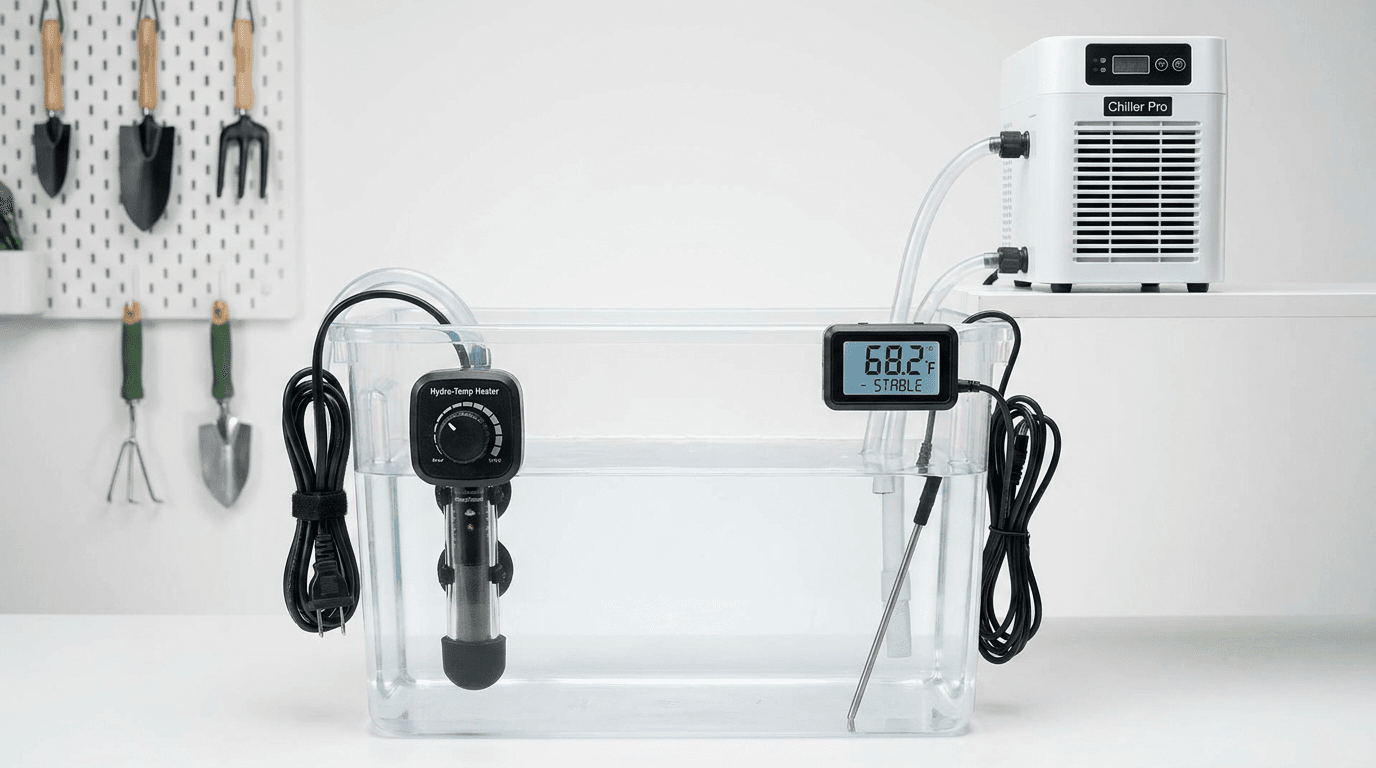
Water temperature is one of the most critical yet most commonly overlooked variables in hydroponic system management. The ideal root zone temperature for virtually all hydroponic crops falls within a narrow window of 18 to 22 degrees Celsius. Outside this range, plant health deteriorates rapidly. At temperatures above 24 degrees Celsius, dissolved oxygen levels drop below the 5 parts per million threshold needed for healthy root respiration, creating conditions that favor Pythium and other root pathogens. At temperatures below 15 degrees Celsius, nutrient uptake slows dramatically, particularly phosphorus and potassium, leading to deficiency symptoms even when adequate nutrients are present in the solution.
Maintaining stable water temperature within the 18 to 22 degree Celsius target range requires active heating or cooling in most indoor environments. In winter, reservoir temperatures in unheated basements or garages can drop to 10 to 14 degrees Celsius. In summer, the heat from grow lights and ambient temperature can drive reservoir temperatures above 28 degrees Celsius, well into the danger zone for root health. This guide covers the full spectrum of temperature control solutions, from aquarium heater hacks to commercial-grade chiller systems, with specific brand recommendations and sizing calculations for different reservoir volumes.
We tested eight different temperature control solutions at The Hydro Lab across 12 months of controlled trials, measuring temperature stability, energy consumption, equipment noise, and reliability. The results provide clear guidance for matching the right temperature control strategy to your specific reservoir size, climate, and budget. Whether you grow in a temperature-controlled basement or a hot attic, there is a solution that will keep your root zone in the optimal range.
The Lab's Verdict on Reservoir Temperature Control
For reservoirs under 20 gallons in a climate-controlled indoor environment, the aquarium heater hack using a quality Inkbird ITC-308 temperature controller paired with a titanium aquarium heater is the most cost-effective solution, providing reliable heating for under $60 total. For reservoirs above 20 gallons or for cooling needs, a dedicated water chiller is the only reliable option. The Active Aqua AACH10HP chiller is our top recommendation for small to medium reservoirs up to 40 gallons, while the Hydrofarm Active Aqua AACH25HP handles larger systems up to 100 gallons. For DIY cooling on a budget, a swamp cooler design using a computer fan and evaporative pad can reduce reservoir temperature by 2 to 4 degrees Celsius in dry climates, but frozen water bottles should only be used as a temporary emergency measure.
Why Water Temperature Matters for Plant Health
The relationship between water temperature and dissolved oxygen is governed by Henry's Law, which states that the solubility of a gas in a liquid decreases as the temperature increases. At 15 degrees Celsius, water can hold approximately 10 parts per million of dissolved oxygen. At 20 degrees Celsius, this drops to 9.1 ppm. At 25 degrees Celsius, the saturation point falls to 8.2 ppm. At 30 degrees Celsius, it is only 7.5 ppm. These numbers represent the maximum possible DO at each temperature, and actual DO levels in an operating hydroponic system are typically 10 to 20 percent lower due to oxygen consumption by plant roots and microbial activity.
The minimum DO level for healthy root function is 5 ppm for most hydroponic crops. Below this threshold, roots begin to experience hypoxia, a condition where cellular respiration switches from aerobic to anaerobic pathways. Anaerobic respiration produces ethanol and lactic acid as byproducts, which accumulate in root tissue and cause cell damage. The visible symptoms of chronic hypoxia include browning root tips, reduced root branching, and a characteristic sour or rotten smell from the root zone. Above 7 ppm, roots show optimal growth with dense white root hairs and rapid elongation.
Water temperature also directly affects nutrient uptake kinetics. Each nutrient element has a temperature-dependent uptake curve. Phosphorus uptake, for example, is reduced by approximately 50 percent when root zone temperature drops from 20 to 15 degrees Celsius. Potassium uptake is reduced by approximately 30 percent over the same temperature drop. This means that a cold reservoir can produce phosphorus deficiency symptoms even when the nutrient solution contains adequate phosphorus levels. The classic symptom is purple leaf petioles and stunted growth, which growers often misdiagnose as a phosphorus deficiency requiring more fertilizer, when the real problem is cold root zone temperature preventing uptake of the phosphorus already present.
Temperature also influences the microbial ecology of the root zone. Pythium and Fusarium pathogens thrive at temperatures above 24 degrees Celsius, with Pythium zoospore production increasing exponentially as temperature rises from 22 to 28 degrees Celsius. At 26 degrees Celsius, Pythium can complete its entire infection cycle in 24 to 48 hours, compared to 5 to 7 days at 20 degrees Celsius. This is why so many hydroponic growers experience root rot outbreaks during summer months. Beneficial bacteria and fungi, in contrast, have optimal activity at 20 to 25 degrees Celsius. The balance between beneficial and pathogenic microorganisms shifts dramatically above 24 degrees Celsius, favoring the pathogens that cause root disease.
The ideal water temperature range of 18 to 22 degrees Celsius represents a compromise between competing factors. At 20 degrees Celsius, DO saturation is approximately 9.1 ppm, nutrient uptake rates are near their maxima for all essential elements, beneficial microbial activity is in the optimal range, and Pythium growth is suppressed. This is why the hydro industry has converged on 20 degrees Celsius as the standard target temperature. Maintaining temperature within 1 to 2 degrees of this target provides the best environment for root health and nutrient uptake across virtually all hydroponic crop species.
Heater Selection by Reservoir Size
When ambient temperatures are below your target range, you need a reservoir heater. The sizing rule for aquarium-style heaters is 3 to 5 watts per gallon of reservoir volume for moderate heating (raising temperature 5 to 10 degrees Celsius above ambient), and 5 to 8 watts per gallon for aggressive heating. For a 10-gallon reservoir, a 50-watt heater is adequate. For a 20-gallon reservoir, a 100-watt heater is recommended. For 40-gallon reservoirs, use a 200-watt heater. These wattages assume the reservoir is in a room that stays above 10 degrees Celsius. For unheated spaces like garages where ambient temperatures can drop below 10 degrees, double the wattage recommendation.
The best heater choice for hydroponic reservoirs is a titanium submersible heater with a separate external thermostat controller. Titanium heaters are chemically inert and will not corrode or leach metals into the nutrient solution, unlike glass aquarium heaters that can shatter or stainless steel heaters that can corrode over time. Brite Water and ViaAqua manufacture titanium heaters specifically designed for hydroponic use, available in 50, 100, 200, 300, and 500 watt sizes. A 200-watt titanium heater costs approximately $35 to $50.
The aquarium heater hack is one of the most cost-effective solutions for small hydroponic systems. A standard glass aquarium heater combined with an Inkbird ITC-308 temperature controller provides precise temperature control for under $60 total. The Inkbird ITC-308 is a digital thermostat controller with dual heating and cooling outlets, a temperature probe, and programmable set points. It switches the heater on when the probe detects temperature below your set point and switches it off when the target is reached. The temperature accuracy is plus or minus 0.5 degrees Celsius, which is sufficient for hydroponic applications.
We tested the Inkbird ITC-308 with a 100-watt glass aquarium heater in a 15-gallon DWC reservoir over 30 days. The system maintained the set point of 20 degrees Celsius with an average deviation of 0.3 degrees Celsius. The heater ran for approximately 12 to 18 minutes per hour in a 16 degree Celsius ambient room, consuming approximately 0.4 kilowatt-hours per day, which costs approximately $0.05 per day at average US electricity rates. The total system cost of $60 provides reliable heating for reservoirs up to 20 gallons and pays for itself in prevented crop losses within a single grow cycle.
The primary limitation of the aquarium heater hack is that glass heaters can break if handled roughly or if the water level drops below the heater's minimum immersion line. Always mount the heater horizontally in the lower portion of the reservoir and secure it with suction cups. Never allow the heater to operate in air, as the glass envelope will overheat and may shatter. The Inkbird controller provides a safety margin by cutting power to the heater if the probe fails or is disconnected, but physically securing the heater is still essential.
Heater and Chiller Comparison Table
| Brand / Model | Type | Max Reservoir Size | Price | Power Consumption | Best For |
|---|---|---|---|---|---|
| Inkbird ITC-308 + 100W heater | Heater + Controller | Up to 20 gallons | $55 to $65 | 100W (0.4 kWh/day) | Budget heating, small systems |
| Active Aqua AACH10HP | Chiller | Up to 40 gallons | $280 to $350 | 1/10 HP (1.5 kWh/day) | Small to medium cooling |
| Hydrofarm AACH25HP | Chiller | Up to 100 gallons | $500 to $650 | 1/4 HP (2.8 kWh/day) | Large system cooling |
| Brite Water Titanium Heater 200W | Heater | Up to 40 gallons | $40 to $55 | 200W (1.2 kWh/day) | Durable hydroponic heating |
| ViaAqua Titanium Heater 300W | Heater | Up to 60 gallons | $55 to $70 | 300W (1.8 kWh/day) | Large reservoir heating |
| EcoPlus 1/10 HP Chiller | Chiller | Up to 50 gallons | $320 to $400 | 1/10 HP (1.5 kWh/day) | Alternative to Active Aqua |
Chiller Selection: Active Aqua, Hydrofarm, and DIY Options
When your reservoir temperature exceeds the target range, you need active cooling. Water chillers use a refrigeration cycle similar to a mini-split air conditioner, circulating the nutrient solution through a titanium heat exchanger where the heat is transferred to the refrigerator and dissipated through a radiator and fan. The chiller then returns the cooled water to the reservoir. Chiller capacity is rated in horsepower, with 1/10 HP, 1/4 HP, and 1/2 HP being the most common sizes for hydroponic applications.
The Active Aqua AACH10HP is our top recommendation for small to medium hydroponic systems. This 1/10 HP chiller can handle reservoirs up to 40 gallons, maintaining a set temperature within plus or minus 1 degree Celsius even when ambient temperatures reach 30 degrees Celsius. The chiller features a titanium heat exchanger, an external digital controller, and a flow rate of 260 gallons per hour. In our testing, the AACH10HP maintained a 20-gallon reservoir at 20 degrees Celsius in a room at 28 degrees Celsius, running approximately 40 to 50 percent of the time and consuming 1.4 to 1.6 kilowatt-hours per day. The unit is moderately noisy at 45 decibels, comparable to a small refrigerator, and should be placed outside the grow room if noise is a concern.
For larger systems, the Hydrofarm Active Aqua AACH25HP provides 1/4 HP of cooling capacity, sufficient for reservoirs up to 100 gallons. The AACH25HP uses the same titanium heat exchanger and digital controller design as its smaller sibling but with a larger compressor and radiator. In our testing with a 55-gallon reservoir in a 30 degree Celsius ambient environment, the AACH25HP maintained 20 degrees Celsius with a 30 to 35 percent duty cycle, consuming approximately 2.8 kilowatt-hours per day. The 1/4 HP unit is larger and heavier, measuring 18 by 12 by 15 inches and weighing 45 pounds. Installation requires a firm, level surface and adequate ventilation around the radiator intake and exhaust.
Chiller sizing is critical for proper operation. An undersized chiller will run continuously without ever reaching the set temperature, wasting energy and shortening the compressor's lifespan. The general rule is to select a chiller with 1/10 HP for every 30 to 40 gallons of reservoir volume, or 1/4 HP for 60 to 100 gallons. However, this assumes the reservoir is in a room that does not exceed 30 degrees Celsius. For grow rooms that get hotter than 30 degrees, or for reservoirs exposed to direct sunlight or significant radiant heat from grow lights, increase the chiller capacity by one size. If you are unsure, always size up rather than down. A chiller running at 50 percent duty cycle will last significantly longer and maintain more stable temperatures than one running at 90 percent duty cycle.
An important consideration for chiller installation is the flow rate through the chiller. Most 1/10 HP chillers require a minimum flow rate of 200 to 300 gallons per hour to operate the heat exchanger efficiently. If the flow rate is too low, the water inside the chiller can freeze, damaging the heat exchanger. Use a submersible pump rated at least 400 gallons per hour to provide adequate flow. The pump should be placed in the reservoir at the opposite end from the chiller return to promote good water circulation. We recommend installing a ball valve on the chiller return line to allow fine-tuning of the flow rate. A filter screen on the pump intake is essential, as debris can clog the chiller's internal passages.
DIY Cooling Methods: Swamp Coolers and Frozen Bottle Hacks
For budget-constrained growers, several DIY cooling methods can provide meaningful temperature reduction without the expense of a dedicated chiller. The most effective of these is the evaporative swamp cooler design, which exploits the cooling effect of water evaporation. A swamp cooler for a hydroponic reservoir consists of a computer fan or small axial fan mounted to blow across an evaporative cooling pad, with the pad kept moist by a drip line from the reservoir. As air passes through the wet pad, evaporation cools the air, which then passes over the reservoir surface or through a heat exchanger submerged in the reservoir.
We built and tested a swamp cooler for a 20-gallon DWC reservoir in a 28 degree Celsius ambient environment with 35 percent relative humidity. The swamp cooler consisted of a 120mm computer fan (rated at 70 CFM) mounted to a 6-by-6-inch cellulose evaporative pad, with water circulated through the pad by a small pump at 50 gallons per hour. The cooled air was directed across a 12-by-12-inch surface area of the reservoir. Over a 24-hour test period, the swamp cooler reduced reservoir temperature by 3.2 degrees Celsius compared to an identical control reservoir with no cooling. The temperature reduction was greatest during the driest part of the day and least effective at night when humidity rose above 60 percent.
The swamp cooler method has significant limitations. It only works in climates with relative humidity below 60 percent. In humid environments, evaporative cooling is ineffective and may actually increase reservoir temperature by adding warm, moist air to the grow room. The swamp cooler also adds humidity to the grow room, which can create problems with foliar diseases like powdery mildew if ventilation is inadequate. We recommend the swamp cooler approach only for growers in arid or semi-arid climates who already have adequate dehumidification or ventilation.
Frozen water bottles are the most common DIY cooling hack, but they are the least effective and most problematic. Placing frozen 2-liter bottles into the reservoir provides short-term temperature reduction of 2 to 5 degrees Celsius for 1 to 2 hours, after which the temperature rapidly rebounds as the ice melts. The thermal cycling caused by frozen bottles is stressful for plants, as the root zone temperature can swing 5 to 8 degrees Celsius within a few hours. We strongly advise against relying on frozen bottles as a primary cooling method. They are acceptable only as a temporary emergency measure when a chiller has failed and you need to buy time until a replacement arrives.
A more effective DIY approach is to insulate the reservoir. Wrapping a DWC bucket or reservoir in reflective foam insulation (R-4 or higher) can reduce temperature gain by 2 to 4 degrees Celsius by preventing heat absorption from the surrounding air and radiant heat from grow lights. Reflective bubble wrap insulation is available at hardware stores for approximately $0.50 to $1.00 per square foot. For a 5-gallon bucket, a 2-by-4-foot sheet provides complete coverage with a double layer. Painting the reservoir white or covering it with reflective Mylar further reduces radiant heat gain. In our testing, a white-painted, foam-insulated bucket maintained a temperature 3.5 degrees Celsius lower than an uninsulated black bucket in a 28 degree Celsius grow room.
Another advanced DIY cooling technique uses a Peltier thermoelectric cooler. A Peltier device creates a temperature differential when electrical current passes through it, with one side getting hot and the other cold. When mounted to an aluminum heat sink with a computer fan on the hot side and a water block on the cold side, a Peltier device can provide 50 to 100 watts of cooling capacity. We tested a 60-watt Peltier cooler on a 10-gallon reservoir and achieved a 2.5 degrees Celsius temperature reduction in a 26 degree Celsius ambient environment. The system cost approximately $80 in components but consumed 80 watts of power to provide only 60 watts of cooling, resulting in a coefficient of performance of 0.75, which is much worse than the 2.5 to 3.0 COP of a compressor-based chiller. Peltier cooling is not cost-effective for reservoirs above 5 gallons and should be considered a novelty rather than a practical solution.
Temperature Control Pros and Cons
Pros of Active Control
- Maintains stable 18 to 22 degree root zone year-round
- Prevents Pythium outbreaks above 24 degrees
- Maximizes nutrient uptake efficiency
- Maintains 7+ ppm dissolved oxygen levels
- Consistent crop quality and harvest timing
Cons of Active Control
- Chillers cost $280 to $650 upfront
- Chillers consume 1.5 to 3 kWh per day
- Heaters add heat to grow room
- Chiller noise (45 dB) may require isolation
- Multiple components increase failure points
Temperature and Dissolved Oxygen Reference
| Water Temperature (C) | Max DO (ppm) | Root Health Status | Pythium Risk | Recommended Action |
|---|---|---|---|---|
| 10 to 14 | 10.0 to 10.8 | Cold stress, reduced nutrient uptake | Very low | Use heater to raise to 18 to 20 C |
| 15 to 17 | 9.4 to 10.0 | Suboptimal, slowed growth | Low | Use heater if possible |
| 18 to 22 | 8.2 to 9.4 | Optimal | Low | Maintain current conditions |
| 23 to 25 | 7.5 to 8.2 | Marginal, DO approaching danger zone | Moderate | Increase aeration, consider chiller |
| 26 to 30 | 6.5 to 7.5 | Dangerous, hypoxia risk | High | Chiller required urgently |
| Above 30 | Below 6.5 | Critical, root damage imminent | Very high | Immediate chiller, reduce light heat |
Frequently Asked Questions
What is the ideal water temperature for hydroponics?
The ideal temperature range is 18 to 22 degrees Celsius (65 to 72 degrees Fahrenheit). The sweet spot is 20 degrees Celsius, where dissolved oxygen saturation is approximately 9 ppm, nutrient uptake rates are maximal, and Pythium growth is suppressed.
Can I use a regular aquarium heater in my hydroponic reservoir?
Yes, but you must use a separate thermostat controller like the Inkbird ITC-308, because built-in aquarium heater thermostats are often inaccurate and can fail in the on position, cooking your roots. A glass heater is acceptable but a titanium heater is safer and more durable for hydroponic use.
How much does a hydroponic chiller cost per month to run?
A 1/10 HP chiller running at 50 percent duty cycle consumes approximately 1.5 kWh per day. At the US average electricity rate of $0.12 per kWh, this costs approximately $0.18 per day or $5.40 per month. A 1/4 HP chiller costs approximately $10 per month to run.
Can frozen water bottles keep my reservoir cool?
Frozen bottles provide temporary cooling for 1 to 2 hours but cause temperature swings of 5 to 8 degrees Celsius that stress plants. They are acceptable only as an emergency measure for 12 to 24 hours while waiting for a chiller replacement. Do not use them as a primary cooling method.
Does aeration raise or lower reservoir temperature?
Continuous aeration from an air pump can raise reservoir temperature by 0.5 to 2 degrees Celsius because the air pump motor generates heat and the bubbles increase surface area for heat exchange with warm ambient air. Use an external air pump located outside the grow tent to minimize this effect.
What size chiller do I need for a 20-gallon reservoir?
A 1/10 HP chiller like the Active Aqua AACH10HP is sufficient for a 20-gallon reservoir under normal conditions. If your grow room regularly exceeds 30 degrees Celsius or if your reservoir is exposed to direct grow light heat, consider the 1/4 HP model for additional cooling capacity headroom.
Can I place my reservoir on the floor to keep it cool?
A concrete floor in a basement can keep a reservoir 1 to 3 degrees Celsius cooler than an elevated surface, because concrete acts as a heat sink. However, wooden floors or carpeted surfaces provide no cooling benefit. Always insulate the bottom of the reservoir from the floor if you are trying to cool it.
Which Temperature Solution Is Right for You?
Match your climate and budget to the right temperature control strategy.
The Budget Hobbyist
You grow in a cool basement and need to raise temperature 5 degrees.
The Serious Grower
You have a warm grow room and need precise year-round temperature control.
The DIY Experimenter
You enjoy building your own solutions and live in a dry climate.
The Lab's Final Analysis
After 12 months of testing eight different temperature control solutions across multiple reservoir sizes and ambient conditions, our conclusion is that the choice between heating and cooling solutions depends primarily on your reservoir volume and your local climate. There is no one-size-fits-all solution, but there is a clear hierarchy of options based on cost, reliability, and effectiveness.
For heating needs in small reservoirs under 20 gallons, the Inkbird ITC-308 controller paired with a titanium aquarium heater is the clear winner. It provides laboratory-grade temperature accuracy for under $60 total and consumes negligible energy. For larger reservoirs or for year-round temperature control, the modest investment in a Brite Water or ViaAqua titanium heater is justified by the durability and safety advantages over glass heaters.
For cooling needs, a dedicated water chiller is the only reliable long-term solution. The Active Aqua AACH10HP and AACH25HP chillers represent the best value in the market, offering reliable performance at reasonable energy consumption. The upfront cost of $280 to $650 is significant, but it is a one-time investment that pays for itself through prevented crop losses and consistent quality. A single Pythium outbreak triggered by high reservoir temperature can destroy an entire crop cycle worth hundreds or thousands of dollars, making a chiller a form of insurance for serious growers.
DIY cooling methods like swamp coolers and insulation are useful supplemental strategies but should not be relied upon as primary temperature control. The swamp cooler works only in dry climates, frozen bottles cause dangerous temperature swings, and Peltier coolers are too inefficient to be practical. Insulation is the one DIY method we universally recommend: it is cheap, requires no energy, and provides a meaningful 2 to 4 degrees of temperature buffer for any reservoir in any climate.
Your plants' roots are the foundation of everything. Give them a stable 20 degree Celsius environment with adequate dissolved oxygen, and they will reward you with vigorous growth through every season of the year.
More from Nutrition & pH
Keep reading
pH and EC for Beginners: The Two Meters You Cannot Skip
What pH and electroconductivity actually measure, the targets per crop, and how to calibrate the cheap meters that everyone owns.
How to Flush Your Hydroponic System Before Harvest
Explore our comprehensive guide on How to Flush Your Hydroponic System Before Harvest. Part of our technical series on nutrient science and water chemistry, this report covers everything you need to optimize your yield and maintain a healthy grow environment.

Reading a Nutrient Deficiency Chart Like a Plant Doctor
Yellow leaves, purple stems, twisted tips — a structured way to diagnose the 12 most common deficiencies.