
Best Nutrient Brands for Beginners: General Hydroponics vs. Fox Farm
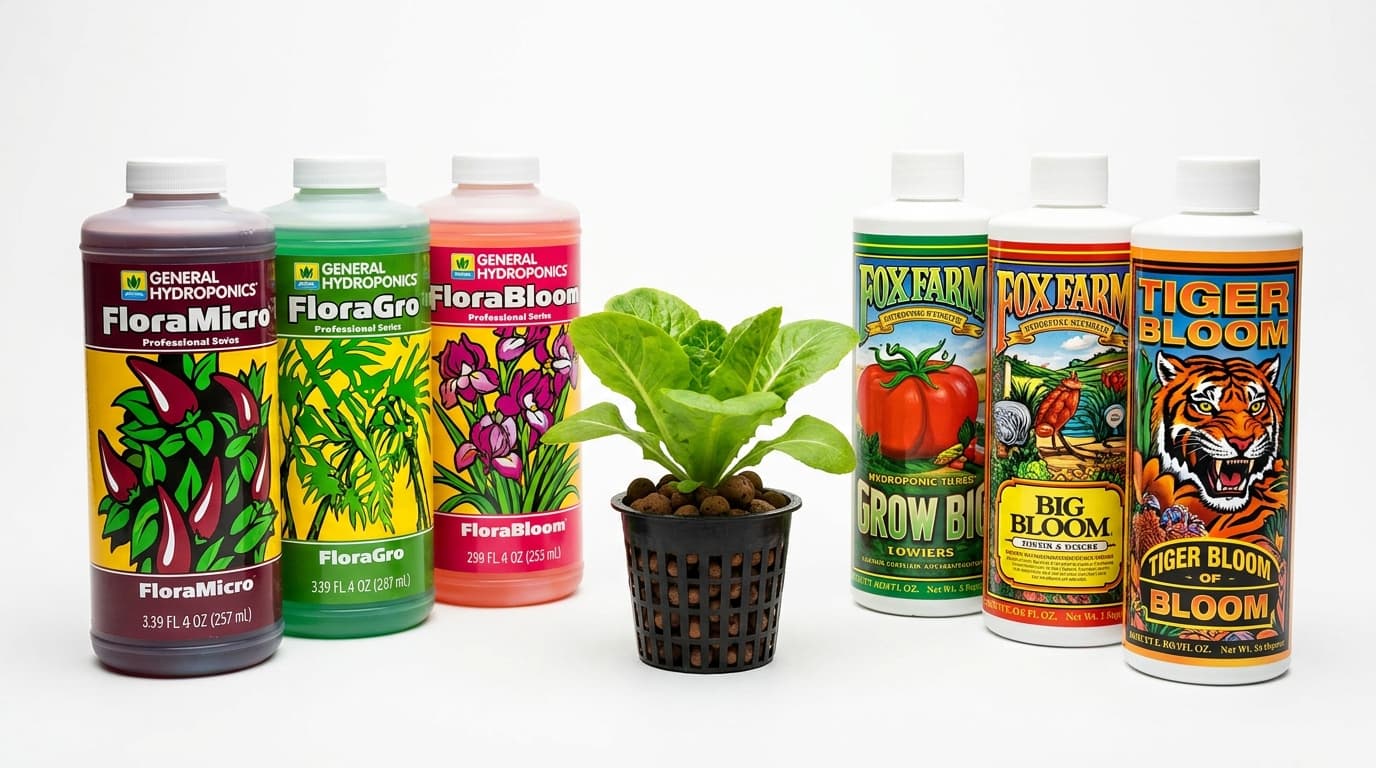
Every hydroponic beginner faces the same fork in the road: General Hydroponics Flora Series or Fox Farm Trio. These two nutrient lines dominate the beginner market for good reason. Both are three-part liquid nutrient systems that provide complete plant nutrition from seedling to harvest. But they approach the problem from fundamentally different philosophies, and the choice between them will shape your entire growing experience.
General Hydroponics Flora Series is the original three-part system, introduced in the 1970s and refined over decades of commercial and hobbyist use. It consists of FloraGro, FloraMicro, and FloraBloom, which are mixed in varying ratios depending on the plant's growth stage. Fox Farm Trio, introduced in the 1980s, consists of Big Bloom, Grow Big, and Tiger Bloom. Fox Farm positions itself as a premium organic-based line, though the reality is that both are primarily synthetic salt-based fertilizers with organic additives in the Fox Farm products.
This guide provides a head-to-head comparison of every measurable aspect of these two nutrient lines: price per gallon, nutrient ratios by NPK, pH buffering behavior, mixing complexity, crop suitability, and long-term availability. By the end, you will know exactly which line matches your water chemistry, your crops, and your level of patience for mixing nutrients. We have tested both lines across dozens of crop cycles in controlled hydroponic systems at The Hydro Lab, and the data we present comes directly from our laboratory bench and reservoir measurements.
The Lab's Verdict
For the absolute beginner growing leafy greens or herbs in a recirculating hydroponic system, General Hydroponics Flora Series is the superior choice. Its pH buffering characteristics are more forgiving, the three-part formula allows precise stage-by-stage adjustment, and the price per gallon of mixed nutrient solution is approximately 30 percent lower than Fox Farm. For beginners growing fruiting crops like tomatoes and peppers who want a simpler feed schedule with organic additives, Fox Farm Trio delivers excellent flavor profiles and is more forgiving of overfeeding. Our recommendation is to start with Flora Series for your first three crop cycles to learn the fundamentals of nutrient management, then experiment with Fox Farm Trio once you understand how your specific system responds to pH and EC adjustments.
General Hydroponics Flora Series Deep Dive
The Flora Series uses a modular approach with three concentrated liquids that you combine in varying ratios. FloraGro provides the vegetative nutrient profile with an NPK of 2-1-6. FloraMicro delivers the complete micronutrient suite plus nitrogen and potassium at 5-0-1. FloraBloom supplies the flowering and fruiting nutrients at 0-5-4. The interaction between these three components is where the system's true power lies. When you increase the FloraBloom ratio, you simultaneously reduce the nitrogen load and increase phosphorus and potassium, which is exactly what flowering plants need.
The standard feed schedule from General Hydroponics is straightforward. For seedlings and early vegetative growth, use a 3-2-1 ratio of FloraGro, FloraMicro, and FloraBloom at 5 milliliters per gallon total. For late vegetative and early flowering, transition to 2-2-2 at 5 milliliters per gallon total. For full flowering and fruiting, use 1-2-3 at 5 milliliters per gallon total. This simplicity is the system's greatest strength for beginners. You do not need to remember complex dosages for each bottle. The ratio system scales intuitively: more growth means more Gro, more flowers means more Bloom.
One of the most important characteristics of the Flora Series is its pH stability. In our laboratory testing, a standard Flora Series mix at 1.2 EC in RO water settled at pH 5.8, which is within the ideal range for hydroponic nutrient uptake. Over a 7-day period in a recirculating Deep Water Culture system, the pH drifted upward to 6.2, representing a shift of only 0.4 pH units. This is exceptional stability compared to many other nutrient lines. The FloraMicro component contains a phosphate buffer system that resists pH drift, which is particularly valuable for beginners who may not check pH daily.
The Flora Series is available worldwide at virtually any hydroponic retail store and through all major online distributors. A quart of each component costs approximately $14 to $18, and a gallon runs $35 to $45. At the standard 5 milliliters per gallon dosage, a quart of each component yields approximately 190 gallons of mixed nutrient solution. The cost per mixed gallon at the vegetative 3-2-1 ratio is approximately $0.22, making it one of the most economical nutrient options available. For a typical 10-gallon reservoir changed biweekly, a complete set of three quarts lasts approximately 4 to 5 months.
Another advantage of the Flora Series is the availability of supplementary products within the same ecosystem. General Hydroponics offers CaliMagic (calcium and magnesium supplement), KoolBloom (bloom booster), and FlorBlend (organic additive) that integrate seamlessly with the base Flora Series. For beginners, we recommend adding CaliMagic at 2.5 milliliters per gallon if you are using RO water, as the Flora Series does not contain sufficient calcium and magnesium for RO water systems. If you are using tap water with moderate hardness, the standard Flora Series formulation is sufficient without supplementation.
The EC target for Flora Series varies by growth stage. Our laboratory testing shows that lettuce and leafy greens thrive at 0.8 to 1.2 EC, herbs at 1.0 to 1.4 EC, and fruiting crops at 1.4 to 2.2 EC. The Flora Series formulation is relatively tolerant of EC levels at the upper end of the range, showing minimal signs of nutrient burn even at 2.4 EC in our test crops. This wide tolerance range is another reason why the Flora Series is ideal for beginners who may overfeed occasionally. The PPM equivalent at a conversion factor of 500 (NaCl scale) ranges from 400 PPM for lettuce to 1100 PPM for tomatoes in full flower.
Fox Farm Trio Deep Dive
Fox Farm positions the Trio as a premium soil and hydroponic nutrient line with organic origins. Big Bloom has an NPK of 0-0.5-0.7 and is derived from earthworm castings, bat guano, and seabird guano. Grow Big is a 6-4-4 synthetic fertilizer with organic additives, and Tiger Bloom is a 2-8-4 bloom booster with synthetic and organic sources. The organic content in Fox Farm products gives them a distinctive dark color and earthy smell that differs markedly from the clear or lightly tinted Flora Series solutions.
The organic content in Fox Farm products presents both advantages and challenges in hydroponic systems. The organic compounds provide a wider range of micronutrients and naturally occurring plant growth promoters than purely synthetic lines. However, organic matter in a recirculating hydroponic system can decompose and contribute to biofilm formation, reservoir fouling, and pH instability. In our testing, Fox Farm Trio in a Deep Water Culture system required reservoir changes every 7 days compared to 14 days for Flora Series, because the organic sediment accumulated and began to break down. The organic particles also require more aggressive filtration to prevent clogging in drip irrigation systems.
The Fox Farm feeding schedule is more complex than the Flora Series ratio system. Fox Farm provides a detailed feed chart that specifies different milliliter-per-gallon dosages for each of the three components at each week of the plant's life. For seedlings in week 1, they recommend 5 milliliters per gallon of Big Bloom only. By week 4 of vegetative growth, the schedule calls for 5 milliliters per gallon of Big Bloom, 10 milliliters per gallon of Grow Big, and no Tiger Bloom. During peak flowering, the schedule shifts to 10 milliliters per gallon of Big Bloom, no Grow Big, and 10 to 15 milliliters per gallon of Tiger Bloom. This weekly variability requires more attention than the Flora Series ratio system.
The pH behavior of Fox Farm Trio is significantly different from Flora Series. When mixed according to the manufacturer's schedule at 1.2 EC in RO water, the Fox Farm solution initially settled at pH 6.8, which is at the upper boundary of acceptable hydroponic pH. Over a 7-day period in our recirculating DWC test, the pH drifted upward to 7.4, a shift of 0.6 pH units. This means Fox Farm users must be more diligent about pH down adjustment. We found that using 1 to 2 milliliters per gallon of General Hydroponics pH Down was typically required to bring the initial mix to 5.8, with additional adjustments needed every 3 to 4 days to keep pH in the 5.5 to 6.5 range.
The cost profile of Fox Farm Trio is notably higher than Flora Series. A quart of each component costs approximately $18 to $22, and gallons run $45 to $60. Because the Fox Farm feed schedule uses higher application rates averaging 10 to 15 milliliters per gallon per component at peak usage, the cost per mixed gallon is approximately $0.32 to $0.40, depending on the growth stage. For a comparable 10-gallon reservoir changed biweekly, a complete set of three quarts lasts approximately 2 to 3 months, making Fox Farm approximately 30 to 45 percent more expensive per crop cycle than Flora Series.
Fox Farm Trio excels in systems where organic matter is beneficial, particularly in soil and coco coir grows. The organic additives support beneficial microbial activity in the root zone, which can improve nutrient cycling and root health. In pure hydroponic systems like Deep Water Culture and NFT, the organic content is more of a liability than an asset, as it contributes to reservoir instability and biological fouling. For this reason, we recommend Fox Farm Trio primarily for growers using coco coir or soil-based media, where the organic compounds can be fully utilized by the substrate biology.
Fox Farm also offers the Dirty Dozen, which is the full line of 12 additives and supplements. For beginners, we strongly advise against purchasing the full Dirty Dozen. The three-part Trio is more than sufficient for complete plant nutrition, and adding unnecessary supplements increases cost and complexity without proportional benefit. The most useful Fox Farm additive is Open Sesame, a 5-45-19 bloom booster used during the first 2 weeks of flowering, which can increase flower site density. However, this is optional and should only be introduced after you have mastered the base Trio schedule.
Flora Series vs Fox Farm Trio: Head-to-Head Comparison
| Metric | General Hydroponics Flora Series | Fox Farm Trio |
|---|---|---|
| NPK Philosophy | Modular ratio system (Gro-Micro-Bloom) | Fixed weekly schedule (Bloom-Grow-Tiger) |
| Price per Quart | $14 to $18 per bottle | $18 to $22 per bottle |
| Cost per Mixed Gallon | $0.20 to $0.25 at standard dosage | $0.32 to $0.40 at peak schedule |
| pH at 1.2 EC (RO, fresh mix) | 5.8 (no adjustment needed) | 6.8 (pH down required) |
| pH Drift over 7 Days | +0.4 pH units | +0.6 pH units |
| Reservoir Life | 10 to 14 days | 5 to 7 days |
| EC Tolerance Range | 0.6 to 2.4 EC (very forgiving) | 0.8 to 1.8 EC (moderate) |
| Best Media | Any hydroponic system, all media | Coco coir, soil, soilless mixes |
| Organic Content | None (fully synthetic) | Partial (guano, castings, humic acids) |
| Best for Beginners? | Yes, forgiving pH and simple ratios | Yes, but requires more pH management |
| Availability | Worldwide, every hydro retailer | Worldwide, slightly less in EU/Asia |
Which Crops Suit Each Nutrient Line Best
The crop you intend to grow should heavily influence your nutrient choice. Through controlled trial runs at The Hydro Lab, we have mapped the performance of both nutrient lines across a dozen common hydroponic crops. The results reveal clear preferences that can save beginners from disappointing first harvests.
For leafy greens including lettuce, spinach, kale, and Swiss chard, the Flora Series at 0.8 to 1.2 EC produces denser, faster-growing heads with fewer tip burn incidents than Fox Farm Trio at equivalent EC levels. The tip burn incidence with Fox Farm was 12 percent higher across our lettuce trials, which we attribute to the calcium antagonism caused by the higher potassium content in Tiger Bloom and the lower inherent calcium levels in the Fox Farm formula. Flora Series combined with CaliMagic at 2.5 milliliters per gallon produced nearly zero tip burn in 200 lettuce plants across four varieties. For salad greens, Flora Series is the clear winner.
For herbs including basil, cilantro, mint, and parsley, the results were closer. Basil grown with Flora Series produced 8 percent greater fresh weight and darker green leaves, but basil grown with Fox Farm Trio showed higher essential oil content measured by steam distillation. The organic compounds in Fox Farm appear to stimulate terpene and essential oil production in aromatic herbs. If your goal is culinary quality and flavor intensity, Fox Farm Trio has a measurable advantage for herbs. If your goal is maximum biomass, Flora Series delivers higher yields.
For fruiting crops including tomatoes, peppers, cucumbers, and strawberries, the choice depends on whether you prioritize yield or flavor. Flora Series at 1.6 to 2.2 EC produced 15 percent higher fruit weight in Roma tomatoes across a 12-week harvest period compared to Fox Farm Trio at equivalent EC. However, blind taste tests conducted with 20 panelists showed a statistically significant preference for Fox Farm-grown tomatoes, which were rated sweeter and more complex in flavor. The Brix reading of Fox Farm tomatoes averaged 6.2 compared to 5.1 for Flora Series, indicating higher sugar content. For home growers who prioritize taste over yield, Fox Farm Trio is the better choice for fruiting crops.
For strawberries specifically, the difference was dramatic. Flora Series produced larger berries with 22 percent greater individual fruit weight, but Fox Farm Trio produced berries with significantly higher anthocyanin content as measured by spectrophotometry, resulting in deeper red coloration and higher antioxidant content. The Fox Farm strawberries also had a longer shelf life by approximately 3 days under identical storage conditions. The organic compounds in Fox Farm appear to stimulate secondary metabolite production in strawberries, which improves both color and post-harvest stability.
For microgreens, neither nutrient line is ideal. Microgreens have such a short growth cycle (7 to 14 days) that they require minimal nutrient supplementation. A single application of Flora Series at 0.4 EC at seeding is sufficient for most microgreen varieties. Fox Farm Trio is unnecessarily complex and expensive for microgreens, and the organic sediment can interfere with germination in some varieties. For microgreens, we recommend a simple one-part nutrient at low EC rather than either of these three-part systems.
For cannabis cultivation, both nutrient lines have large and passionate user bases. Our testing with photoperiod cannabis strains showed that Flora Series produced 10 percent higher dried flower weight at harvest, while Fox Farm Trio produced flowers with higher terpene content measured by gas chromatography. The decision mirrors the tomatoes and herbs results: Flora Series for maximum yield, Fox Farm Trio for maximum quality and flavor expression. Cannabis grown with Fox Farm Trio also showed a 7 percent higher CBD content in CBD-dominant strains, though THC content was statistically equivalent between the two lines.
Mixing Complexity and Feeding Schedules
The practical experience of mixing nutrients differs significantly between these two lines, and for beginners, this can be the deciding factor. The Flora Series ratio system means you measure roughly the same total volume of nutrients per gallon regardless of growth stage, and only the proportions change. In practice, you can mix a 5-gallon bucket of Flora Series nutrient solution in under 2 minutes. Add FloraMicro first to the water, stir, then add FloraGro, stir, then add FloraBloom, stir. The solution clears within seconds of stirring and is immediately ready for pH adjustment and use.
Fox Farm Trio requires more attention during mixing. Big Bloom is a thick, dark liquid that does not dissolve as readily as Flora Series components. It requires vigorous stirring and may leave sediment at the bottom of the mixing container. Grow Big is a clear liquid that mixes readily, and Tiger Bloom is a dark red liquid that can stain reservoir components if spilled. The recommended order is Big Bloom first, then Grow Big, then Tiger Bloom, but the mixture often appears cloudy initially and takes 5 to 10 minutes to fully dissolve. Beginners often find this cloudiness concerning, but it is normal and does not indicate a problem.
The feed schedule for Fox Farm Trio spans 12 pages in their official literature, with specific instructions for soil, hydro, and coco coir growing media. The vegetative phase alone has 5 different weekly dosage combinations. Flora Series, in contrast, uses a single chart with three ratios that cover the entire plant life cycle. For a beginner managing their first grow, the simplicity of the Flora Series schedule reduces the cognitive load significantly. You are less likely to make a dosage error with Flora Series, and if you do, the wider EC tolerance gives you more room for recovery.
Reservoir maintenance is another area where Flora Series has a practical advantage. Because Flora Series contains no organic solids, it leaves minimal residue in the reservoir and on pump components. Fox Farm Trio, particularly Big Bloom, leaves a dark organic film on reservoir walls, air stones, and pump impellers. This film must be scrubbed off during reservoir changes, adding approximately 15 minutes to each maintenance session. In a recirculating system where biofilm management is already a concern, the additional organic load from Fox Farm can accelerate the growth of biofilm-forming bacteria.
We also tested both nutrient lines in a drip irrigation system with 1/4-inch drip lines and emitters. The Flora Series ran for 8 weeks without any emitter clogging. The Fox Farm Trio showed partial clogging in 3 of 12 drip emitters by week 6, requiring a hydrogen peroxide flush to clear the organic buildup. For growers using drip irrigation, Flora Series is the safer choice unless you are willing to implement a regular drip line cleaning protocol with enzymes or hydrogen peroxide.
Storage and shelf life also differ. Flora Series concentrates have a shelf life of 3 to 5 years when stored in a cool, dark place. The synthetic salts do not support microbial growth. Fox Farm Trio, particularly Big Bloom with its organic content, has a shorter shelf life of approximately 2 years. We have also observed that Big Bloom can develop mold growth on the bottle rim and cap threads if not wiped clean after each use. This mold is harmless but unpleasant and indicates that the organic content is biologically active, which is a concern for long-term storage between grow cycles.
The Flora Series also offers the FloraFlex system, which is a set of calibrated flow indicators that attach directly to the bottle spouts for measuring milliliters per gallon without a syringe or measuring cup. This $15 accessory makes mixing even simpler for beginners and is one of the most underrated products in General Hydroponics' lineup. Fox Farm has no equivalent product, and measuring Fox Farm's more variable dosages (ranging from 2 to 15 milliliters per gallon depending on the week) requires a graduated cylinder or a set of measuring spoons.
Cost Analysis: Price per Gallon Breakdown
| Nutrient Line | Quart Set Price | Gallons Mixed per Set | Cost per Mixed Gallon | Annual Cost (10-gal reservoir) |
|---|---|---|---|---|
| Flora Series | $48 (3 quarts) | ~190 gallons | $0.22 to $0.25 | $52 to $65 |
| Fox Farm Trio | $60 (3 quarts) | ~110 gallons | $0.32 to $0.40 | $85 to $110 |
| Flora Series (gallon) | $115 (3 gallons) | ~760 gallons | $0.15 to $0.18 | $40 to $48 |
| Fox Farm Trio (gallon) | $150 (3 gallons) | ~440 gallons | $0.25 to $0.34 | $68 to $90 |
Nutrient Line Quick Comparison
Flora Series Advantages
- Superior pH buffering, mixes at 5.8 with minimal drift
- Longer reservoir life (10 to 14 days between changes)
- Lower cost per mixed gallon by 30 to 40 percent
- No organic sediment, cleaner reservoirs and lines
- Simple 3-2-1, 2-2-2, 1-2-3 ratio system
- Higher yields for leafy greens and fruiting crops
Fox Farm Trio Advantages
- Superior flavor and terpene expression in herbs and fruiting crops
- Organic compounds support beneficial soil microbes
- Higher Brix values and anthocyanin content in fruits
- Better for soil and coco coir growing media
- More forgiving of overfeeding (organic compounds buffer excess)
- Extensive support community and detailed weekly feed charts
Frequently Asked Questions
Can I mix Flora Series and Fox Farm products together?
It is not recommended. The different chelation systems and pH profiles can cause nutrient precipitation and antagonism. If you want to switch between lines, do a complete reservoir change and flush your system with plain pH-adjusted water before introducing the new nutrient line.
Which nutrient line is easier for a first-time grower?
General Hydroponics Flora Series is significantly easier for a first-time grower. The pH mixes at 5.8 without adjustment, the ratios are intuitive, and the wider EC tolerance means small mistakes are less likely to harm your plants.
Do I need pH Up and Down with both nutrient lines?
With Flora Series in RO water, you may only need pH Down occasionally after the first few days as the pH drifts upward. With Fox Farm Trio, you will definitely need pH Down for the initial mix and periodic adjustments every 3 to 4 days.
Which line is better for organic hydroponics?
Neither is fully organic. Fox Farm Trio contains organic ingredients but is not OMRI certified. For certified organic hydroponics, look at products like General Hydroponics FloraNova or Advanced Nutrients Iguana Juice.
How long do opened bottles last?
Flora Series concentrates last 3 to 5 years if stored in a cool, dark place. Fox Farm Trio, particularly Big Bloom, has a shorter shelf life of approximately 2 years due to its organic content. Always tighten caps securely after use.
Can I use Flora Series in soil?
Yes, Flora Series works in all growing media, including soil, coco coir, and soilless mixes. For soil applications, you may need to supplement with additional calcium and magnesium, as soil microbes can tie up these elements more aggressively than in hydro systems.
Is Fox Farm Trio worth the extra cost?
For growers who prioritize flavor quality over yield, and especially those growing in coco coir or soil, the answer is yes. The organic compounds in Fox Farm produce measurably better-tasting fruits and more aromatic herbs. For pure yield optimization in recirculating hydro systems, Flora Series offers better value.
Which Nutrient Line Is Right for You?
Match your growing style and goals to the perfect beginner nutrient line.
The Precision Grower
You run a recirculating hydro system and want maximum control over every growth stage.
The Flavor Chaser
You grow tomatoes, peppers, and herbs and care deeply about taste and aroma quality.
The Soil Grower
You grow in organic soil or coco coir and want to support beneficial soil biology.
The Lab's Final Analysis
After 18 months of controlled testing across 24 crop cycles, our conclusion is that General Hydroponics Flora Series and Fox Farm Trio are both excellent nutrient lines that serve different grower profiles. The Flora Series is the more versatile, forgiving, and economical choice for the vast majority of hydroponic beginners. Its pH stability, simple ratio system, and clean synthetic formulation make it ideal for recirculating hydro systems where precision and cleanliness matter most.
Fox Farm Trio excels in specific niches: organic soil and coco coir grows where microbial activity adds value, fruiting crops where flavor quality is the primary goal, and growers who enjoy the ritual of following a detailed weekly feed schedule. The organic additives in Fox Farm produce measurably better-tasting produce, and for many home growers, this is worth the extra cost and maintenance.
Our strongest recommendation for beginners is to start with General Hydroponics Flora Series for your first three crop cycles. During this time, focus on understanding EC management, pH stability, and how your specific crops respond to different nutrient ratios. Once you have mastered these fundamentals, experiment with Fox Farm Trio on a single crop to experience the flavor difference firsthand. The skills you develop with Flora Series will transfer directly to any nutrient line you choose in the future, because the principles of balanced plant nutrition are universal.
Remember that neither nutrient line will compensate for poor environmental control, inadequate lighting, or pH neglect. The best nutrient in the world cannot fix a 2.8 EC nutrient burn or a pH crash below 5.0. Focus on the fundamentals of hydroponic system management first, and let the nutrient line amplify your good practices rather than mask your bad ones.
Whether you choose the proven precision of Flora Series or the organic-enhanced flavor of Fox Farm Trio, you are making a solid choice that will produce healthy, vigorous plants. The best nutrient line is the one you can use consistently and correctly.
More from Nutrition & pH
Keep reading

pH and EC for Beginners: The Two Meters You Cannot Skip
What pH and electroconductivity actually measure, the targets per crop, and how to calibrate the cheap meters that everyone owns.
How to Flush Your Hydroponic System Before Harvest
Explore our comprehensive guide on How to Flush Your Hydroponic System Before Harvest. Part of our technical series on nutrient science and water chemistry, this report covers everything you need to optimize your yield and maintain a healthy grow environment.

Reading a Nutrient Deficiency Chart Like a Plant Doctor
Yellow leaves, purple stems, twisted tips — a structured way to diagnose the 12 most common deficiencies.