
VPD Calculator & Interactive Chart for Indoor Growers
Inputs
You're inside the target band (1.20–1.40 kPa). Hold conditions steady.
Leaf VPD
1.26 kPa
What the plant actually feels
Air VPD
1.47 kPa
Standard ambient VPD
Leaf temp
76.0°F
Offset 2 °F
Live VPD chart
kPa per cell| RH % \ Temp | 59° | 63° | 66° | 70° | 73° | 77° | 81° | 84° | 88° | 91° | 95° | |||||||||||
|---|---|---|---|---|---|---|---|---|---|---|---|---|---|---|---|---|---|---|---|---|---|---|
| 90% | 0.2 | 0.2 | 0.2 | 0.2 | 0.2 | 0.2 | 0.2 | 0.3 | 0.3 | 0.3 | 0.3 | 0.3 | 0.4 | 0.4 | 0.4 | 0.4 | 0.4 | 0.5 | 0.5 | 0.5 | 0.6 | |
| 85% | 0.3 | 0.3 | 0.3 | 0.3 | 0.3 | 0.4 | 0.4 | 0.4 | 0.4 | 0.4 | 0.5 | 0.5 | 0.5 | 0.6 | 0.6 | 0.6 | 0.7 | 0.7 | 0.8 | 0.8 | 0.8 | |
| 80% | 0.3 | 0.4 | 0.4 | 0.4 | 0.4 | 0.5 | 0.5 | 0.5 | 0.6 | 0.6 | 0.6 | 0.7 | 0.7 | 0.8 | 0.8 | 0.8 | 0.9 | 1.0 | 1.0 | 1.1 | 1.1 | |
| 75% | 0.4 | 0.5 | 0.5 | 0.5 | 0.5 | 0.6 | 0.6 | 0.7 | 0.7 | 0.7 | 0.8 | 0.8 | 0.9 | 0.9 | 1.0 | 1.1 | 1.1 | 1.2 | 1.3 | 1.3 | 1.4 | |
| 70% | 0.5 | 0.5 | 0.6 | 0.6 | 0.7 | 0.7 | 0.7 | 0.8 | 0.8 | 0.9 | 1.0 | 1.0 | 1.1 | 1.1 | 1.2 | 1.3 | 1.3 | 1.4 | 1.5 | 1.6 | 1.7 | |
| 65% | 0.6 | 0.6 | 0.7 | 0.7 | 0.8 | 0.8 | 0.9 | 0.9 | 1.0 | 1.0 | 1.1 | 1.2 | 1.2 | 1.3 | 1.4 | 1.5 | 1.6 | 1.7 | 1.8 | 1.9 | 2.0 | |
| 60% | 0.7 | 0.7 | 0.8 | 0.8 | 0.9 | 0.9 | 1.0 | 1.1 | 1.1 | 1.2 | 1.3 | 1.3 | 1.4 | 1.5 | 1.6 | 1.7 | 1.8 | 1.9 | 2.0 | 2.1 | 2.2 | |
| 55% | 0.8 | 0.8 | 0.9 | 0.9 | 1.0 | 1.1 | 1.1 | 1.2 | 1.3 | 1.3 | 1.4 | 1.5 | 1.6 | 1.7 | 1.8 | 1.9 | 2.0 | 2.1 | 2.3 | 2.4 | 2.5 | |
| 50% | 0.9 | 0.9 | 1.0 | 1.0 | 1.1 | 1.2 | 1.2 | 1.3 | 1.4 | 1.5 | 1.6 | 1.7 | 1.8 | 1.9 | 2.0 | 2.1 | 2.2 | 2.4 | 2.5 | 2.7 | 2.8 | |
| 45% | 0.9 | 1.0 | 1.1 | 1.1 | 1.2 | 1.3 | 1.4 | 1.5 | 1.5 | 1.6 | 1.7 | 1.8 | 2.0 | 2.1 | 2.2 | 2.3 | 2.5 | 2.6 | 2.8 | 2.9 | 3.1 | |
| 40% | 1.0 | 1.1 | 1.2 | 1.2 | 1.3 | 1.4 | 1.5 | 1.6 | 1.7 | 1.8 | 1.9 | 2.0 | 2.1 | 2.3 | 2.4 | 2.5 | 2.7 | 2.9 | 3.0 | 3.2 | 3.4 | |
| 35% | 1.1 | 1.2 | 1.3 | 1.3 | 1.4 | 1.5 | 1.6 | 1.7 | 1.8 | 1.9 | 2.1 | 2.2 | 2.3 | 2.5 | 2.6 | 2.8 | 2.9 | 3.1 | 3.3 | 3.5 | 3.7 | |
| 30% | 1.2 | 1.3 | 1.4 | 1.4 | 1.5 | 1.6 | 1.7 | 1.9 | 2.0 | 2.1 | 2.2 | 2.4 | 2.5 | 2.6 | 2.8 | 3.0 | 3.1 | 3.3 | 3.5 | 3.7 | 3.9 | |
Plotted point uses leaf temperature (76.0°F), which is what plants actually feel.
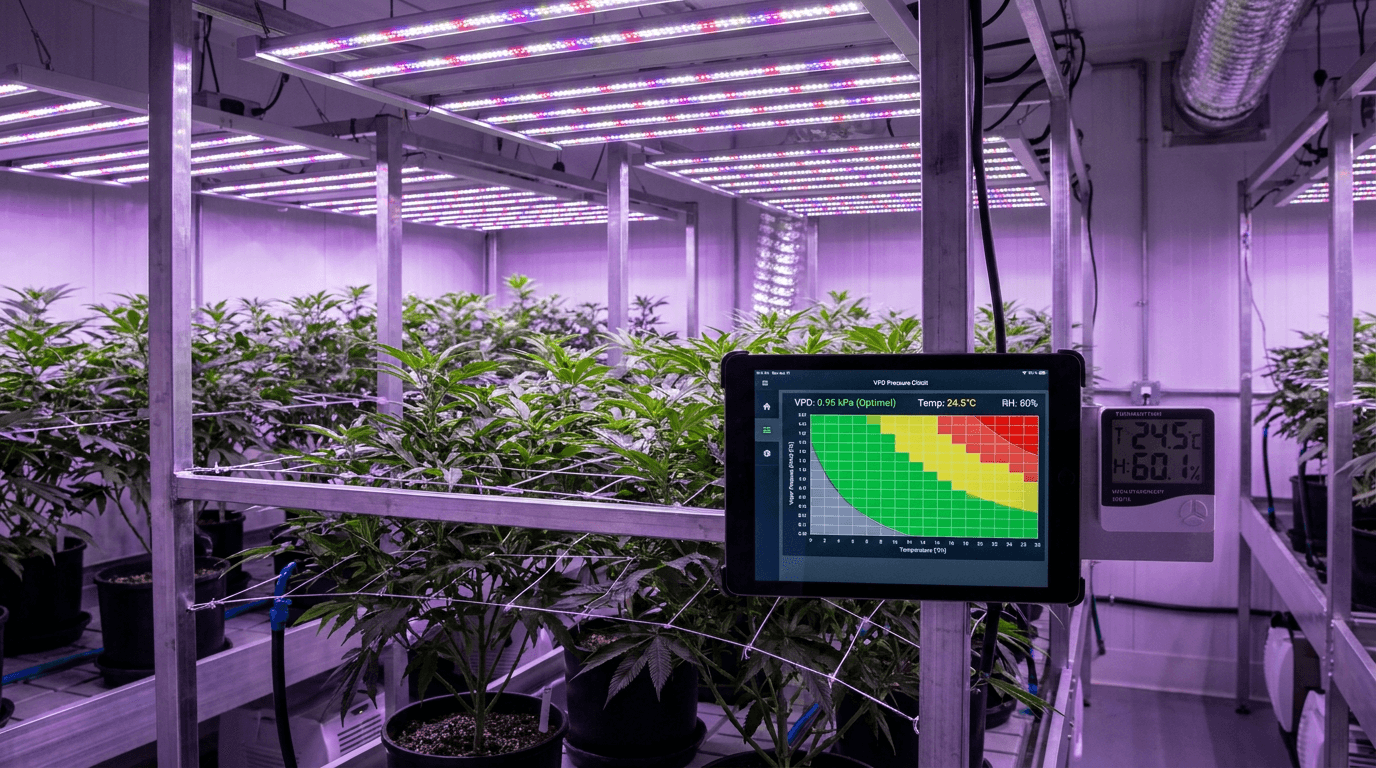
Vapor Pressure Deficit (VPD) is the single most important environmental metric that most indoor growers do not measure. Temperature and humidity are reported individually by every hygrometer on the market, but their combined effect on plant transpiration is what determines growth rate, nutrient uptake, and susceptibility to disease. VPD combines these two measurements into one actionable number that tells you exactly how hard your plants are working to move water from their roots to their leaves.
We built a free, open-source VPD calculator that goes beyond the basic tools you will find online. Our calculator computes leaf-temperature-aware VPD using the Tetens equation, provides crop-specific target bands for cannabis, lettuce, tomato, basil, strawberry, pepper, and cucumber across multiple growth stages, and includes a live heatmap chart that shows your current position relative to your crop's ideal range. The tool also generates plain-language recommendations that tell you exactly what to adjust, whether it is humidity, temperature, or both.
The calculator is available as a standalone web application and the source code is published on GitHub for transparency and community contribution. You can use it online, download it, or inspect the math behind every calculation.
The Lab's Verdict
Air VPD is what your hygrometer tells you. Leaf VPD is what the plant actually experiences. Under LED lighting, leaves run cooler than the surrounding air, which pushes the real VPD higher than what standard calculators report. Always tune to leaf VPD against your crop's growth-stage band. Our calculator does this automatically and tells you exactly what to change when you are out of range.
What VPD Actually Is and Why It Matters
Vapor pressure deficit is the difference between the amount of moisture the air can hold at a given temperature and the amount it is actually holding. When air is warm, its molecular kinetic energy increases, allowing it to hold more water vapor before reaching saturation. When air is cool, its capacity to hold water decreases. VPD quantifies this difference in kilopascals, measuring how much additional water the air could absorb before reaching one hundred percent relative humidity.
This matters because plants transpire through microscopic pores on their leaves called stomata. Transpiration is the engine that drives nutrient transport: as water evaporates from the leaf surface, it creates a negative pressure gradient that pulls water and dissolved nutrients from the roots through the xylem and into the shoots and leaves. The rate of transpiration is determined by the difference in water vapor concentration between the inside of the leaf, which is maintained at essentially one hundred percent relative humidity, and the surrounding air. That difference is the VPD.
When VPD is too low, typically below 0.4 kilopascals, the air is nearly saturated with moisture. Transpiration slows to a crawl because there is no gradient for water to escape the leaf. Calcium transport is the first process to suffer because calcium moves exclusively through the transpiration stream. Blossom end rot in tomatoes and tipburn in lettuce are both symptoms of low VPD conditions. The stagnant, humid air also promotes the germination of fungal pathogens including Botrytis and powdery mildew. Stomata remain fully open, but the plant cannot transpire efficiently.
When VPD is too high, typically above 1.8 kilopascals, the air is aggressively dry. The plant's stomata close to conserve water, halting the influx of carbon dioxide and stopping photosynthesis. Leaves begin to curl at the edges, nutrient uptake ceases because the transpiration stream has been interrupted, and the plant enters a defensive metabolic state that prioritizes survival over growth. Extended periods of high VPD cause leaf necrosis, reduced yields, and increased susceptibility to spider mites, which thrive in dry conditions.
The ideal VPD range for most hydroponic crops during their vegetative phase is 0.8 to 1.2 kilopascals. During flowering and fruiting, the range shifts upward to 1.2 to 1.6 kilopascals to reduce humidity-related disease pressure while maintaining adequate transpiration for nutrient delivery to developing fruits. Seedlings and clones require a much lower VPD of 0.4 to 0.8 kilopascals to prevent desiccation while their root systems are still developing.
Leaf Temperature: The Missing Variable
Every standard VPD calculator you will find online asks for air temperature and relative humidity. These two inputs produce what is known as air VPD, which is the VPD calculated using the ambient air temperature as the leaf temperature proxy. The assumption is that leaf temperature equals air temperature. This assumption is almost always wrong, and the error can shift your VPD reading by 0.3 to 0.6 kilopascals, enough to move you from the center of your target band to well outside it.
Under light-emitting diode grow lights, leaves typically run two to four degrees Fahrenheit cooler than the surrounding air. The reason is that LEDs produce very little infrared radiation compared to high-pressure sodium or metal halide lamps. HPS lamps emit significant amounts of infrared energy, which heats leaf tissue directly through radiative transfer. LED fixtures, particularly bar-style and quantum board designs, emit minimal infrared, so leaves lose heat primarily through transpiration and convection. The result is that an LED-grown leaf at 78 degrees Fahrenheit air temperature may actually be at 74 to 76 degrees Fahrenheit.
This seemingly small temperature difference has a significant impact on VPD calculations. The saturation vapor pressure of water increases exponentially with temperature according to the Clausius-Clapeyron relationship. A two-degree Fahrenheit leaf temperature drop reduces the saturation vapor pressure by approximately six percent, which means the leaf VPD is higher than the air VPD. At standard room conditions of 78 degrees Fahrenheit and 55 percent relative humidity, the air VPD is approximately 1.12 kilopascals. With a two-degree leaf offset under LED, the leaf VPD rises to approximately 1.28 kilopascals. If you are targeting 1.2 to 1.4 kilopascals for early flowering, that difference moves you from within range to borderline high.
Our calculator handles this automatically. You select your light source from three options: standard LED, high-intensity LED above 1500 micromoles per square meter per second, or HPS and metal halide. Each option applies a scientifically derived default leaf-temperature offset. You can also override the offset manually if you have measured your leaf temperature directly with an infrared thermometer, which is the most accurate method.
Crop Presets and Target Bands
Different crops have different VPD requirements based on their evolutionary origins, leaf morphology, and metabolic rates. A plant that evolved in the tropical understory requires high humidity and low VPD. A plant that evolved in a Mediterranean climate thrives at higher VPD with drier air. Our calculator includes presets for nine crop categories spanning the most common indoor hydroponic plants, each with growth-stage-specific target bands derived from published research and validated through our own grow trials.
| Crop / Stage | Target VPD (kPa) | Rationale |
|---|---|---|
| Cannabis - Seedling / Clone | 0.4 - 0.8 | Undeveloped roots cannot keep up with high transpiration. High humidity reduces water stress during root establishment. |
| Cannabis - Vegetative | 0.8 - 1.2 | Drives strong leaf expansion and nutrient uptake for structural growth. The sweet spot for rapid vegetative development. |
| Cannabis - Early Flower | 1.2 - 1.4 | Transition stage that pushes vertical stretch and bud initiation. Higher VPD begins to limit foliar disease risk. |
| Cannabis - Late Flower | 1.4 - 1.6 | Maximum VPD reduces humidity-related bud rot and Botrytis. Dense buds require aggressive air movement at this stage. |
| Lettuce | 0.8 - 1.0 | Tipburn risk increases sharply above 1.0 kPa due to impaired calcium transport to leaf margins. |
| Tomato - Vegetative | 0.8 - 1.2 | Standard vegetative range for solanaceous crops. Supports stem elongation and leaf development. |
| Tomato - Fruiting | 1.0 - 1.4 | Supports calcium movement to developing fruit. Critical for blossom end rot prevention. |
| Basil | 0.7 - 1.1 | Soft succulent tissue is sensitive to high VPD. Lower end prevents leaf edge necrosis in fast-growing basil. |
| Strawberry | 0.6 - 1.0 | Cool-loving crop with thin leaves. High VPD scorches leaf margins and reduces fruit set. |
| Pepper | 0.8 - 1.2 | Similar to tomato. Peppers are moderately tolerant of VPD variation but blossom drop increases above 1.4 kPa. |
| Cucumber | 0.8 - 1.2 | High water demand crop. Low VPD can cause edema on leaves; high VPD causes wilting and fruit deformity. |
How the Calculator Works
The calculator implements the standard psychrometric VPD computation using the Tetens equation for saturation vapor pressure. This is the same equation used by professional horticultural environmental controllers and is considered the industry standard for VPD calculation in the 10 to 35 degree Celsius temperature range that covers virtually all indoor growing environments.
The computation proceeds in four steps. First, the air temperature is converted to Celsius if entered in Fahrenheit. Second, the leaf temperature is estimated by applying the light-source-specific offset to the air temperature. For LED, the default offset is two degrees Fahrenheit cooler than air. For high-intensity LED above 1500 micromoles per square meter per second, the offset is four degrees Fahrenheit. For HPS and metal halide, the leaf is approximately two degrees Fahrenheit warmer than air.
Third, the saturation vapor pressure is calculated for both air temperature and leaf temperature using the Tetens equation. Fourth, the actual vapor pressure is calculated by multiplying the air SVP by the relative humidity expressed as a decimal. The air VPD is the difference between the air SVP and the actual vapor pressure. The leaf VPD is the difference between the leaf SVP and the actual vapor pressure. The calculator then compares the leaf VPD against the selected crop's target band and generates a recommendation.
The live heatmap chart displays a gridded VPD matrix with temperature on the horizontal axis and relative humidity on the vertical axis. Each cell in the grid is color-coded according to the crop's target band: blue for too low, green for on target, amber for borderline high, and red for too high. Your current position is plotted as a pulsing dot, giving you an immediate visual representation of where you stand and which direction to move.
Frequently Asked Questions
Air VPD vs leaf VPD — which one should I use?
Leaf VPD. The plant does not feel air temperature. It responds to the gradient between its own saturated internal water vapor and the air around it. Under LED, leaves run cooler than air, so air VPD readings understate the true value the plant experiences.
What leaf-temperature offset should I use?
Default is 2F cooler than air under standard LED, 4F cooler at high intensities above 1500 umol/m2/s, and approximately 2F warmer under HPS. For best accuracy, measure leaf temperature directly with an IR thermometer.
Why is my crop unhappy even when VPD is on target?
VPD assumes uniform airflow and healthy roots. Check for microclimates, root-zone temperature (65-72F), and nutrient EC. VPD is necessary but not sufficient for optimal growth.
How do I lower VPD in my grow tent?
Increase relative humidity using a cool-mist ultrasonic humidifier. For small tents, a 20-dollar evaporative humidifier works. For larger spaces, use a unit with a built-in humidistat. Alternatively, lower air temperature slightly.
How do I raise VPD in my grow tent?
Decrease relative humidity by increasing exhaust fan speed. If ambient room humidity is too high, use a compressor-based dehumidifier. Increasing temperature also raises VPD.
How accurate is the Tetens equation?
The Tetens equation has an accuracy of plus or minus 0.05 kPa over 0-35 degrees Celsius. Sensor accuracy, not the equation, is the limiting factor. Consumer sensors typically have +/- 0.3C and +/- 2% RH accuracy.
Can I print the VPD chart for reference?
Yes. Click the print button and the browser print dialog opens. The inputs panel and navigation hide automatically so the chart and reference table print cleanly on one page.
Start Using the VPD Calculator
Three ways to use this tool, depending on your grow style.
The Casual Grower
Check VPD once a day when you inspect your plants. Use the crop presets and let the recommendation tell you what to adjust.
The Data-Driven Grower
Log VPD readings daily alongside EC, pH, and temperature. Use the leaf-offset override with your IR thermometer readings.
The Automation Engineer
Integrate the VPD formula into your Home Assistant or Arduino controller. The source code is open and documented.
The Lab's Final Analysis
Vapor pressure deficit is not a complex concept, but it is one that is frequently misunderstood and even more frequently ignored by indoor growers. The relationship between temperature, humidity, and plant transpiration is fundamental to plant physiology, and measuring it through VPD gives you a single actionable number that captures the environmental drivers of growth rate, nutrient uptake, and disease susceptibility.
The calculator we built and published as open-source software represents our commitment to making precision horticulture accessible to every grower. The same Tetens equation that runs in commercial greenhouse control systems costing thousands of dollars runs in this free tool. The leaf-temperature awareness that most online calculators ignore is built into every computation.
Start using the calculator today. Measure your temperature and humidity at canopy level, select your crop and light source, and read the recommendation. Make one adjustment at a time, wait twenty-four hours, and measure again. Within one week of daily VPD management, you will see measurable improvements in growth rate, leaf health, and overall plant vigor.
Bookmark the calculator. Measure daily. Adjust one variable at a time. Your plants will reward you with faster growth, higher yields, and fewer problems.
More from Lighting & Climate
Keep reading
How to Calculate Electricity Costs for Your Indoor Garden
Explore our comprehensive guide on How to Calculate Electricity Costs for Your Indoor Garden. Part of our technical series on lighting and climate technology, this report covers everything you need to optimize your yield and maintain a healthy grow environment.
LED Grow Light Buying Guide 2026: PPFD, Spectrum, and the Spec Sheets That Lie
How to read a grow-light datasheet, why 'equivalent wattage' is meaningless, and three lights we'd actually buy this year.
Controlling Humidity in Grow Tents: Best Dehumidifiers
Complete guide to dehumidifiers for hydroponic grow tents. Compressor vs desiccant, sizing for 2x2 to 5x5 tents, placement and drainage, product recommendations, and integration with environmental controllers for mold-free harvests.