
Controlling Humidity in Grow Tents: Best Dehumidifiers
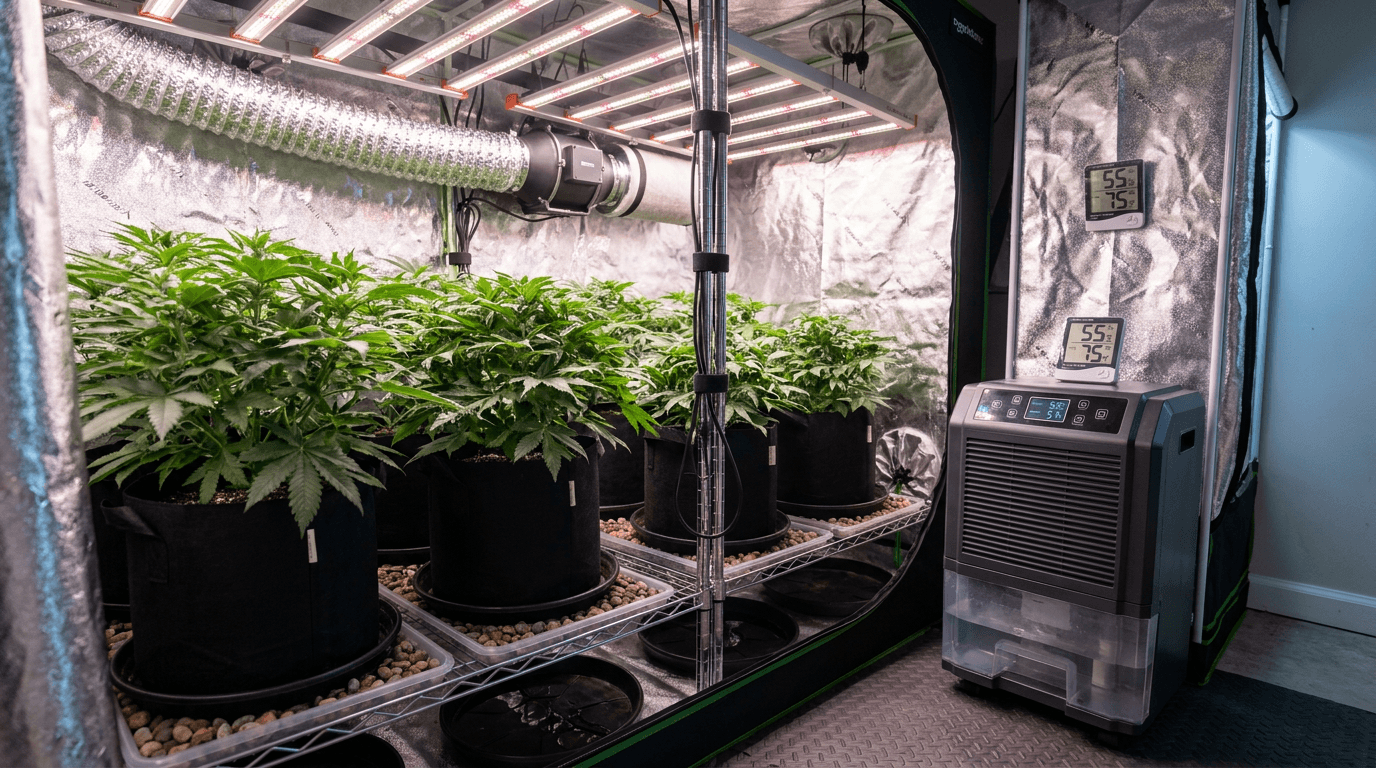
Humidity control is the most underestimated environmental variable in indoor hydroponic growing. Temperature gets attention because it is easy to measure and uncomfortable when wrong. Nutrients get attention because they directly affect plant health and are adjusted frequently. Humidity, by contrast, is a silent variable that causes problems gradually. Leaves curl, stems soften, buds develop gray mold, and the grower often does not connect these symptoms to the relative humidity readings that have been creeping higher over the past week.
A dehumidifier is the most effective tool for managing humidity in a sealed or semi-sealed grow tent. Unlike ventilation, which exchanges humid indoor air with outdoor air of unknown and variable humidity, a dehumidifier actively removes water vapor from the air and maintains a consistent vapor pressure deficit regardless of outdoor conditions. The right dehumidifier, sized and positioned correctly, transforms an environment that is prone to mold, bud rot, and nutrient lockout into one that supports vigorous transpiration and disease-free growth.
This guide covers the physics of humidity in grow tents, how to calculate the dehumidifier capacity you actually need, the difference between compressor-based and desiccant dehumidifiers, specific product recommendations for small and large tents, placement and drainage strategies, and how to integrate dehumidification with your existing climate control system.
The Lab's Verdict
Most home growers buy a dehumidifier that is too small for their space. A 30-pint dehumidifier is adequate for a 2x4 tent in veg but will struggle to keep up during late flower when plants are transpiring at maximum rate and the target humidity drops to forty percent. For a 4x4 tent or larger, buy a 50-pint or 70-pint unit from the start. Oversizing a dehumidifier costs fifty to one hundred dollars more upfront but prevents the frustration of watching humidity climb into the danger zone during the most critical phase of your grow cycle. We recommend the Midea MAD50C1ZWS for most 4x4 setups and the Frigidaire FFAP5033W1 for larger tents or sealed rooms.
The Physics of Humidity in a Grow Tent
Every plant in your grow tent is a water pump. Through transpiration, roots absorb nutrient solution, which travels up the xylem and evaporates from the leaf surface into the surrounding air. A single mature tomato plant in full flower can transpire one to two liters of water per day. A 4x4 tent with six mature plants in late flower can add four to eight liters of water vapor to the tent air every twenty-four hours. That water vapor must go somewhere.
In a ventilated tent, exhaust fans remove humid air and draw in drier air from the surrounding room. This works well when the room air is drier than the tent air, which is the case during winter heating season when indoor humidity typically falls to twenty to thirty percent. During summer, or in humid climates, the incoming room air may already be at fifty to sixty percent relative humidity, which limits how much the ventilation system can reduce tent humidity. In a sealed tent with CO2 enrichment, ventilation is deliberately restricted, and all water vapor must be removed by a dehumidifier.
Relative humidity is temperature-dependent. At 75 degrees Fahrenheit and sixty percent relative humidity, the air contains approximately 13 grams of water per cubic meter. If the temperature drops to 65 degrees Fahrenheit without removing any water, the relative humidity rises to approximately eighty-five percent because the cooler air has a lower saturation capacity. This is why humidity spikes during the dark cycle when temperatures drop, and it is the reason dehumidifiers should run during both light and dark cycles in late flower.
The relationship between temperature and humidity is described by vapor pressure deficit, which we covered in detail in our VPD calculator guide. For flowering crops, the target VPD is 1.2 to 1.6 kilopascals, which corresponds to approximately forty to fifty percent relative humidity at 75 degrees Fahrenheit. Maintaining this range requires removing between three and six liters of water per day from a typical 4x4 tent during peak flower.
Understanding these numbers matters because it determines the size of dehumidifier you need. A dehumidifier rated for 30 pints per day removes approximately 14 liters of water per day under laboratory conditions at 80 degrees Fahrenheit and sixty percent relative humidity. Under real grow tent conditions at 75 degrees and fifty percent target humidity, the actual removal rate is closer to 60 to 70 percent of the rated capacity. This derating is why oversizing is recommended.
Dehumidifier Type Comparison
| Feature | Compressor (Refrigerant) | Desiccant (Absorption) |
|---|---|---|
| Best temperature range | 65-90°F | 40-80°F |
| Performance in cold temps | Poor — coils frost below 60°F | Excellent — works below freezing |
| Heat output | Moderate — warm exhaust air | High — significantly warms the room |
| Energy efficiency | Good — 3-5 kWh per day | Lower — 5-8 kWh per day |
| Noise level | Moderate — compressor hum + fan | Lower — fan only, no compressor |
| Size / weight | Bulky, heavy (30-50 lbs) | Compact, lightweight (10-20 lbs) |
| Upfront cost | $150-$400 for 50-pint | $100-$250 for comparable capacity |
| Best for grow tents | Larger tents (4x4 and up), warm climates | Small tents, cool basements, low-noise needs |
Compressor vs Desiccant: Which Technology for Your Tent
Compressor dehumidifiers, also called refrigerant dehumidifiers, work by drawing air over cold coils. Water vapor condenses on the coils and drips into a collection tank or drain hose. The cooled air is then reheated slightly before being released back into the room. These units are the standard choice for most home and commercial applications because they are energy-efficient, remove large volumes of water, and are widely available at appliance retailers.
The main limitation of compressor dehumidifiers is that they lose efficiency as temperature drops. Below 60 degrees Fahrenheit, the coils can frost over, forcing the unit into defrost cycles that stop water removal entirely. In a grow tent that runs at 75 to 80 degrees Fahrenheit during the day, this is not a problem. In a basement grow room where ambient temperatures hover around 60 to 65 degrees, performance degradation becomes noticeable.
Desiccant dehumidifiers use a rotating wheel impregnated with a moisture-absorbing material, typically silica gel. The wheel rotates slowly through two zones: an absorption zone where moisture is captured from the incoming air, and a regeneration zone where a heated air stream drives the moisture out of the desiccant and exhausts it. Desiccant units perform well at all temperatures down to freezing and produce negligible noise because they have no compressor.
The trade-off is that desiccant dehumidifiers consume more electricity and produce more heat than compressor units of equivalent water removal capacity. The heated regeneration air exhausts at approximately 120 to 140 degrees Fahrenheit, which can raise the temperature of a small grow tent by three to five degrees. In a warm climate or a tent that already runs hot, this additional heat load can push temperatures above the optimal range.
For most home growers running a 4x4 or smaller tent at standard temperatures, a compressor dehumidifier is the better choice. Desiccant units are更适合 for cold environments, small tents where noise is a concern, or as supplemental dehumidification in the lung room during winter when the primary unit struggles with low intake air temperature.
Sizing Your Dehumidifier Correctly
Dehumidifier capacity is rated in pints per day under standard test conditions of 80 degrees Fahrenheit and sixty percent relative humidity. The actual water removal rate in your grow tent depends on tent size, plant count and size, temperature, and target humidity. Under-sizing is the most common purchasing mistake.
For a 2x2 tent with one to two small plants in vegetative growth, a 20-pint or 30-pint dehumidifier is sufficient. The water load is low because the plants are small and transpiration rates are moderate. Even a 20-pint unit can maintain fifty percent relative humidity in this space during both veg and early flower.
For a 2x4 tent with two to four plants, a 30-pint unit works during vegetative growth but will struggle during late flower when plants reach full size and transpiration peaks. We recommend a 50-pint unit for this tent size to provide headroom during the most demanding phase. The extra capacity also allows the dehumidifier to cycle on and off rather than running continuously, which extends the unit lifespan.
For a 4x4 tent with four to six mature plants, a 50-pint unit is the minimum viable size. A 70-pint unit provides better performance during late flower at forty to forty-five percent target humidity. The additional cost of upgrading from 50 to 70 pints is approximately fifty to eighty dollars, which is justified by the improved humidity control during the most critical phase of the grow cycle.
For a 5x5 or larger tent or a sealed room, calculate the required capacity by multiplying the floor area in square feet by 1.5 to 2 pints per day. A 5x5 tent at 25 square feet requires 38 to 50 pints per day minimum. A 10x10 room at 100 square feet requires 150 to 200 pints per day, which typically means two 70-pint or 100-pint units positioned at opposite ends of the room.
Placement, Drainage, and Integration
Dehumidifier placement inside the grow tent is the most effective configuration because it removes water vapor at the source. Place the unit on a stable, level surface inside the tent, ideally in a corner or along a wall where it does not block airflow from fans or access to plants. The intake should face the center of the tent to draw the most humid air directly from the plant canopy. The exhaust should be directed away from the plants to avoid blowing dry, warm air directly onto leaves.
The main disadvantage of inside-tent placement is that the dehumidifier occupies valuable floor space. In a 2x2 or 2x4 tent, a 50-pint compressor unit takes up approximately two square feet, which is space that could otherwise hold two to four plants. For small tents, outside placement in the lung room is often a better compromise, with the dehumidifier controlling the humidity of the air that the tent intake fan draws in.
Drainage is the operational detail that most growers overlook. A 50-pint dehumidifier running at full capacity fills its collection tank in four to eight hours. Emptying the tank manually twice per day becomes tedious within a week, and missed empties result in the unit shutting off automatically when the tank is full, allowing humidity to climb back into the danger zone. A gravity drain hose connected to a floor drain, a condensate pump that lifts water to a sink or drain, or a large external collection tank with an auto-pump are the solutions that experienced growers use.
Integration with your environmental controller is the final step. A smart controller such as a Pulse Grow VPD or AC Infinity Controller 69 can monitor tent humidity and turn the dehumidifier on and off through a switched outlet. This automation maintains your target humidity band without manual intervention and eliminates the risk of the dehumidifier running when the lights are off and humidity naturally rises, which can over-dry the tent and stress plants.
Alternative and Supplementary Humidity Control Methods
A dehumidifier is the most effective tool for active humidity control, but several supplementary strategies reduce the load on the dehumidifier and provide backup when it cannot keep up.
Increased ventilation is the simplest and cheapest humidity control method. If your tent is in a dry room, increasing the exhaust fan speed or running the fan continuously rather than on a timer can remove enough humid air to maintain target levels without a dehumidifier. Measure the humidity of the intake air to determine whether this approach is viable. If the lung room is above fifty percent relative humidity during the light cycle, ventilation alone will not be sufficient during late flower.
Air conditioning removes moisture as a byproduct of cooling. A portable or mini-split air conditioner in the grow room serves double duty by controlling both temperature and humidity. The condensate drain from the AC unit must be routed to a drain or collected, but the volume of water removed by air conditioning is often sufficient to maintain target humidity without a separate dehumidifier. In hot climates, this is the most energy-efficient approach because both cooling and dehumidification are achieved by a single appliance.
Desiccant bags containing silica gel or calcium chloride can absorb small amounts of moisture in microclimates such as inside a propagation dome or around the base of a plant with dense foliage. These are not a solution for whole-tent humidity control because their absorption capacity is measured in grams, not liters. They are useful for spot treatment of localized high-humidity zones that the main dehumidifier does not reach.
Defoliation reduces the transpiration surface area and therefore reduces the rate of water vapor production. Strategic removal of lower fan leaves and inner canopy foliage during the week three of flower reduces humidity at the canopy level by two to five percent in our trials. Defoliation should be performed sparingly and only during the early flower window to avoid stressing the plant during bud development.
Dehumidifier Maintenance Checklist
- Weekly: Clean the air intake filter with vacuum or rinse with water. Clogged filters reduce airflow and water removal rate by up to 30%.
- Monthly: Inspect the drain hose for kinks, algae buildup, or blockages. Flush with diluted hydrogen peroxide if algae is present.
- Every 3 months: Clean the condenser coils with a soft brush or coil cleaning spray. Dust-insulated coils lose efficiency.
- Seasonally: Check the humidity sensor calibration by placing a calibrated hygrometer next to the dehumidifier display for 24 hours.
- Annually: Replace the desiccant filter if your unit has one. Replace the collection tank if cracks or mineral deposits are visible.
Frequently Asked Questions
Should I put the dehumidifier inside or outside the tent?
Inside the tent is more effective because it removes water vapor at the source. Outside the tent in the lung room is acceptable for small tents where floor space is limited. For sealed CO2-enriched tents, the dehumidifier must be inside the tent because the lung room air is not exchanged.
Will a dehumidifier raise my tent temperature too much?
Compressor dehumidifiers add minimal heat to the tent, typically one to three degrees Fahrenheit. Desiccant units add more heat, three to five degrees, due to the heated regeneration cycle. Position the dehumidifier exhaust away from plants and monitor canopy temperature for the first 24 hours after installation.
Can I run a dehumidifier with my exhaust fan?
Yes, and you should. The dehumidifier and exhaust fan work together. The exhaust fan removes bulk humid air, and the dehumidifier polishes the remaining air to the target humidity. In sealed tents with CO2, the exhaust fan runs minimally, and the dehumidifier handles all water removal.
What humidity should I target during each growth stage?
Seedlings and clones: 65-75% RH. Vegetative: 55-65% RH. Early flower (weeks 1-3): 50-55% RH. Late flower (weeks 4-8): 40-50% RH. These ranges correspond to optimal VPD bands for each stage.
Why does my dehumidifier run but not collect water?
Check the humidity setpoint. If the setpoint is above the current room humidity, the unit will run the fan but not engage the compressor. Lower the setpoint at least five percent below the current reading. Also check the ambient temperature below 60 degrees Fahrenheit, which can cause the compressor to cycle off during defrost.
Can one dehumidifier serve multiple tents?
Yes, if the tents share a lung room. Place the dehumidifier in the common lung room and set it to maintain the humidity required by the most demanding tent. Individual tents may still need supplemental dehumidification if their internal humidity differs significantly from the lung room.
Is a dehumidifier necessary for growing in dry climates?
In arid climates where ambient humidity is consistently below 30%, a dehumidifier may not be needed during vegetative growth. During late flower, when target humidity is 40-50%, you may need to add moisture rather than remove it. Monitor VPD rather than RH alone to determine your actual dehumidification requirements.
Find the Right Dehumidifier for Your Setup
Match your tent size and budget to the right solution.
Small Tent Grower
2x2 or 2x4 tent with 1-3 plants. Budget under $150. Low noise preferred for bedroom or living room placement.
Mid-Size Grower
4x4 tent with 4-6 plants. Needs reliable late-flower performance. Continuous drain setup required.
Large Room / Commercial
5x5 tent or sealed room. Multiple units or high-capacity single unit required. Smart controller integration for automation.
The Lab's Final Analysis
Humidity control is not an optional accessory for indoor hydroponic growing. It is a fundamental environmental requirement that directly determines whether your plants thrive or succumb to disease. The link between high humidity and botrytis, powdery mildew, and bud rot is absolute. Every grower who has lost a harvest to mold in the final weeks of flower understands this viscerally, and most of them will tell you that they wished they had bought a larger dehumidifier before the problem appeared.
The cost of a dehumidifier is small compared to the value of a single harvest. A 50-pint compressor unit costs approximately two hundred dollars. A single mature tomato plant can produce fifteen to twenty pounds of fruit over a six-month grow cycle, valued at sixty to one hundred dollars at retail prices. The dehumidifier pays for itself in the first grow cycle if it prevents even a partial crop loss to botrytis.
The technology is not complicated. Choose a compressor unit for most grow tents, oversize it by one category beyond what the sizing chart recommends, set up a continuous drain so you never have to empty a tank, and integrate it with your environmental controller for automatic setpoint management. These four decisions eliminate the humidity variable from your grow operation permanently.
Measure your humidity at canopy level, not at the tent wall. Target VPD rather than relative humidity alone. Size your dehumidifier for late flower, not for veg. Set up continuous drainage before the unit arrives. These four actions will save you more crop loss than any other environmental control investment you can make.
More from Lighting & Climate
Keep reading
How to Calculate Electricity Costs for Your Indoor Garden
Explore our comprehensive guide on How to Calculate Electricity Costs for Your Indoor Garden. Part of our technical series on lighting and climate technology, this report covers everything you need to optimize your yield and maintain a healthy grow environment.
LED Grow Light Buying Guide 2026: PPFD, Spectrum, and the Spec Sheets That Lie
How to read a grow-light datasheet, why 'equivalent wattage' is meaningless, and three lights we'd actually buy this year.
Automating Tent Climate with Home Assistant and a $20 Sensor
Wire a humidity/temperature sensor, an inline fan, and a humidifier into Home Assistant for hands-off VPD control.