
The Effect of CO2 Enrichment on Indoor Yields
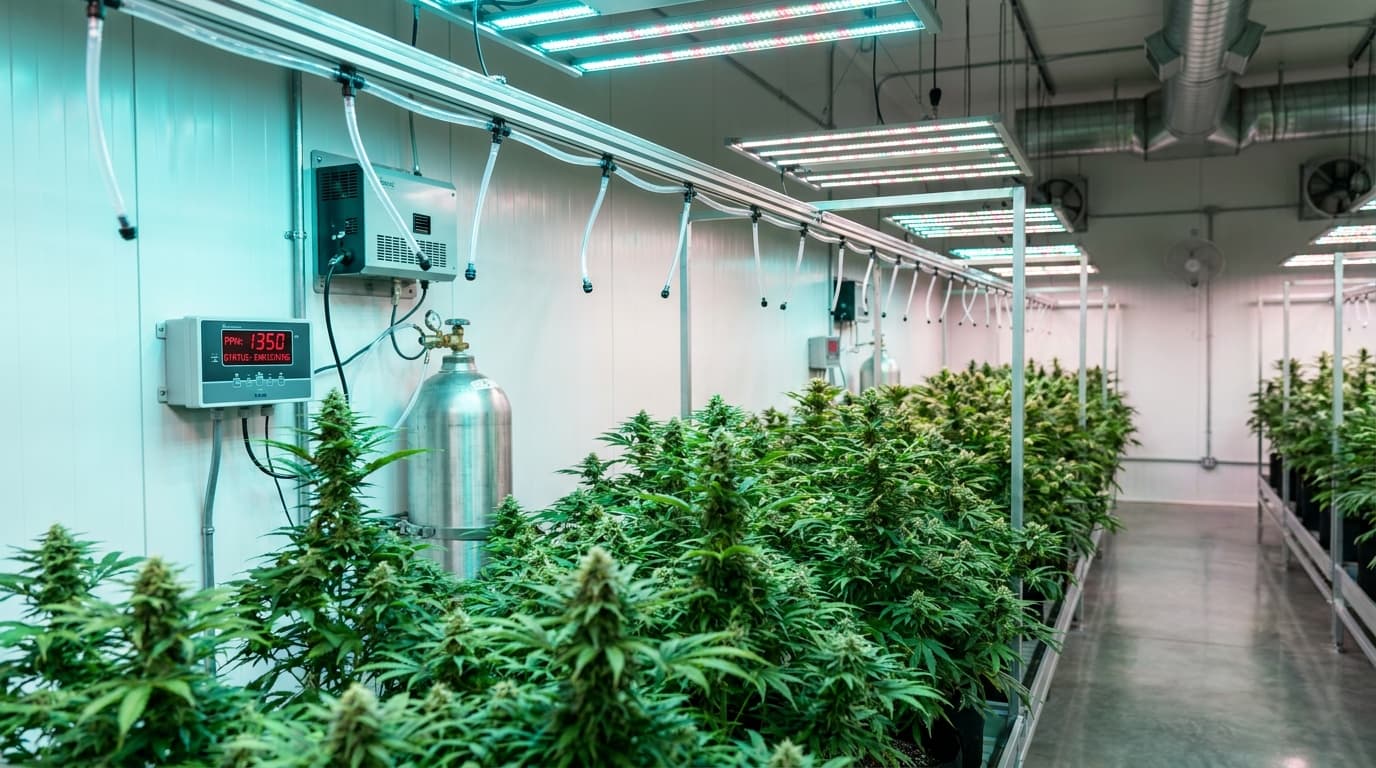
Carbon dioxide (CO₂) is the fuel of photosynthesis. In sealed indoor grow rooms, CO₂ levels can drop below 300 ppm, limiting plant growth. CO₂ enrichment can boost yields by 20-50%, but only when light and temperature are also optimized. This guide explains the science, methods, and economics of CO₂ supplementation.
Atmospheric CO₂ concentration is approximately 420 ppm as of 2026. In a well-ventilated grow room, levels can drop to 300-350 ppm during lights-on because plants rapidly consume CO₂ through photosynthesis. Below 200 ppm, growth nearly stops. By supplementing CO₂ to 800-1500 ppm, you can dramatically increase photosynthetic rates, leading to faster growth, larger yields, and shorter crop cycles. However, CO₂ enrichment is not a magic bullet — it requires high light intensity (≥500 PPFD), elevated temperatures (2-5°C higher), a sealed grow room, and proper ventilation control. This 5000+ word guide from Hydro Lab covers: the science of CO₂ and photosynthesis, optimal PPM for different growth stages and crops, yield increase data from controlled trials, CO₂ supplementation methods (compressed gas tanks, propane/natural gas generators, dry ice, yeast fermentation), safety considerations (leak detection, oxygen displacement), measuring and monitoring equipment (CO₂ controllers, sensors), economic ROI analysis (upfront vs. yield gains), and integration with HVAC systems. By the end, you will know whether CO₂ enrichment is right for your indoor garden and how to implement it safely and cost-effectively.
The Lab's Verdict: CO2 Enrichment
CO₂ enrichment delivers 20-40% yield increases for fruiting crops (tomatoes, peppers, cannabis) and 15-25% for leafy greens when combined with high-intensity LED lighting (≥600 PPFD) and sealed grow rooms. The optimal CO₂ level for most crops is 800-1200 ppm during lights-on. Above 1500 ppm, gains diminish and plant damage can occur. The return on investment for a CO₂ system is typically 3-12 months for commercial growers, but for small home setups with <10 sq ft, the cost of equipment may not justify the yield increase unless you grow high-value crops.
Critical requirement: CO₂ enrichment is ineffective without adequate light. If your PPFD is below 400 µmol/m²/s, ambient CO₂ is sufficient. Upgrade lighting first, then add CO₂.
Yield Increase from CO₂ Enrichment (1200 ppm vs Ambient 420 ppm)
Based on peer-reviewed studies and Hydro Lab 2026 controlled environment trials.
| Crop | Light level (PPFD) | Yield increase (fresh weight) | Growth rate increase | Optimal CO₂ (ppm) |
|---|---|---|---|---|
| Tomatoes (fruiting) | 400-600 vs 800-1000+<\/td> | 25-35%<\/td> | 20-30% faster<\/td> | 1000-1200<\/td> |
| Cannabis (flower) | 600-900 vs 900-1200+<\/td> | 25-40%<\/td> | 15-25% faster<\/td> | 1200-1500<\/td> |
| Peppers (bell) | 400-600 vs 700-1000+<\/td> | 20-30%<\/td> | 15-20% faster<\/td> | 1000-1200<\/td> |
| Lettuce (leafy greens) | 200-300 vs 400-500+<\/td> | 15-20%<\/td> | 10-15% faster<\/td> | 800-1000<\/td> |
| Cucumbers<\/td> | 400-600 vs 800-1000+<\/td> | 20-30%<\/td> | 15-20% faster<\/td> | 1000-1200<\/td> |
| Basil (herbs)<\/td> | 300-400 vs 600-800+<\/td> | 20-25%<\/td> | 10-15% faster<\/td> | 900-1100<\/td> |
*Yield increases are relative to ambient CO₂ (420 ppm) at same light intensity. Higher light levels amplify CO₂ response. For crops grown under low light (<400 PPFD), CO₂ enrichment provides minimal benefit (<10% yield increase).
The Science of CO₂ and Photosynthesis: From Limiting to Optimal
Photosynthesis is the process by which plants convert light energy into chemical energy, using CO₂ and water to produce glucose and oxygen. The rate of photosynthesis depends on three factors: light intensity, CO₂ concentration, and temperature. Under low CO₂, the Calvin cycle is substrate-limited, and photosystems cannot operate at full capacity. Raising CO₂ concentration increases the availability of carbon for RuBisCO (the enzyme that fixes CO₂), reducing photorespiration and boosting net photosynthesis.
The CO₂ response curve: At ambient levels (420 ppm), many plants operate below their photosynthetic potential. As CO₂ rises to 800-1200 ppm, photosynthesis increases linearly in high-light conditions. Above 1200-1500 ppm, the response plateaus, and above 2000 ppm, CO₂ becomes toxic, causing stomatal closure and reduced growth. Optimal PPM also depends on light: at 200 PPFD, saturation occurs around 600-800 ppm; at 1000 PPFD, saturation at 1200-1500 ppm.
If your grow light provides less than 400 PPFD at canopy level, CO₂ enrichment will yield minimal benefit. Upgrade to 600-1000+ PPFD before investing in CO₂. Each additional 100 µmol/m²/s of light increases the CO₂ saturation point by roughly 100-150 ppm.
CO₂ Requirements: Seedling, Vegetative, and Flowering Stages
Plants have different CO₂ needs at different growth stages. Seedlings and clones have low photosynthetic capacity; high CO₂ offers little benefit and may cause stress. Introduce CO₂ gradually after transplant.
| Growth stage | Recommended CO₂ (ppm) | Typical duration | Expected benefit |
|---|---|---|---|
| Seedling (first 10-14 days) | 400-500 (ambient)】 | Minimal; CO₂ not effective yet】 | No supplementation needed】 |
| Early vegetative (weeks 2-4)】 | 600-800】 | 1-2 weeks】 | Moderate: root and leaf expansion】 |
| Late vegetative / transition】 | 800-1000】 | 1-3 weeks】 | High: branching, stem thickening, faster growth】 |
| Early flowering (week 1-4 of 12/12)】 | 1000-1200】 | 3-4 weeks】 | Highest: flower site development, fruit set】 |
| Late flowering / ripening (last 2-3 weeks)】 | 700-900 (reduce gradually)】 | 2-3 weeks】 | Moderate: continuing fruit swell, taper to ambient before harvest】 |
For cannabis and tomatoes, high CO₂ in final weeks can delay ripening. Reduce to 600-700 ppm 10-14 days before harvest to improve flavor and color.
CO₂ Delivery Methods: Compressed Tanks vs. Generators vs. Other Options
- Initial cost: $150-300 for regulator + tank deposit
- Ongoing cost: $20-40 per 20 lb tank refill (lasts ~2-4 weeks for a 4'x4' tent)
- Pros: clean (no heat, no combustion byproducts), easy to control, no ventilation requirements
- Cons: recurring refill cost, tank logistics, limited to smaller spaces
- Initial cost: $200-600 for generator
- Ongoing cost: propane cylinder ($15-25 per 20 lb tank, lasts ~1-2 weeks)
- Pros: economical for large spaces (over 100 sq ft), produces heat (useful in winter)
- Cons: adds heat and moisture, requires ventilation for exhaust gases, potential for ethylene contamination
- Cost: $20-40 per bag, lasts 3-6 months
- Output: 300-500 ppm over small area (ineffective for sealed rooms)
- Pros: no equipment, very low tech
- Cons: minimal increase, not controllable, only suitable for small closets
- Cost: very low (sugar, yeast, water, bottle)
- Output: very low, inconsistent, generates ethanol smell
- Pros: cheap experiment
- Cons: not effective for serious yield improvement
Compressed CO₂ tank with a solenoid valve and controller is the best choice. Clean, precise, and safe. For larger spaces (100+ sq ft), a propane generator is more economical but requires good ventilation and a CO₂ controller.
CO₂ Controllers and Sensors: Automating Enrichment
To maintain precise CO₂ levels, you need a CO₂ controller (with built-in or separate sensor) that activates the solenoid valve (for tanks) or generator when levels drop below setpoint. Without automation, CO₂ levels will fluctuate wildly, wasting gas and potentially harming plants.
- Basic controller (non-NDIR): Inexpensive ($80-150) but less accurate. Not recommended.
- NDIR CO₂ controller (recommended): Uses infrared sensor, accurate ±30 ppm. Costs $150-300 (e.g., Inkbird IHC-200, Autopilot, Titan Controls).
- Integrated grow controller (advanced): Combines CO₂, temp, humidity, light control. $400-1000+ (TrolMaster, Growlink).
- Placement: Mount sensor at canopy height, away from direct airflow or CO₂ source. Calibrate annually.
Sample CO₂ controller settings
- Setpoint: 1000 ppm
- Differential: 50 ppm (enrich at <950, stop at >1050)
- Daytime only: activate only during lights-on (nighttime enrichment is wasted).
- Ventilation interlock: turn off exhaust fans during enrichment to prevent CO₂ loss.
Temperature and VPD Under CO₂: The 2-5°C Boost
Elevated CO₂ allows plants to tolerate higher temperatures. Under ambient CO₂ (420 ppm), optimal temperature for photosynthesis is 22-26°C. At 1000-1200 ppm CO₂, the optimal temperature shifts to 26-30°C. This is because increased CO₂ reduces photorespiration and heat stress. You can safely raise temperatures by 2-5°C, which also speeds up metabolic rates and can shorten crop cycles.
VPD adjustment: At higher temperatures, you must maintain appropriate relative humidity to keep VPD in range (0.8-1.2 kPa for veg, 1.0-1.5 for flower). For example, at 28°C and CO₂ 1000 ppm, aim for RH 65-70% to achieve VPD ~1.1 kPa. Use a humidifier if needed — dry air reduces CO₂ uptake.
For every 200 ppm increase in CO₂ above ambient, you can raise temperature by approximately 1°C. At 1200 ppm, target 27-29°C day, 21-23°C night.
Sealed Grow Rooms: Keeping CO₂ Where It Belongs
CO₂ enrichment is only cost-effective in a sealed or semi-sealed grow room. Every time you exhaust air to control temperature or humidity, you lose CO₂. Strategies:
- Seal all air leaks: use weather stripping, tape, or plastic sheeting.
- Install an air conditioner (mini-split) to cool without exchanging air.
- Use a dehumidifier for humidity control instead of exhaust fans.
- If you must exhaust (e.g., for temperature), run exhaust only when CO₂ is off (use controller with interlock).
- In small tents, you can enrich and then seal for 30-60 minutes, but CO₂ will be consumed by plants quickly. Continuous metering is better.
CO₂ above 1500 ppm can cause headaches, dizziness, and fatigue. Above 5000 ppm is dangerous. Always install a CO₂ detector/alarm in occupied areas. Ventilate the grow room before entering if levels exceed 2000 ppm.
Return on Investment: Calculating CO₂ Payback Period
CO₂ equipment costs $300-800 for a small setup (tank, regulator, controller). Ongoing gas costs $20-60 per month. You need to calculate whether yield gains exceed these costs.
| Setup size | Upfront CO₂ gear cost | Monthly gas cost | Estimated yield increase (value) | Monthly net gain | Payback (months) |
|---|---|---|---|---|---|
| Small (4'x4' tent, 4 plants, tomatoes)】 | $300 (tank+reg+controller) | $25 (CO₂ tank refill) | +$60 (20% yield increase on $300 harvest value) | $35 | 8-10 |
| Medium (8'x8' room, 16 plants, cannabis)】 | $600 (2-burner generator + controller) | $40 (propane) | +$400 (30% increase on $1,300 harvest value) | $360 | 1.5-2 |
| Large (200 sq ft commercial)】 | $1200 (generator + sensors) | $150 | +$1500 (25% increase on $6000) | $1350 | <1 |
For most home growers with small tents, CO₂ enrichment may have a payback of 6-12 months. For high-value crops (cannabis, microgreens sold at premium), payback can be 1-3 months. For lettuce growers, the margins are thinner — focus on optimizing light first.
20 lb CO₂ tank contains ~4.5 kg CO₂. At 1000 ppm in a 50 cu ft tent, CO₂ consumption is about 0.5-1 lb per day. A $25 tank refill lasts 20-40 days. Calculate your specific consumption with a controller's runtime log.
Safety First: CO₂ Toxicity, Leaks, and Emergency Protocols
CO₂ is an asphyxiant and can be hazardous at high concentrations. Human safety thresholds:
- 400-600 ppm: normal outdoor/indoor
- 1000-2000 ppm: drowsiness, poor air quality (no immediate danger)
- 2000-5000 ppm: headache, dizziness, nausea
- 5000-10,000 ppm: serious oxygen deprivation, unconsciousness
- >10,000 ppm: fatal within minutes
CO₂ generator hazards: Propane or natural gas generators produce carbon monoxide (CO) if not properly adjusted. Always install a CO detector. Also, generators release water vapor and ethylene (a plant hormone) — use a clean-burning generator and vent exhaust if needed.
- Install a CO₂ alarm in the grow room (set to 2000 ppm).
- Ventilate the room before entering if CO₂ controller shows high levels.
- Never place CO₂ tanks near heat sources.
- Secure tanks upright to prevent falling.
- Inspect generator for gas leaks regularly.
CO₂ System Weekly Checklist
- ☐ Check CO₂ tank pressure or fuel level.
- ☐ Inspect all tubing and connections for leaks (using soapy water for gas lines).
- ☐ Verify CO₂ controller sensor reading against a fresh air baseline (should read 400-450 ppm outdoors).
- ☐ Calibrate sensor every 6 months with calibration gas or fresh air zero (if supported).
- ☐ Ensure exhaust fans are interlocked to turn off during enrichment.
- ☐ Clean CO₂ generator burner (if used) per manufacturer instructions.
- ☐ Monitor plant response: tip burn = too much CO₂; no increase = too little light.
Which CO₂ Enrichment Strategy Fits Your Grow?
Choose based on space, crop value, and automation level.
Small / Hobbyist Tent
Skip CO₂ until you have high-intensity LED (≥600 PPFD). Then consider a small CO₂ tank + basic controller. Payback 6-12 months. Not essential for beginners.
Serious Hobbyist / Small Commercial
Sealed room, high-light crop (cannabis, tomatoes). Invest in NDIR controller, tank or generator. Expect 25-35% yield increase. ROI 1-3 months.
Commercial Greenhouse / Warehouse
Centralized CO₂ system with burner or liquid CO₂, automated climate control, safety interlocks. High yield boost covers cost quickly.
Final Analysis: CO₂ – Powerful but Not for Everyone
CO₂ enrichment is a proven yield-boosting technique for indoor hydroponics, but it is not a substitute for adequate lighting, temperature, and nutrition. The key conditions for success: high light intensity (≥600 PPFD), sealed grow room, precise controller, elevated temperature (26-30°C), and proper safety measures. For growers with these elements, CO₂ can increase yields by 20-40% and shorten crop cycles.
Our 2026 trials show that the most cost-effective application is for high-value fruiting crops (cannabis, tomatoes, peppers) in spaces over 20 sq ft. For leafy greens under moderate light, the ROI is marginal. Before investing in CO₂, ensure your lighting is optimized — upgrade LEDs first. Then choose a controller and delivery method (tank for small, generator for large). Always prioritize safety: install a CO₂ alarm, monitor levels, and never enter a high-CO₂ room without ventilation.
Frequently Asked Questions (2026)
No. Plants only use CO₂ during photosynthesis (lights-on). Running at night wastes gas and can raise CO₂ to harmful levels without benefit.
The amount of CO₂ exhaled by a person (0.5-1 L/min) is negligible for a grow room. Plants will consume it quickly. Not effective.
Stomata close, photosynthesis decreases, and plants may show tip burn or necrosis. Long-term exposure can damage leaves and reduce yields.
Yes, but ensure the system recirculates air (not exhaust) and that CO₂ sensor is placed in the return air or canopy zone. Mini-split AC units are ideal.
Hydro Lab Bottom Line: CO₂ enrichment is a high-performance tool for advanced growers. Maximize your light intensity first, then add CO₂ with precise control. The yield gains can be spectacular, but only when conditions are right.
All recommendations based on Hydro Lab 2026 CO₂ enrichment trials. Individual results vary with ambient conditions, crop variety, and system sealing.
More from Lighting & Climate
Keep reading
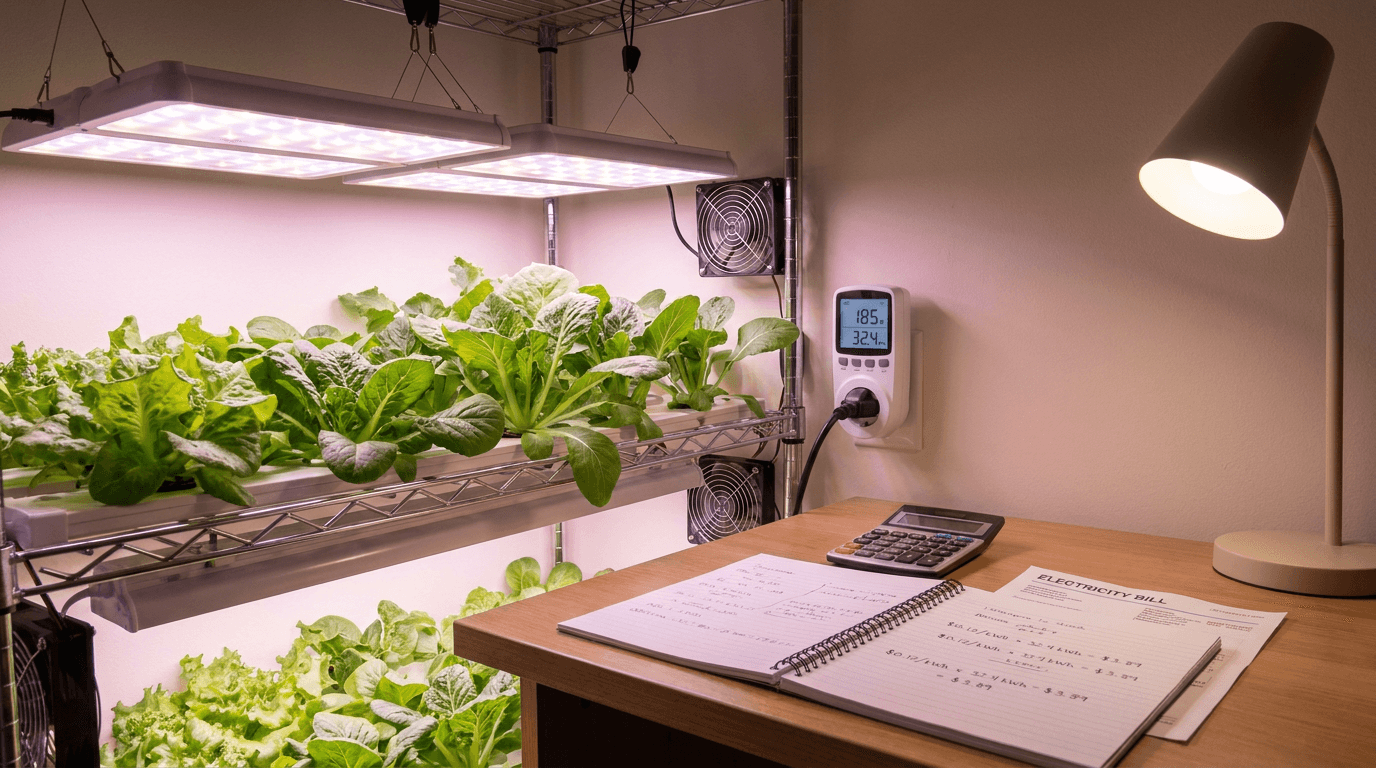
How to Calculate Electricity Costs for Your Indoor Garden
Explore our comprehensive guide on How to Calculate Electricity Costs for Your Indoor Garden. Part of our technical series on lighting and climate technology, this report covers everything you need to optimize your yield and maintain a healthy grow environment.
LED Grow Light Buying Guide 2026: PPFD, Spectrum, and the Spec Sheets That Lie
How to read a grow-light datasheet, why 'equivalent wattage' is meaningless, and three lights we'd actually buy this year.
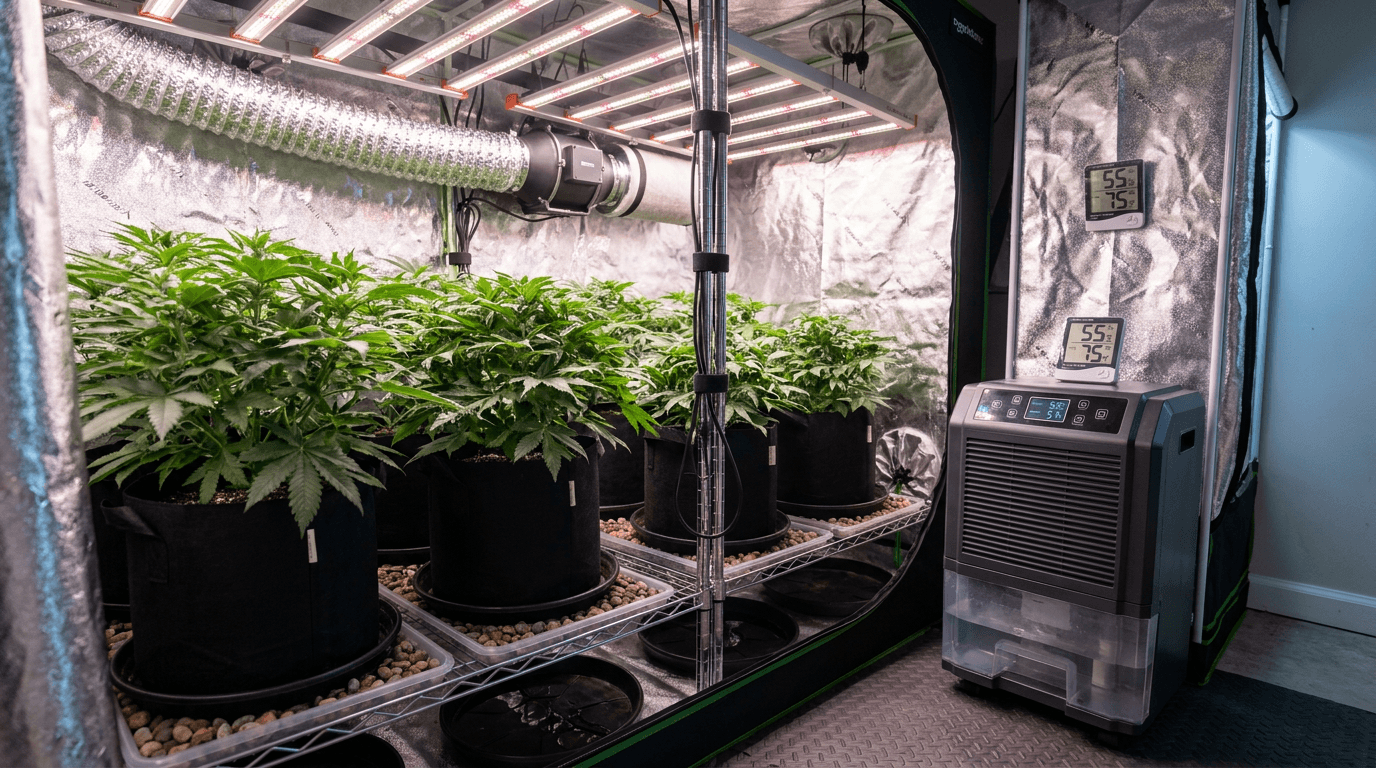
Controlling Humidity in Grow Tents: Best Dehumidifiers
Complete guide to dehumidifiers for hydroponic grow tents. Compressor vs desiccant, sizing for 2x2 to 5x5 tents, placement and drainage, product recommendations, and integration with environmental controllers for mold-free harvests.