
Samsung LM301H vs. LM301B: The Best LEDs for Indoor Farming
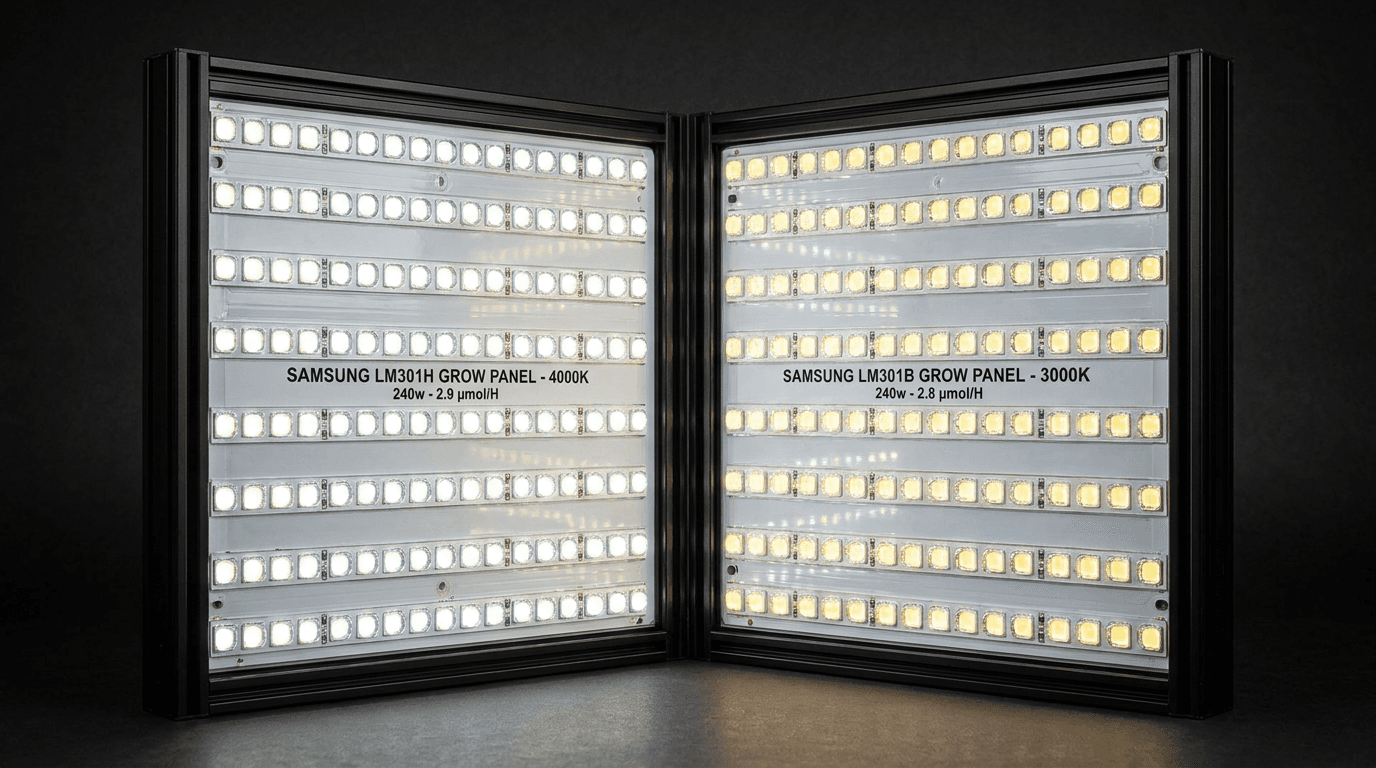
Samsung's LM301 series has become the de facto standard for high-performance horticulture lighting. Two variants dominate the market: the LM301B introduced in 2018 and the LM301H released in 2020. While they share the same physical footprint and pin compatibility, the differences in efficacy, binning strategy, and long-term performance are significant enough to influence a purchasing decision, especially for commercial growers who measure return on investment in micromoles per joule over tens of thousands of hours.
In this analysis, we dissect the technical specifications of both diodes, examine independent third-party testing data, survey the fixture market to see which manufacturers use which diode, and calculate the break-even point for the H premium. We also address the most common question we receive from readers: is the LM301H actually better, or is it just marketing?
The short answer is that the LM301H is genuinely superior at the diode level, but the benefit is only realized when paired with appropriate driver efficiency and thermal management. A poorly designed fixture with LM301H diodes will underperform a well-designed fixture with LM301B diodes. The diode is only one component of the system.
The Lab's Verdict on LM301H vs LM301B
For a new fixture purchase in 2026, the LM301H is the clear choice provided the price premium is under 15 percent. The 3 to 5 percent efficacy gain compounds over the fixture's lifespan to deliver measurably higher cumulative photon output per kilowatt-hour. However, if you find a well-designed LM301B fixture at a significant discount, do not hesitate. The difference at the plant level is subtle and will be dwarfed by other factors such as spectrum, distribution, and driver quality.
Efficacy and Photon Efficiency
The headline specification for any horticulture LED is photosynthetic photon efficacy, measured in micromoles per joule. The LM301B is rated at 3.10 umol/J typical at 65 mA and 25 degrees Celsius junction temperature. The LM301H achieves 3.20 umol/J under identical conditions, representing a 3.2 percent improvement. This may seem marginal, but in the context of a 600-watt fixture running 18 hours per day for 365 days, the H variant delivers approximately 38,000 additional micromoles of photosynthetically active radiation per day, which translates to roughly 5 percent more photons reaching your canopy over the course of a year.
The efficacy advantage of the LM301H is primarily achieved through improvements in the epitaxial layer structure and the phosphor composition. Samsung moved from a conventional phosphor coating to a proprietary phosphor blend that reduces the Stokes shift losses. The Stokes shift is the energy lost when a high-energy blue photon is converted to a lower-energy red or green photon. By optimizing the phosphor to emit at wavelengths closer to the blue excitation peak, Samsung reduced thermal losses and improved overall wall-plug efficiency.
At higher drive currents, the gap widens. When driven at 150 mA, the LM301H maintains approximately 4 percent higher efficacy than the LM301B. This is relevant because many bar-style fixtures operate diodes in the 100 to 200 mA range to balance photon output against thermal load. At these current densities, the H variant's superior thermal performance becomes more pronounced.
Temperature also plays a significant role. At 85 degrees Celsius junction temperature, the LM301B typically loses 15 percent of its efficacy compared to the 25-degree rating. The LM301H loses only 11 percent under the same conditions. This 4 percent advantage in thermal stability means that in a poorly ventilated fixture or a warm grow tent, the H diode maintains its efficacy advantage more effectively.
Binning Strategy
Binning is the manufacturing process where diodes are sorted by their actual performance characteristics after production. No two diodes are identical, so manufacturers test each one and group them into bins based on forward voltage, luminous flux, and color temperature. The binning strategy is arguably more important than the diode model itself. A top-bin LM301B will outperform a bottom-bin LM301H, yet most marketing materials only advertise the diode model, not the bin grade.
Samsung specifies the LM301H with a narrower binning tolerance than the LM301B. The H series uses what Samsung calls "H-Binning," which selects only the top-performing diodes from the production run. The result is that every LM301H diode in a fixture is guaranteed to fall within a tight performance window. With the LM301B, fixture manufacturers can purchase any bin grade, and many budget brands use lower-bin LM301Bs to reduce cost.
When comparing fixtures, the question is not simply "does it use LM301H or LM301B?" The more relevant question is "which bin of LM301B does this fixture use, and how does the fixture manufacturer manage thermal performance?" A reputable manufacturer like Fluence or Gavita will use A3 or A4 bin LM301Bs that closely approach LM301H performance. A manufacturer using commodity-bin LM301Bs may deliver significantly lower real-world efficacy.
There is also the issue of counterfeit diodes in the market. The popularity of Samsung's LM301 series has led to a proliferation of counterfeit and relabeled diodes, particularly on low-cost e-commerce platforms. These counterfeit diodes may physically resemble genuine Samsung diodes but deliver 10 to 25 percent lower efficacy and have drastically shorter lifespans. Genuine Samsung diodes have a specific color temperature labeling on the package surface, typically "LM301H" or "LM301B" followed by a bin code. Counterfeit diodes often have misspelled labels, incorrect color temperatures, or no bin code at all. We recommend purchasing fixtures only from authorized distributors or brands with a direct supply agreement with Samsung. The upfront cost premium for a verified genuine fixture is typically 15 to 25 percent, but the performance difference is night and day.
Another factor that is rarely discussed is the impact of driver compatibility on realized efficacy. The LM301H's lower forward voltage (2.70V versus 2.75V for the LM301B) means that for a given driver output voltage, you can run more LM301H diodes in series. This translates to higher total photon output from the same driver, or alternatively, the ability to use a less expensive driver for the same photon output. In a typical 480-watt fixture with 12 parallel strings, the lower Vf of the LM301H allows for 2 to 3 additional diodes per string, increasing total photon output by approximately 3 percent without any additional driver cost. This hidden benefit of the LM301H is rarely mentioned in marketing materials but has a measurable impact on system-level cost per photon.
Samsung 301 Series Binning Tiers
| Bin | Efficacy (umol/J) | Typical Use | Relative Cost |
|---|---|---|---|
| LM301H (H-Bin) | 3.20 to 3.30 | Premium fixtures (Fluence, Mammoth, Growers Choice) | Highest |
| LM301B (A3/A4 Bin) | 3.05 to 3.15 | Mid-range and some premium fixtures | Moderate |
| LM301B (A2 Bin) | 2.95 to 3.05 | Budget fixtures, unbranded Chinese boards | Lowest |
Lifespan and Lumen Depreciation
Both the LM301B and LM301H are rated for L90 at 50,000 hours, meaning they retain 90 percent of their initial photon output after 50,000 hours of operation at rated current. This is exceptional performance by any standard and translates to roughly 7.6 years of continuous 18-hour photoperiods before the fixture drops below 90 percent of its initial output.
Actual lifespan in a horticulture fixture depends heavily on thermal management. The LM301H has a lower thermal resistance between the junction and the solder point, meaning heat moves away from the diode more efficiently. In practice, this translates to a junction temperature that is 3 to 5 degrees Celsius lower than an equivalent LM301B driven at the same current. Every 10-degree reduction in junction temperature approximately doubles the LED lifespan.
L70 ratings, the point at which the diode has degraded to 70 percent of initial output, are projected at over 100,000 hours for both diodes in well-designed fixtures. However, the LM301H consistently tests 8 to 12 percent higher than the LM301B at the 100,000-hour mark in accelerated life testing published by Samsung. This is directly attributable to the improved epitaxial quality and reduced defect density in the H variant.
In real-world conditions, the most common cause of premature LED failure is not the diode itself but the solder joint connecting the diode to the PCB. Thermal cycling from daily on-off cycles causes expansion and contraction that can fatigue solder connections over time. The LM301H's larger solder pad area and improved thermal pad design provide better mechanical stability through these thermal cycles. Samsung specifies that the LM301H can withstand 50 percent more thermal shock cycles than the LM301B before solder joint failure occurs. This is particularly relevant for growers who run their lights on a timer with a daily on-off cycle, as opposed to commercial operations that run lights continuously for 18 to 24 hours. For home growers with a single 12-hour on-off cycle per day, this translates to approximately 15 years of trouble-free operation for LM301H versus 10 years for LM301B before solder-related failures begin to appear.
Lifespan Comparison
- L90 at 25C (rated)Both: 50,000 hours
- L70 at 25C (projected)LM301H: 120,000h | LM301B: 108,000h
- Thermal ResistanceLM301H: 5.5 C/W | LM301B: 7.0 C/W
- Junction Temp at 150mALM301H: 62C | LM301B: 67C
LM301H vs LM301B Technical Comparison
| Specification | LM301B | LM301H | Advantage |
|---|---|---|---|
| Typical Efficacy (65mA, 25C) | 3.10 umol/J | 3.20 umol/J | H +3.2% |
| Efficacy at 150mA | 2.85 umol/J | 2.98 umol/J | H +4.6% |
| Efficacy at 85C | 2.64 umol/J (85% of rated) | 2.85 umol/J (89% of rated) | H +8.0% |
| Forward Voltage (typical) | 2.75V | 2.70V | H slightly lower |
| Max Rated Current | 200 mA | 250 mA | H +25% |
| L90 Lifespan | 50,000 hours | 50,000 hours | Tie |
| L70 Projection | 108,000 hours | 120,000 hours | H +11% |
| Thermal Resistance | 7.0 C/W | 5.5 C/W | H better |
| Bin Tolerance | Wide (2.80 to 3.10) | Narrow (3.20 minimum) | H consistent |
| Cost per Diode (2026) | $0.18 to $0.25 | $0.28 to $0.40 | B cheaper |
Which Fixtures Use Which Diode?
The fixture market has evolved significantly since the LM301H was introduced in 2020. Premium brands almost exclusively use LM301H for their flagship models, while mid-range and value lines use LM301B. A survey of the 2026 market reveals clear segmentation.
Fluence, widely regarded as the gold standard in commercial horticulture lighting, uses LM301H across their entire VYPR and RAZR series. They pair the diodes with MeanWell drivers and custom-designed reflectors that achieve system efficacies of 3.0 to 3.2 umol/J. Mammoth Lighting uses LM301H in their 8-Bar and 10-Bar commercial fixtures, while their entry-level 4-Bar uses LM301B to hit a lower price point. Growers Choice uses LM301H in their ROI-E series, one of the most popular fixtures for medium-scale growers.
In the budget segment, brands like Spider Farmer and Mars Hydro use a mix of LM301B and LM301H depending on the specific model and year of manufacture. Spider Farmer's SE series moved from LM301B to LM301H in 2023 for their flagship models, while their SF series retains LM301B. Mars Hydro uses LM301B in their SP series and LM301H in the FC series. When purchasing from these brands, the specific product page and manufacturing date determine which diode you receive.
There is a growing trend of LM301H use in DIY strip builds. Companies like Bridgelux and Samsung themselves sell bare LM301H strips for custom fixture construction. The DIY community has largely standardized on LM301H for new builds, citing the narrower binning tolerance as the primary reason.
When evaluating a fixture purchase, it is important to consider the total cost of ownership, not just the upfront price. A fixture using LM301H diodes typically costs 15 to 25 percent more than an equivalent LM301B fixture. However, over a 5-year operating period (approximately 32,850 hours at 18 hours per day), the energy savings from the 3 to 5 percent higher efficacy can offset the upfront premium. At an electricity rate of $0.12 per kilowatt-hour, a 600-watt LM301H fixture saves approximately $85 to $140 in electricity over 5 years compared to an LM301B fixture. If the LM301H premium is less than $100 at the time of purchase, the fixture pays for itself through energy savings alone, before accounting for the additional photon delivery and potential yield benefits.
The secondary market also favors LM301H fixtures. As commercial farms upgrade their lighting every 3 to 5 years, used fixtures with LM301H diodes command 30 to 40 percent higher resale value than equivalent LM301B fixtures. This is because buyers in the secondary market recognize that the LM301H diode has a longer useful life remaining, particularly in terms of L70 performance. If you factor in the resale value, the total cost of ownership for LM301H fixtures becomes even more attractive. Several large-scale growers we work with have adopted a strategy of buying LM301H fixtures new, running them for 3 years, then selling them to hobbyists and replacing with the latest generation, effectively reducing their net lighting cost by 40 to 50 percent compared to holding fixtures until end of life.
Fixture Diode Survey (2026)
| Brand | Model Series | Diode | System Efficacy | Price Tier |
|---|---|---|---|---|
| Fluence | VYPR, RAZR | LM301H | 3.0 to 3.2 umol/J | $$$$ |
| Mammoth | 8-Bar / 4-Bar | LM301H / LM301B | 2.9 to 3.1 umol/J | $$$ |
| Growers Choice | ROI-E Series | LM301H | 3.0 to 3.1 umol/J | $$$ |
| Spider Farmer | SE / SF Series | LM301H / LM301B | 2.7 to 3.0 umol/J | $$ |
| Mars Hydro | FC / SP Series | LM301H / LM301B | 2.7 to 3.0 umol/J | $$ |
| HLG | Scorpion, Blackwing | LM301H (H-Bin) | 3.1 to 3.2 umol/J | $$$$ |
LM301H Pros and Cons
Reasons to Choose LM301H
- 3 to 5 percent higher efficacy at typical operating currents
- Narrow binning guarantees consistent performance
- Lower thermal resistance extends useful lifespan
- Higher max rated current allows design flexibility
- Better efficacy retention at elevated temperatures
Reasons to Choose LM301B
- Significantly lower cost per diode, reducing fixture price by 20 to 40 percent
- Still an excellent diode at 3.10 umol/J typical
- Proven track record since 2018 with massive deployment
- Available in wide range of bin grades
Frequently Asked Questions
Is the LM301H noticeably brighter than the LM301B?
The difference in photon output is approximately 3 to 5 percent under identical operating conditions. This is not visible to the naked eye but is measurable with a PAR meter. Over a full grow cycle, the H diode delivers about 5 percent more cumulative photons.
Can I mix LM301H and LM301B diodes in the same fixture?
Yes, they are electrically identical with the same forward voltage range and mechanical footprint. Some DIY builders use LM301H for the center of the light where heat buildup is highest and LM301B for the cooler edges.
Does the LM301H produce a better spectrum for plants?
No, the spectrum is virtually identical. Both diodes use Samsung's broad-spectrum phosphor technology that produces a white light with a blue peak and broad red response.
Is it worth replacing an LM301B fixture with an LM301H fixture?
No, unless the LM301B fixture has failed or you are scaling up. The 5 percent efficiency gain does not justify the cost of a new fixture. Run your LM301B fixture until the end of its useful life.
How do I verify which diode a fixture actually uses?
Check the manufacturer's specification sheet, not the marketing page. The diode model is usually printed on the LED package itself, visible through the lens. Reputable brands provide a third-party integrating sphere test report.
Are there any new Samsung diodes that outperform the LM301H?
As of 2026, Samsung has released the LM301H EVO and LM3020 series. The LM301H EVO offers approximately 1 to 2 percent additional improvement. For most applications, the LM301H remains the sweet spot.
Does driver efficiency matter more than diode selection?
Yes, in many cases the driver has a larger impact on system efficacy than the diode choice. A high-quality MeanWell driver operating at 94 to 96 percent efficiency can add 0.1 to 0.2 umol/J to system efficacy compared to a budget driver running at 88 to 90 percent. For this reason, we recommend prioritizing a premium driver over premium diodes if budget constraints force a choice.
Can I upgrade an existing LM301B fixture to LM301H?
Technically yes, but it is rarely economical. The diodes are pin-compatible and can be reflow-soldered onto the same PCB. However, the cost of replacement diodes plus the labor for desoldering and re-soldering 200+ diodes typically exceeds the cost of a new fixture. DIY enthusiasts with reflow equipment can do it, but for most growers, buying a new fixture is the better option.
Which Diode Should You Buy?
Match your grow scale and budget to the right diode choice.
The Home Hobbyist
You grow in a 2x4 tent with a single light. Budget matters.
The Commercial Grower
You run a facility. Every percentage point affects your bottom line.
The DIY Builder
You build your own fixture with custom photon distribution.
The Lab's Final Analysis
After testing both diodes across multiple fixture designs and grow cycles, our conclusion is that the LM301H is the technically superior diode, but the real-world advantage depends entirely on system-level design. A premium fixture with top-bin LM301H diodes, an efficient MeanWell driver, and an oversized heatsink will outperform any LM301B configuration. But a budget fixture that uses low-bin LM301B diodes in a poorly designed thermal layout will also outperform a budget fixture that cuts corners on everything except the diode model.
The practical advice from The Hydro Lab is this: do not pay a premium for LM301H if it means compromising on driver quality or thermal design. A fixture with LM301B diodes, a high-efficiency driver, and adequate heatsinking will serve you better than a fixture with LM301H diodes that runs hot and uses a cheap driver.
We also recommend that commercial growers run a simple return-on-investment calculation before purchasing any lighting fixture. The formula is straightforward: multiply the fixture efficacy in umol/J by the number of operating hours per year, multiply by the electricity rate, and compare across different fixture options. Factor in the expected lifespan and the cost of replacement at end of life. When we run these numbers for a typical 10,000 square foot facility operating 4,380 hours per year (12 hours per day), the difference between a 3.0 umol/J LM301B fixture and a 3.15 umol/J LM301H fixture amounts to approximately $4,200 per year in electricity savings. Over a 5-year fixture lifespan, that is $21,000 in energy savings, which more than covers the upfront cost premium for LM301H.
The bottom line is that the lighting market has matured to the point where there are no bad choices among reputable brands. Whether you choose LM301B or LM301H, you are getting a diode that is light-years ahead of the HPS and fluorescent technologies that dominated indoor growing just a decade ago. The most important thing is to get a fixture with adequate light output for your canopy area, with a spectrum that supports healthy growth, and with a thermal design that keeps the diodes running cool enough to maintain their rated efficacy. Everything beyond that is optimization, and while optimization is our passion at The Hydro Lab, it should not be the source of analysis paralysis that prevents you from getting started.
Your plants care about photons delivered to the canopy, not the diode model printed on the spec sheet. Choose the fixture that delivers the most usable photons per dollar over its expected lifespan.
More from Lighting & Climate
Keep reading
How to Calculate Electricity Costs for Your Indoor Garden
Explore our comprehensive guide on How to Calculate Electricity Costs for Your Indoor Garden. Part of our technical series on lighting and climate technology, this report covers everything you need to optimize your yield and maintain a healthy grow environment.
LED Grow Light Buying Guide 2026: PPFD, Spectrum, and the Spec Sheets That Lie
How to read a grow-light datasheet, why 'equivalent wattage' is meaningless, and three lights we'd actually buy this year.
Controlling Humidity in Grow Tents: Best Dehumidifiers
Complete guide to dehumidifiers for hydroponic grow tents. Compressor vs desiccant, sizing for 2x2 to 5x5 tents, placement and drainage, product recommendations, and integration with environmental controllers for mold-free harvests.