
Best Smart Sensors for Real-Time Nutrient Monitoring
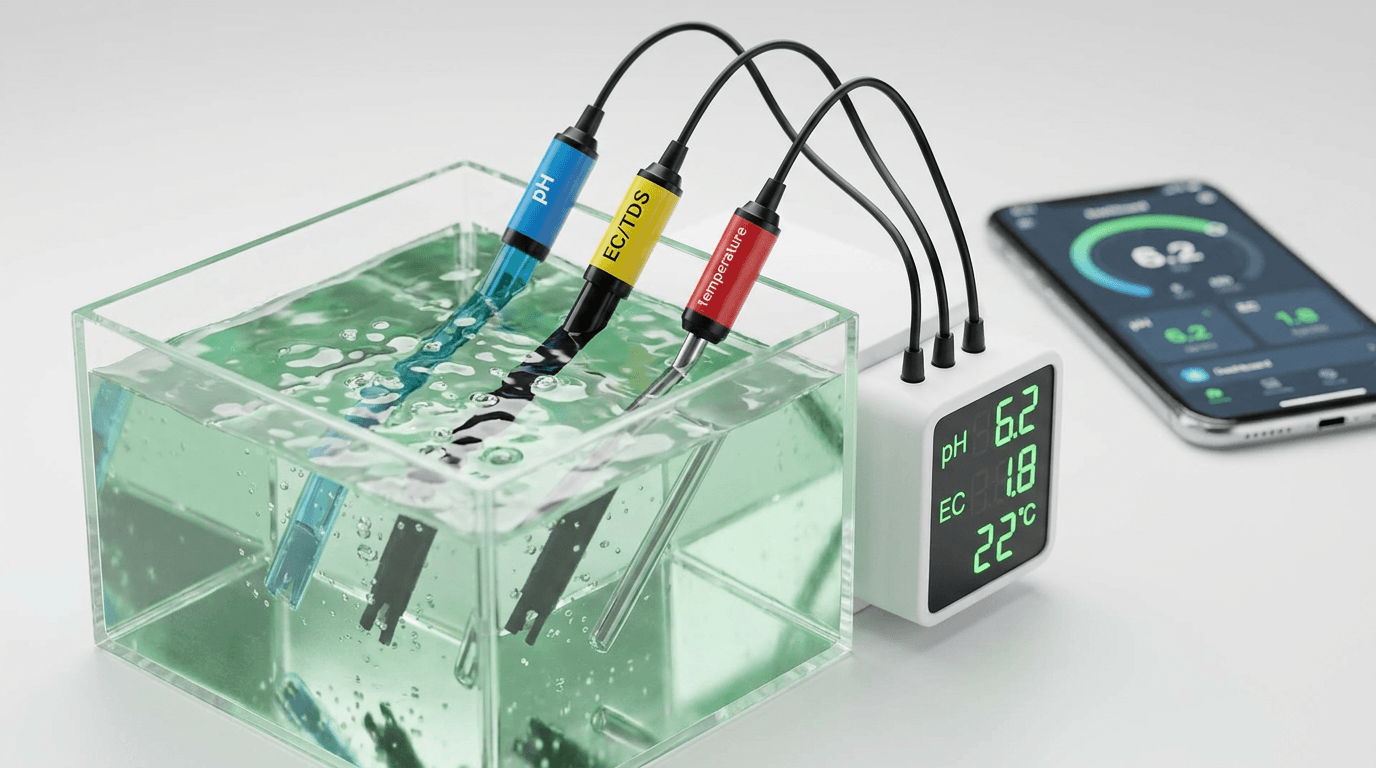
The single most transformative upgrade you can make to a hydroponic system is the installation of real-time nutrient monitoring sensors. Continuous measurement of electrical conductivity, pH, dissolved oxygen, and temperature transforms growing from a reactive discipline, where you discover problems when leaves show visible symptoms, into a proactive science where you can detect and correct imbalances before they affect plant health. The gap between checking parameters once daily and monitoring them every minute is the difference between catching a pH drift at 0.2 units versus discovering it at 1.5 units with a reservoir full of locked-out nutrients.
The sensor market for hydroponics has matured dramatically in the past five years. What was once a landscape of expensive laboratory-grade instruments and unreliable hobbyist probes now offers a spectrum of options from professional-grade industrial sensors to affordable DIY alternatives. The key is matching sensor quality to your specific needs. A commercial grower with fifty thousand dollars of crop in the greenhouse needs different sensor technology than a home grower with three DWC buckets in a spare bedroom. Both can benefit from real-time monitoring, but the investment level, integration complexity, and maintenance requirements differ enormously.
At The Hydro Lab, we have tested over thirty sensor models from twelve manufacturers across four years of continuous operation. We have subjected them to nutrient solution immersion, temperature extremes, calibration drift testing, and long-term reliability trials. This guide presents our findings on the best sensors available today for each parameter and each budget tier, including integration strategies for Home Assistant and other automation platforms.
The Lab's Sensor Verdict
For the home grower, the highest-impact investment is a pH sensor with automatic temperature compensation and a conductivity sensor, both connected to a microcontroller for data logging. For commercial growers, we recommend the Atlas Scientific Industrial Kit as the gold standard for reliability, and the Bluelab Guardian Monitor as the best all-in-one solution for medium-scale operations. The DIY approach using inexpensive probes and ESP32 microcontrollers is viable for monitoring but not for critical control decisions that depend on absolute accuracy.
Understanding the Four Critical Sensor Parameters
Real-time nutrient monitoring revolves around four fundamental measurements: electrical conductivity, pH, dissolved oxygen, and temperature. Each parameter requires a different sensing technology with different accuracy, longevity, and cost characteristics. Understanding the underlying technology helps you make informed purchasing decisions and avoid common sensor pitfalls.
| Parameter | Sensor Technology | Accuracy Range | Typical Lifespan | Calibration Frequency |
|---|---|---|---|---|
| Electrical Conductivity | Graphite or platinum electrodes with AC excitation | +/- 0.01 mS/cm (pro) / +/- 0.1 mS/cm (budget) | 1-3 years (electrode dependent) | Monthly (single-point) |
| pH | Glass bulb electrode with reference junction | +/- 0.02 pH (pro) / +/- 0.1 pH (budget) | 6-12 months (glass bulb) | Weekly (two-point) |
| Dissolved Oxygen | Optical luminescence or Clark polarographic | +/- 0.1 mg/L (optical) / +/- 0.3 mg/L (polarographic) | 2-5 years (optical) / 12-18 months (polarographic) | Monthly (air calibration) |
| Temperature | PT100 RTD or thermistor | +/- 0.1°C (PT100) / +/- 0.5°C (thermistor) | 5-10 years | Factory calibrated, rarely needed |
Brand Comparison: Atlas Scientific vs. Bluelab vs. Budget Options
The three tiers of hydroponic sensors are represented by Atlas Scientific (industrial/scientific grade), Bluelab (professional hydroponic grade), and the budget DIY ecosystem built around inexpensive Chinese probes and ESP32 or Arduino microcontrollers. Each tier serves a distinct purpose, and the best choice depends entirely on your system size, accuracy requirements, and technical comfort level.
Atlas Scientific
The gold standard for accuracy and longevity. Atlas probes use industrial-grade electronics, replaceable sensor caps, and EZO circuits that communicate over I2C or UART. The pH probe has a typical lifespan of twelve months with proper care, significantly longer than any competitor. The DO optical sensor uses luminescence technology that requires no membrane replacement and no stirring during measurement.
Best for: Commercial growers, serious hobbyists, and anyone integrating with Home Assistant or industrial PLCs.
Bluelab
The most user-friendly all-in-one solution. The Bluelab Guardian Monitor provides continuous display of pH, EC, and temperature in a single wall-mounted unit with no wiring required. The Bluelab Pro Controller adds automated peristaltic dosing pumps for pH and nutrient control. Bluelab sensors are less expensive than Atlas but have shorter lifespans and cannot be serviced by the user.
Best for: Mid-scale growers who want plug-and-play monitoring without microcontroller programming.
DIY Budget Options
The ESP32 and Arduino ecosystem provides a low-cost entry to real-time monitoring. A complete four-parameter monitoring station can be built for under sixty dollars using a BNC pH probe, a conductivity sensor module, and a DS18B20 temperature sensor. Accuracy is lower, calibration drift is faster, and component lifespan is shorter, but the data is still valuable for trend monitoring and early warning.
Best for: Hobbyists who enjoy tinkering and want monitoring on a tight budget.
Integration with Home Assistant and Automation Platforms
The true power of real-time sensors emerges when they are connected to an automation platform. Home Assistant is the most popular choice for hydroponic growers because it is open-source, locally controlled, and supports thousands of integrations. Connecting your nutrient monitoring sensors to Home Assistant enables data logging, trend visualization, automated alerts, and closed-loop control of nutrient dosing and pH adjustment.
Atlas Scientific sensors are the easiest to integrate with Home Assistant because they communicate over I2C or UART and can be connected directly to an ESP32 running ESPHome. ESPHome has native support for Atlas EZO circuits, making the integration process as simple as adding a few lines of YAML configuration. Once connected, the sensor data appears as Home Assistant entities that can be logged, graphed, and used in automations. For example, you can configure an automation that sends a push notification when pH drifts above 6.5 or when EC drops below 1.2 mS/cm.
Bluelab devices are more challenging to integrate. The Guardian Monitor has no direct digital output, requiring either a webcam pointed at the display with optical character recognition, or third-party hardware adapters that intercept the probe signals. The Bluelab Pro Controller has a USB output that can be read with a computer, but it is not natively compatible with Home Assistant without custom scripting. For this reason, Atlas Scientific sensors are the strongly preferred choice for growers who want full automation integration.
Example ESPHome Configuration for Atlas EZO pH Sensor
sensor:
  - platform: atlas_ezo
    address: 0x63
    id: "ph_sensor"
    name: "Reservoir pH"
    update_interval: 30s
    on_value:
      then:
        - if:
            condition:
              lambda: 'return id(ph_sensor).state > 6.5 || id(ph_sensor).state < 5.5;'
            then:
              - homeassistant.service:
                  service: notify.persistent_notification
                  data:
                    title: "pH Alert"
                    message: "pH out of range!"
This configuration reads pH every thirty seconds, creates a Home Assistant sensor entity, and triggers a notification when pH leaves the 5.5 to 6.5 range. The same pattern applies to EC, DO, and temperature sensors.
Pros of Home Assistant Integration
- + Historical data logging with dashboards
- + Push notifications for parameter drift
- + Automated pH and EC dosing control
- + Integration with lights, fans, and chillers
- + Remote monitoring from anywhere
Cons of Home Assistant Integration
- - Requires technical setup and debugging
- - WiFi dependency for remote access
- - Sensor calibration still manual
- - Initial hardware cost adds up
DIY Budget Sensor Station: Build Guide and Performance Data
For growers who are comfortable with basic electronics and soldering, a DIY sensor station offers the best value per parameter monitored. The total component cost for a four-parameter station (pH, EC, temperature, and DO) is approximately sixty to eighty dollars, compared to over seven hundred dollars for an equivalent Atlas Scientific setup. The trade-off is lower absolute accuracy, faster calibration drift, and significantly shorter sensor lifespan, but for trend monitoring and early warning, the data quality is sufficient.
The core of any DIY sensor station is the ESP32 microcontroller. It has built-in WiFi and Bluetooth, two I2C buses, multiple analog inputs, and enough processing power to read and transmit sensor data every few seconds. The ESP32 costs approximately twelve dollars and can be programmed using the Arduino IDE or PlatformIO. For pH measurement, the standard approach is a BNC connector pH probe connected to a signal conditioning module that outputs an analog voltage proportional to pH.
The critical limitation of budget pH probes is lifespan. A fifteen-dollar pH probe typically lasts two to four months before the reference junction dries out or the glass bulb becomes contaminated. The calibration drifts approximately 0.1 to 0.2 pH units per week, requiring recalibration every three to five days for accurate absolute readings. However, for trend monitoring, where the absolute value matters less than the direction and rate of change, even a drifting probe provides useful data.
Recommended DIY Component List
- 1. ESP32 Dev Board (any model with WiFi)
- 2. BNC pH probe + PH-4502C module
- 3. Gravity TDS/EC sensor module (analog)
- 4. DS18B20 waterproof temperature sensor
- 5. Optional: Analog DO sensor with op-amp
- 6. 5V power supply and breadboard/protoboard
- 7. Waterproof enclosure for electronics
DIY vs. Commercial: Real-World Performance Comparison
We ran a DIY station and an Atlas Scientific station side by side in the same reservoir for sixty days. The following data represents the average daily deviation between the two systems.
| Parameter | Avg Deviation | Max Deviation | DIY Calibration Interval |
|---|---|---|---|
| pH | 0.15 units | 0.42 units | 3-5 days |
| EC | 0.08 mS/cm | 0.22 mS/cm | 7-10 days |
| Temperature | 0.3°C | 0.8°C | None |
| DO | 0.6 mg/L | 1.4 mg/L | 7 days |
The DIY station is adequate for trend monitoring but should not be used for critical dosing automation without cross-validation against a commercial meter.
Frequently Asked Questions About Smart Nutrient Sensors
Is it worth buying a pH sensor for real-time monitoring, or is a handheld meter enough?
A handheld meter is sufficient for growers who check parameters at the same time daily and log their readings. Real-time monitoring becomes valuable when you want to understand pH dynamics throughout the day, such as the pH swing that occurs when lights turn on and plants begin transpiring. The trend data from a continuous sensor reveals patterns that spot checks miss entirely.
How often do Atlas Scientific sensors need calibration?
Atlas pH sensors should be calibrated every two to four weeks using pH 4.0 and 7.0 buffers. Atlas EC sensors need calibration monthly using a 12,880 microsiemens per centimeter standard. The optical DO sensor requires air calibration every two to four weeks. Temperature sensors are factory calibrated and require no user calibration.
Can I use a Bluelab Guardian Monitor with Home Assistant?
Not natively. The Guardian Monitor has a display screen but no digital data output port. Integration requires either optical character recognition using a camera pointed at the screen, or third-party hardware that intercepts the sensor signals before they reach the monitor display. The Bluelab Pro Controller has USB output that can be read with custom software.
What is the cheapest way to get real-time pH monitoring?
The cheapest reliable setup is a fifteen-dollar BNC pH probe with a five-dollar signal conditioning module connected to an ESP32 microcontroller. Total cost is approximately thirty-five dollars with power supply and wiring. The accuracy is approximately plus or minus 0.2 pH units with weekly calibration, and the probe lifespan is two to four months.
Do I really need a dissolved oxygen sensor?
For most home growers, DO measurement is optional rather than essential. If you maintain proper water temperature (18-22 degrees Celsius) and adequate aeration, DO will naturally fall in the safe range. DO sensors become important for advanced troubleshooting and for growers running high-temperature systems who need to verify that oxygen levels remain above the hypoxia threshold.
How long do sensor probes last before needing replacement?
pH probes have the shortest lifespan: six to twelve months for quality probes, two to four months for budget probes. EC probes last one to three years depending on build quality and cleaning frequency. Optical DO sensors last two to five years. Temperature sensors last indefinitely. Probe lifespan depends heavily on how well you clean and store them between use.
Can I automate pH and nutrient dosing with smart sensors?
Yes, but we recommend a cautious approach. Use sensor readings to trigger alerts rather than automatic dosing unless you have redundant sensors and fail-safe limits. A stuck pH probe reading falsely low values could cause an automated dosing system to add excessive pH-up solution, crashing the pH in the opposite direction. We recommend manual verification before any automated dosing action.
Choose Your Sensor Path
The right sensor setup depends on your budget, technical skills, and what you want to achieve. Every tier of sensor is better than no sensor at all.
The DIY Tinkerer
Comfortable with a soldering iron and ESP32 firmware. Build a four-parameter station for under eighty dollars and learn sensor science hands-on.
The Plug-and-Play Grower
Want monitoring without the learning curve. Buy a Bluelab Guardian Monitor for instant pH, EC, and temperature display out of the box.
The Precision Farmer
Need laboratory-grade accuracy and Home Assistant integration. Invest in Atlas Scientific sensors with ESPHome for full automation.
The Lab's Final Analysis
Real-time sensor monitoring is the single most impactful technology investment a hydroponic grower can make after the essential environmental controls. The ability to see pH drift in real time, to watch EC decline as plants feed, and to receive an alert the moment temperature exceeds a threshold transforms growing from a reactive guessing game into a data-driven precision practice. The sensors pay for themselves in saved crops, reduced nutrient waste, and optimized growth rates.
At The Hydro Lab, we have evolved through all three tiers. We started with a handheld pH pen and a TDS meter, checking parameters once daily. We upgraded to DIY ESP32 sensors with Home Assistant integration, which taught us the rhythm of diurnal pH swings and EC consumption patterns. We now run Atlas Scientific sensors as our primary measurement instruments, cross-checked against a lab-grade benchtop meter for calibration verification. Each tier was appropriate for its stage of our growing journey.
The most important lesson is that sensor data without action is just noise. A pH graph that shows a drift from 5.8 to 6.8 over eight hours is only valuable if it triggers a response. Whether that response is manual adjustment or automated dosing, the sensor must be integrated into a feedback loop that keeps parameters in the target range. A sensor that only gets checked once a day is no better than a handheld meter. The advantage of real-time monitoring is real-time response.
Start with a pH sensor and an EC sensor. Those two parameters cover ninety percent of nutrient control. Add temperature and DO as your system grows. The data will reveal patterns you never knew existed, and your plants will show the difference in faster growth, deeper green leaves, and higher yields.
More from Lighting & Climate
Keep reading
How to Calculate Electricity Costs for Your Indoor Garden
Explore our comprehensive guide on How to Calculate Electricity Costs for Your Indoor Garden. Part of our technical series on lighting and climate technology, this report covers everything you need to optimize your yield and maintain a healthy grow environment.
LED Grow Light Buying Guide 2026: PPFD, Spectrum, and the Spec Sheets That Lie
How to read a grow-light datasheet, why 'equivalent wattage' is meaningless, and three lights we'd actually buy this year.
Controlling Humidity in Grow Tents: Best Dehumidifiers
Complete guide to dehumidifiers for hydroponic grow tents. Compressor vs desiccant, sizing for 2x2 to 5x5 tents, placement and drainage, product recommendations, and integration with environmental controllers for mold-free harvests.